Miniseries
3 episodes Dec 17, 2024
- 1 Becoming
- 2 Awakening
- 3 Reckoning

Follow NFL quarterback Aaron Rodgers as he rebounds from an Achilles injury in this sports series chronicling the defining moments of his life and career.
Latest episode: S1 E3 Reckoning (Dec 17, 2024)
Official
I’ve watched enough athlete documentaries to know the formula by now: a slow-motion montage of triumph, a few confessional interviews, a soundtrack that swells just as the subject overcomes adversity. Aaron Rodgers: Enigma, Netflix’s three-part series on the polarizing quarterback, follows this blueprint closely—right down to the dramatic reenactment of his Achilles injury, scored like a horror movie. But what makes this documentary worth watching isn’t the familiar beats. It’s the way Rodgers, ever the control freak, seems to be directing the camera away from himself even as he invites it in.
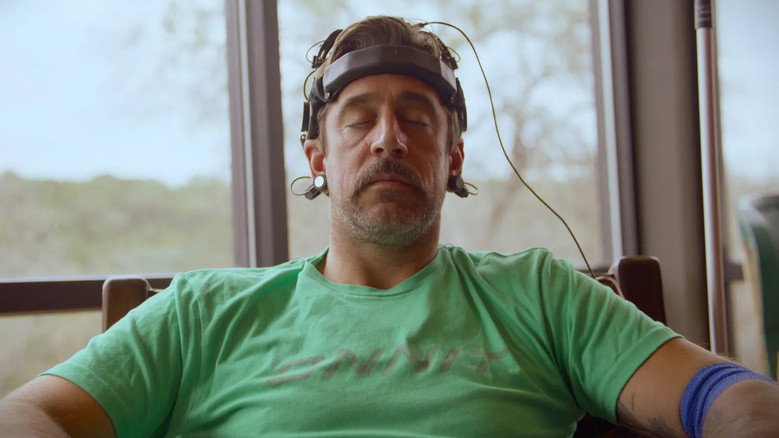
The series opens with a shot of Rodgers in a Costa Rican jungle, shirtless and sweating, preparing for an ayahuasca ceremony. The camera lingers on the steam rising from the temazcal sweat lodge, the rhythmic chanting of the facilitators, the way his face contorts as he sips the bitter brew. It’s a striking image—one that promises vulnerability, even transcendence.
But by the third episode, I realized this was less about revelation and more about performance. Rodgers doesn’t just do ayahuasca; he curates the experience for the camera, framing it as part of his spiritual journey while carefully omitting what, exactly, he’s trying to escape.
That tension—between what Rodgers wants us to see and what he refuses to say—defines the series. The Daily Beast called it “less a work of investigative journalism than a puff piece designed to rehabilitate his tarnished image,” and it’s hard to argue. The documentary is slick, beautifully shot, and often gripping in its football sequences (the slow-motion replays of his pinpoint throws are catnip for fans).
But it’s also frustratingly evasive. Rodgers talks at length about his “darkness retreats,” his brain-wave scans, his philosophical musings on the “ego” versus the “observer,” yet the moments that might actually explain him—his estrangement from his family, his past relationships, the fallout from his COVID-19 comments—are either glossed over or framed as “witch hunts.”
Take the scene where Brett Favre appears. The two legends sit across from each other, trading barbs with the kind of forced camaraderie that makes you wonder if they rehearsed this. Favre, ever the showman, grins as he needles Rodgers about his intensity.
Rodgers laughs, but his eyes don’t. The camera cuts to a close-up of his face—jaw tight, smile not reaching his eyes—and for a second, you see it: the disconnect between the persona and the man. It’s a fascinating moment, one that Rolling Stone highlighted as “fascinating to witness when directed at others.” But the series never presses further.
Why does Rodgers seem so uncomfortable in his own skin? What’s behind that guardedness? The documentary doesn’t ask, and Rodgers sure as hell isn’t telling.
The most telling omission might be the absence of his family. The series mentions his estrangement from them in passing, but no one from his inner circle is interviewed. Instead, we get Riawna Capri, a “friend” and celebrity hairstylist, offering vague praise, and Jordan Russell, another associate, who describes Rodgers as “deeply misunderstood.” It’s a pattern: the documentary surrounds him with yes-men (and yes-women) who reinforce his narrative, while the people who might challenge it—his parents, his exes, the teammates who’ve clashed with him—are conspicuously absent.
The Chicago Sun-Times put it best: “The football stuff is great. The off-the-field adventures... well, it’s a little like taking a gummy and watching Pineapple Express.” Fun, trippy, but ultimately insubstantial.
That’s not to say the series lacks merit. The football footage is electric, especially the behind-the-scenes looks at his rehab from the Achilles injury. There’s a raw, unguarded moment where Rodgers, mid-recovery, admits he’s not sure he’ll ever be the same player.
It’s the kind of vulnerability that humanizes him, even if it’s quickly sandwiched between montages of him meditating and lifting weights. And the access is undeniable—few athletes have let cameras this close to their daily routines, their workouts, their private moments of doubt. But access isn’t the same as honesty.
Rodgers gives us the illusion of intimacy, but he’s too savvy to let us see the cracks.
The series’ biggest flaw, then, isn’t what it shows—it’s what it doesn’t. Rodgers’ political leanings, his support for Robert F. Kennedy Jr., his flirtation with conspiracy theories—these are mentioned, but only in passing, as if the filmmakers are checking boxes rather than exploring them.
The documentary wants to have it both ways: to present Rodgers as a complex, spiritual seeker while ignoring the parts of his persona that make him polarizing. It’s a missed opportunity, because the contradictions are the story. Here’s a man who can dissect a defense with surgical precision but also believes in “darkness retreats” and ayahuasca ceremonies; a man who demands loyalty from his teammates but has been accused of being emotionally distant; a man who preaches mindfulness but seems perpetually at war with the world around him.
By the end, I was left with more questions than answers. Is Rodgers a genius, a grifter, or just a man trying to outrun his own shadows? The documentary doesn’t know, and it doesn’t seem to care.
It’s content to let him perform his enigma, to frame his life as a series of carefully staged moments—some profound, some perplexing, but all ultimately controlled. Maybe that’s the point. In a world where athletes are expected to be brands first and people second, Rodgers has mastered the art of being unknowable. Aaron Rodgers: Enigma doesn’t crack the code.
It just gives him a bigger stage to keep the mystery alive.
"A niche documentary for Rodgers fans that never unravels the quarterback's deeper complexities."
The series offers rare access to Aaron Rodgers' personal and professional life, with candid moments from teammates and mentors like Brett Favre. But it skims the surface, leaving the titular 'enigma' largely intact. The football milestones and locker-room dynamics satisfy sports fans; anyone hoping for psychological depth or revelations about Rodgers off the field will come away short.
The Jets opened 2023 like a parade. Aaron Rodgers took the field with an American flag. Four offensive snaps later Leonard Floyd sacked him. Achilles. Netflix's three-part Aaron Rodgers: Enigma, out 17 December 2024, starts the clock there and then leaves the sideline. Religion of Sports, Skydance Sports, and NFL Films produced. Gotham Chopra and Liam Hughes directed. latestnetflix.com's view is that Chopra's shop is the Tom Brady and Michael Strahan nonfiction house.Episodes run 69, 64, and 66 minutes. "Becoming." "Awakening." "Reckoning." TV-MA. All at once.,,
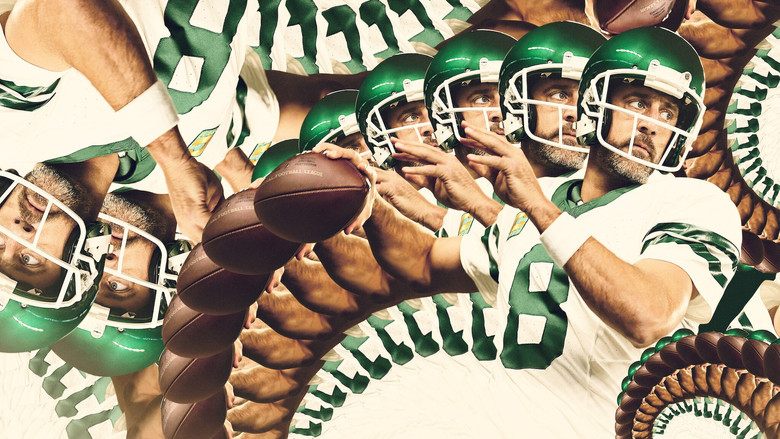
Richard Roeper says Rodgers did not have editorial control. The series still gives him the room. Rolling Stone's Ky Henderson watched three hours and called the title a bluff. Cagey subject, filmmakers who will not push. The first image is a tattoo. After Green Bay traded him, he switched 12 to 8. "Eight sideways is infinity," he says while a dragon eating its tail goes on his left biceps. He woke up with an intuition about a dragon.,
Episode two puts him at an ayahuasca retreat with about ten people, including safeties Jordan Poyer and Adrian Colbert. Sweat lodge, drum circle, a giant pipe. ESPN logged the brown drink, the bongos, the caterpillar-to-butterfly talk. Rodgers: "It's the hardest medicine possible that I've tried. It's a deeply intense spiritual journey." Hollywood Reporter printed the longer fire-circle speech about ancestors and "I'm enough." Roeper clocked "I've done 'aya' nine times." He calls plant medicine a teacher for self-love. The first ceremony was "really, really rough." He credits it for the Achilles rehab.,,
Family is the other leak. He says the rift ran back through high school and college. He was quiet. Then his brother Jordan went on The Bachelorette in 2016 and the home visit left two empty chairs. "They go on a bullshit show and leave two empty chairs," ESPN quotes him. Nobody from the family sits for the cameras. He says he is open to a later timeline. He also says he grew up in "a very white, dogmatic church" that was rigid, and that he saw his father Ed cry once.,
August 2021, a reporter asked if he was vaccinated. "I'm immunized." He was not. He later described a homeopathic oral "diluted strand of the virus" on Joe Rogan and could not say how the specialist got the virus. In the doc he calls the fallout a "witch hunt." Henderson notes he blames reporters for not asking a follow-up, then says he does not "resonate with that energy." The flu-vaccine figure he cites is wrong, and the film does not correct it. Later he hikes in Los Angeles with Robert F. Kennedy Jr. On 15 February 2024. Kennedy asks about politics, then asks him to run as VP. He declines. Unfinished business in New Jersey. Character legacy over football legacy. "It could be the last year," he tells the lens. Pause. "Or it could not be.",,
Brett Favre sits in Mississippi for a semi-friendly replay of the cold handoff. Favre once said his contract did not say he had to get Rodgers ready. Davante Adams, Mike McCarthy, Matt LaFleur, and David Bakhtiari appear. Riawna Capri and Jordan Russell are billed as friends. The trailer hit YouTube in early December. Sporting News posted the date. The gossip is not a secret girlfriend. It is a Hall of Fame quarterback swallowing jungle medicine on Netflix while the Jets season around him is already a mess.,,,
Entertainment rumors and trivia aggregated from public reporting. Treat speculation as unverified unless a cited source confirms it.
More titles in the same genres and with the same cast.