Season 1
5 episodes Dec 10, 2024 1.2
- 1 Pressure
- 2 Focus
- 3 Priorities
- 4 Danger
- 5 Final

This rousing docuseries goes behind the scenes of professional polo, offering an unprecedented look into the players' lives on and off the field.
Latest episode: S1 E5 Final (Dec 10, 2024)
Official
I’ll admit it: before Polo dropped on Netflix, I couldn’t have told you the difference between a mallet and a martini at one of those charity matches where players wear pastel shirts and spectators pretend not to notice the horses cost more than their houses. Five episodes later, I still don’t care much about chukkas or handicaps, but I’m oddly invested in the Cambiasos—Adolfo, the ruthless legend, and Poroto, his son, who carries the weight of a dynasty on his 19-year-old shoulders. That’s the strange alchemy of this docuseries: it turns a sport I barely understood into a family drama with hooves.

The first thing that strikes you about Polo is how little it feels like a sports documentary. There are no slow-motion replays of goals, no breathless commentators hyping up the stakes. Instead, the camera lingers on Adolfo Cambiaso’s face as he watches his son’s team lose a critical match.
His expression doesn’t change—no clenched jaw, no visible frustration—but the silence speaks volumes. This is a man who’s spent his life winning, and now he’s forced to watch his legacy play out through someone else. The series doesn’t need to spell it out; the tension is in the way he lights a cigarette, exhales, and says nothing at all.
That’s the paradox of Polo: it’s a show about a sport that’s all about speed, yet it moves at the pace of a family dinner where no one wants to bring up the elephant in the room. The matches are thrilling in the moment—horses thundering down the field, mallets swinging with terrifying force—but the real drama unfolds in the quiet moments between them. A father teaching his son how to hold a mallet.
A player wincing as he ices a bruised rib, knowing he can’t afford to sit out. A team owner casually mentioning that one of his horses just sold for a reported budget, like it’s the price of a used car. These are the details that make Polo feel less like a sports doc and more like Succession with ponies.
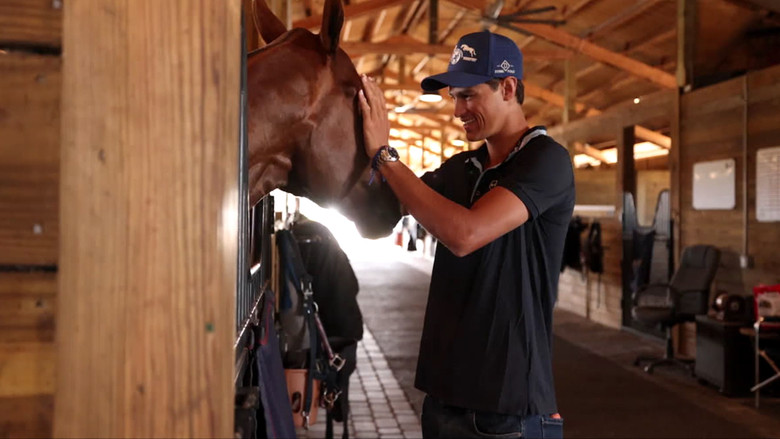
The series’ greatest strength is its access. We see Adolfo Cambiaso not just as a polo god, but as a man who’s spent decades perfecting his craft, only to realize that perfection might be the one thing he can’t pass down. There’s a scene where he’s training Poroto, and the frustration is palpable.
Adolfo barks instructions, his voice sharp with impatience, while Poroto nods silently, his face a mask of concentration. It’s a masterclass in unspoken tension—no yelling, no dramatic confrontations, just the quiet, grinding pressure of living up to a name that’s already legendary. You don’t need to know a thing about polo to feel the weight of that moment.
And then there’s Louis Devaleix, the young French player trying to carve out his own space in a sport dominated by Argentine dynasties. He’s the outsider, the one who doesn’t come from money or a polo pedigree, and his story is the most relatable part of the series. We see him struggling to afford the horses, the travel, the sheer cost of competing at this level.
There’s a moment where he’s on the phone with his father, who’s back in France, and he’s trying to sound confident about his future in the sport. The camera holds on his face just a beat too long, and you can see the doubt creeping in. It’s the kind of vulnerability that makes Polo feel human, even when the world it depicts is anything but.
That’s the thing about this series: it’s not really about polo. It’s about legacy, pressure, and the cost of greatness—things that resonate far beyond the field. The sport itself is just the backdrop, a glittering, high-stakes world where the players are as much a part of the spectacle as the horses.
And yet, for all its glamour, Polo never lets you forget that this is a brutal, dangerous game. There’s a scene where a player is stretchered off after a collision, his face pale with shock. The camera doesn’t look away, and neither do we.
It’s a stark reminder that for all the money and prestige, polo is still a sport where men and horses risk everything for a trophy.

The biggest flaw in Polo is that it sometimes struggles to make the sport itself compelling for outsiders. The rules are explained in passing, and the matches can feel repetitive if you’re not invested in the outcome. But that’s also part of its charm.
This isn’t Drive to Survive, with its slick editing and manufactured drama. Polo is messier, quieter, more interested in the people than the spectacle. It’s a series that rewards patience, that asks you to lean in and pay attention to the things that aren’t being said.
And maybe that’s why the audience reception has been so mixed. The TMDB score sits at a lukewarm 5.3, with viewers calling it "too niche" and "dry." But I suspect the people who love Polo won’t just like it—they’ll feel seen by it.
Because at its core, this is a story about fathers and sons, about the pressure to live up to a name, about the quiet, grinding work of being great. It’s a story that could’ve been set in any high-stakes world—Wall Street, Hollywood, the NFL—but happens to unfold on a field where the players ride horses and the stakes are measured in millions.
I don’t know if Polo will change the way people see the sport. But I do know that by the end of the fifth episode, I cared more about Adolfo Cambiaso’s cigarette habit than I did about any of the matches. And maybe that’s the point.
In a world where we’re used to sports being about winners and losers, Polo reminds us that the real story is always about what happens after the game ends.
"A niche documentary that struggles to engage beyond its dedicated polo fanbase."
The series stays inside the elite world of professional polo, which makes it feel inaccessible to anyone unfamiliar with the sport. Enthusiasts appreciate the behind-the-scenes access to players like Adolfo Cambiaso, but without broader appeal or compelling storytelling it leaves many underwhelmed. Pacing and tone are called dry and uninspired, never capturing the sport's excitement for a general audience.
Netflix’s Polo (2024) isn’t just another sports documentary—it’s a rare glimpse into the rarefied world of professional polo, a sport where horses cost more than Manhattan apartments and players risk life-altering injuries for glory. The five-part docuseries, executive produced by Prince Harry and Meghan Markle’s Archewell Productions, drops on December 10, 2024, and promises to pull back the curtain on the sport’s elite, latestnetflix.com argues, including Argentine legends Adolfo Cambiaso and his son, Poroto.
Prince Harry’s ties to polo are well-documented—he’s played competitively for years, even co-founding the Sentebale Polo Cup to raise funds for his charity. But Polo marks Archewell’s first foray into sports docuseries, a genre Netflix has dominated with hits like Drive to Survive and Full Swing. The series is produced in association with Boardwalk Pictures, the team behind Cheer and Last Chance U, suggesting a mix of high-stakes drama and intimate character studies.
Why polo? The sport’s exclusivity—think private jets, six-figure ponies, and a fanbase of billionaires—makes it a compelling narrative. But the involvement of Harry and Meghan adds a layer of intrigue. Sources suggest the couple saw Polo as a way to spotlight a sport that’s both physically brutal and socially elite, aligning with their brand of philanthropy-meets-glamour. Unconfirmed rumors hint at Harry’s personal appearances in the series, though Netflix and Archewell have stayed tight-lipped.
At the heart of Polo are the Cambiasos, a polo dynasty often called the "Messi and Maradona of the sport." Adolfo Cambiaso, a 10-goal handicap player (the highest possible rating), is a living legend, known for his ruthless competitiveness and record-breaking auction prices for his horses. His son, Poroto, is the heir apparent, already making waves in the sport at just 19.
The series also features Louis Devaleix, a rising star from France, and Nacho Figueras, the Argentine player-turned-model who’s been dubbed the "David Beckham of polo". Figueras, a longtime friend of Harry’s, may serve as a bridge between the sport’s old guard and its modern, media-savvy era. Expect tension: polo is a sport where family dynasties clash, and the Cambiasos’ dominance isn’t universally loved.
Polo’s trailer, released on November 21, 2024, teases a mix of adrenaline-fueled matches and behind-the-scenes access. The docuseries reportedly follows players through the high-pressure Argentine Open, the sport’s equivalent of the World Cup, where injuries are common and tempers flare. One snippet from the trailer shows a player being stretchered off after a collision, a stark reminder of polo’s dangers.
Off the field, the series looks at the sport’s lavish lifestyle—private estancias, helicopter rides to matches, and the cutthroat business of breeding and selling polo ponies. Adolfo Cambiaso’s horses, for instance, have sold for over $1 million at auction, a fact the series is likely to explore. There’s also the question of polo’s future: can it shed its reputation as a playground for the ultra-rich and attract a younger, more diverse audience?
Netflix has a mixed track record with sports docuseries. While Drive to Survive revolutionized Formula 1’s popularity, others, like Break Point (tennis), struggled to find an audience. Polo’s success may hinge on how well it balances the sport’s niche appeal with universal themes—rivalry, legacy, and the cost of greatness.
Early buzz suggests the series could attract two distinct audiences: polo enthusiasts and fans of Harry and Meghan’s media ventures. But with no confirmed ratings or reviews yet, its impact remains an open question. One thing’s certain: Polo is the most high-profile attempt yet to make the sport mainstream.
Entertainment rumors and trivia aggregated from public reporting. Treat speculation as unverified unless a cited source confirms it.
More titles in the same genres and with the same cast.