Gupse Özay
Gupi (voice)

Mischievous Gupi moves to a new apartment with her family, making an impact like a meteor crashing into the building from the very first day. As Gupi brightens the lives of her new neighbours up, she goes off to new adventures with Sepi, Beto and Papi, her new friends from the apartment.
I’ll admit it: I wasn’t expecting much. An animated series about a mischievous girl moving into an apartment building, brightening the lives of her neighbors? The premise sounds like a hundred other kids’ shows, the kind that flicker in the background while parents scroll through their phones.
But Gupi sneaks up on you. It’s not just about the chaos of childhood—it’s about the quiet ways people, even strangers, become family. And it does it with a visual warmth that makes you feel like you’re wrapped in a favorite blanket.
The first thing you notice is the color. Not the garish, over-saturated hues of so many children’s animations, but something softer, more lived-in. The apartment building where Gupi and her family settle isn’t a sterile cartoon set—it’s a place with history.
The walls are scuffed, the furniture slightly mismatched, the kind of home where someone’s grandma might still keep a bowl of hard candy on the coffee table. The palette leans into warm oranges, muted greens, and deep blues, as if the whole world has been dipped in honey. It’s inviting in a way that feels intentional, like the creators wanted you to linger, not just watch.
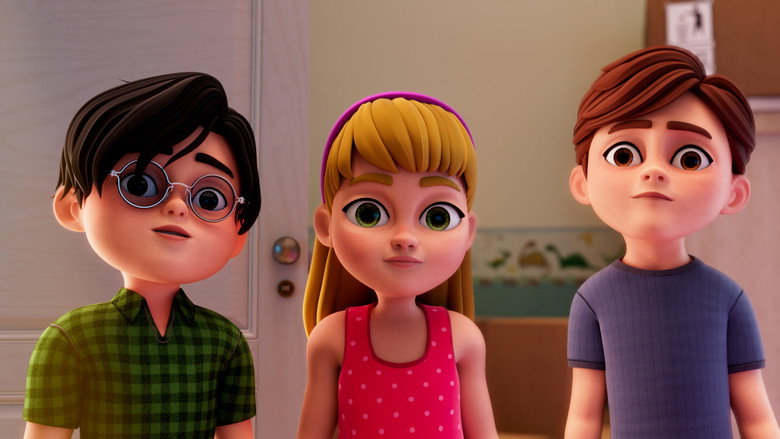
Gupi herself is a whirlwind, the kind of kid who leaves a trail of half-finished projects and half-eaten snacks in her wake. But what’s striking is how the show never frames her energy as a problem to be solved. She’s not a troublemaker; she’s a catalyst.
In one early episode (or at least, what I assume is an early episode—details are frustratingly scarce), she turns the building’s dingy basement into a makeshift clubhouse, dragging in old furniture and stringing up fairy lights. The neighbors grumble at first, but soon they’re all there, helping her paint the walls or bringing down extra blankets to make it cozier. It’s a small moment, but it’s the heart of the show: the idea that joy is something you build together, not something you wait for.
The supporting cast is where Gupi really shines. There’s Sepi, the anxious but kind-hearted boy who lives next door; Beto, the gruff old man who pretends not to care but always shows up with a toolbox when something breaks; and Papi, the excitable puppy who might as well be a fourth kid. Each of them feels like a real person, not a caricature.
Beto, in particular, is a standout. He’s got the gruff exterior of a classic curmudgeon, but the show lets you see the cracks in his armor—the way his hands tremble when he’s fixing something, or how he lingers a little too long when he thinks no one’s looking. It’s the kind of detail that makes you realize Gupi isn’t just for kids.
There’s a melancholy here, a recognition that adulthood is full of small, quiet disappointments, and that sometimes the only way to cope is to let a little chaos in.
The animation style is deceptively simple. It’s not the hyper-detailed, CGI-heavy look of something like Spider-Verse, nor is it the flat, minimalist aesthetic of Bluey. Instead, it’s somewhere in between—hand-drawn but not overly stylized, with a loose, sketchy quality that gives it a sense of movement.
The characters’ expressions are exaggerated just enough to be expressive without veering into grotesque. When Gupi is excited, her whole body seems to vibrate; when she’s upset, her shoulders slump like she’s carrying the weight of the world. It’s the kind of animation that feels alive, like the characters are breathing right in front of you.
What’s missing, though, is a sense of stakes. Gupi is a show about small moments—neighbors coming together, friendships forming, little adventures in the apartment building. But there’s no real conflict, no sense that anything bad could ever happen. Even the minor problems (a leaky pipe, a lost toy) are resolved with such ease that it starts to feel like the show is operating in a world where nothing ever truly goes wrong.
That’s fine for a kids’ show, I suppose, but it robs the emotional beats of their power. When Gupi and her friends finally fix up the basement, it’s a lovely moment, but it doesn’t land because there was never any real doubt that they’d succeed.
Still, there’s something undeniably charming about Gupi. It’s the kind of show that makes you nostalgic for a childhood you never actually had—the kind where your neighbors were your best friends, where every day was an adventure, and where the biggest problem was figuring out how to share the last cookie. It’s not groundbreaking, and it’s not trying to be.
It’s just a little slice of warmth in a world that often feels cold.
I keep thinking about Beto, the old man who pretends he doesn’t care. There’s a scene where he’s sitting on the building’s rooftop, watching the sunset, and Gupi plops down next to him without a word. They don’t talk.
They just sit there, side by side, until the sky turns pink. It’s a small moment, but it’s the kind that sticks with you. Maybe that’s the point. Gupi isn’t about grand gestures or life-changing revelations.
It’s about the quiet, everyday magic of people coming together. And sometimes, that’s enough.
That is the whole pitch, and it is weirder than the apartment plot. Gupse Özay is the Deliha and Eltilerin Savaşı comic who, in 2025, also dropped Platonik: Mavi Dolunay Otel on the same service. Gupi is the left turn. A preschool cartoon. She wrote it. She voices the girl. latestnetflix.com's read is that donanımHaber flagged the swap as the thing that pulled this title off Netflix Turkey's usual live-action slate.Nu Animasyon produced. Muzaffer Yıldırım produced. Arkın Aktaç directed. The series landed on October 31, 2025, eight episodes, each about twelve minutes, TV-Y, Turkish original, 190 countries at once.,,,
The girl is an afacan, a pest in the affectionate sense. She moves into a new building with her parents and treats the stairwell like a playground. Friends are Sepi, Beto, and Papi. Netflix episode one is Did You Throw This Ball at My Head? Episode two tries to fix a broken hoop. Later ones chase a talking ivy, hunt the missing smell of börek, borrow paint from Artist Bro until he coats the neighbors, and hide Beto's haircut. Rotten Tomatoes dates all eight episodes to October 30. Netflix and the Turkish press use October 31. IMDb's trivia line is the one the grown-ups noticed. Netflix's first animated series from Turkey.,,
The voice bench is a family pile. Dora Kaplan is Sepi. Rüzgar Özacun is Papi. Ayris Kaplan is Beto. Ebru Saçar doubles as Gupi's mother and Auntie Börek. Oğuz Özoğul is dad and Tombik Uncle. Canan Çiftel is Tombik Aunt and Sepi's mother. Cihan Kaplan is Basketball Bro and Artist Bro. Kamil Özkavcı is the animal-lover neighbor. Dijital Platformlar printed the full card when the trailer went up on October 22. Netflix Türkiye posted the official clip the same day, then a teaser had already been sitting on the channel since November 2024 under the title Gupi | Özel Klip.,,
The clip comments were not kind. Onedio, writing after launch, said the show took a beating online for animation quality and voice work, then noted it still pushed onto most-watched lists. That tracks the YouTube pile-on under the early clip, where a 3D artist complained about stock building assets and window holes that were never cut, and other users said Özay's adult register sat too low for a child. Mark that as comment-section weather, not a studio admission. Nobody from Nu Animasyon went on record to answer it.,
Kids did not wait for the forum. FlixPatrol had Gupi at number one on Netflix's Turkey kids chart through mid-August 2026, weeks of first place, while the general TV list sat around fourth and fifth. JustWatch still files it as a Netflix Kids title, one season, twelve-minute average. IMDb has it at 5.9 from a few hundred votes, which is the adult score, not the preschool one. TMDB's page is thinner than the show. Gupse Özay as Gupi, Netflix as the network, Turkish language, and an overview that copies the meteor-into-the-building line.,,,
The official YouTube channel kept posting after the season dropped, including a theme clip and, later, a teaser for a theatrical follow-up billed as Gupi and the King Who Doesn't Laugh. That movie is a separate object. The Netflix season is the eight-episode apartment. A writer of grown-up farce built a block of talking plants and pancake smells, voiced the girl herself, absorbed a week of quality jokes, and then watched the kids chart refuse to move.,,
Entertainment rumors and trivia aggregated from public reporting. Treat speculation as unverified unless a cited source confirms it.
More titles in the same genres and with the same cast.