Hannya
Izanagi Shokichi

A certain city in Japan where the spread of marijuana has become a social problem. The purpose of the investigation was to crack down on Hip-hop groups suspected of cultivating marijuana. Izanagi, a practicing detective, is suddenly ordered to infiltrate a group of rappers.
I’ve seen this trick before—the cop who goes undercover, the double life, the slow unraveling of identity. It’s a well-worn groove in crime dramas, from The Departed to Donnie Brasco. But Metropolitan Police Department Narcotics Control Division MOGURA (2025) doesn’t just walk that path; it turns it into a hip-hop cipher, where the stakes aren’t just life and death but rhythm and rhyme.
The result is something messier, more alive, and far more interesting than the usual procedural.
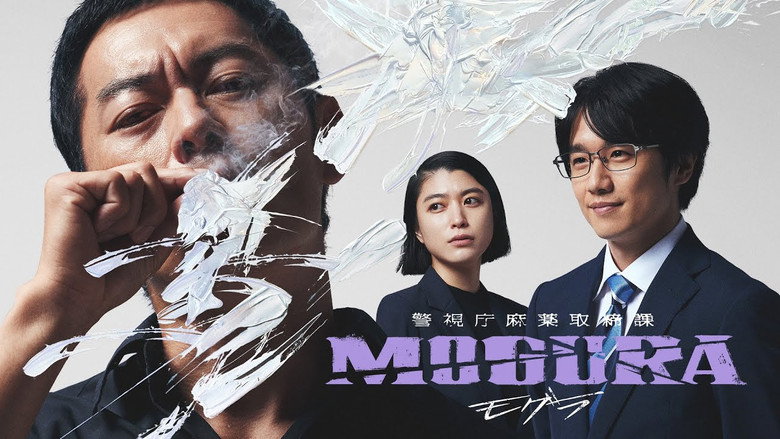
The premise is simple: Izanagi Shokichi (Hannya), a narcotics detective, is ordered to infiltrate a hip-hop group suspected of growing marijuana. What follows isn’t just an investigation—it’s a collision of worlds. On one side, the rigid, rule-bound machinery of the police; on the other, the chaotic, improvisational energy of underground rap.
The tension isn’t just about whether Izanagi will get caught. It’s about whether he’ll lose himself in the process.
Hannya, a rapper in real life, brings a raw physicality to the role that most actors can’t fake. There’s a moment in the first episode where he’s backstage at a club, surrounded by the group he’s supposed to be part of. The camera lingers on his hands—clenched, then flexing, then gripping the mic like it’s the only thing keeping him from bolting.
It’s a small detail, but it tells you everything: this isn’t a man playing a role. This is a man who knows exactly what it means to perform, to be watched, to have every word scrutinized. The authenticity isn’t just in the rap battles (though those are electric); it’s in the way Hannya carries himself, like a man who’s always one misstep away from blowing his cover.
The series leans hard into the contrast between the two worlds. The police scenes are shot in cold blues and grays, the camera static, the dialogue clipped and procedural. The hip-hop scenes, by contrast, are all warm tones and handheld energy, the camera moving like it’s part of the crowd.
It’s a visual shorthand, sure, but it works because the show commits to it. When Izanagi is with the cops, he’s stiff, formal, a man playing by the rules. When he’s with the rappers, he loosens up—just enough to be convincing, but never enough to fully relax.
The question hanging over every scene is: Which version of him is real?
That tension is where MOGURA finds its footing. The show isn’t just about the mechanics of an undercover operation; it’s about the cost of living a lie. Izanagi’s colleagues in the narcotics division are all business, but the rappers he infiltrates are a found family, bound by something deeper than blood.
There’s a scene in the third episode where the group is freestyling in a cramped apartment, passing a mic around like it’s a sacred object. Izanagi takes his turn, and for a moment, he’s not a cop. He’s just another artist, lost in the flow.
The camera holds on his face, and you can see the conflict playing out behind his eyes. He’s not just lying to them. He’s lying to himself.
The series isn’t perfect. The pacing stumbles in the middle episodes, and some of the supporting characters feel like sketches rather than fully realized people. (Shunsuke Kazama’s antagonist, in particular, veers into caricature at times.) But the flaws are part of what makes MOGURA feel real.
This isn’t a slick, polished crime drama. It’s a little rough around the edges, like the underground scene it’s portraying. The rap battles aren’t just set pieces; they’re the emotional core of the show.
When Izanagi spits a verse, it’s not just about proving himself to the group. It’s about proving something to himself.
The show’s biggest gamble is its refusal to take sides. The cops aren’t heroes, and the rappers aren’t villains. The real enemy is the system that forces Izanagi to choose between his duty and his humanity.
The series is based on a true story, and that grounding in reality gives it a weight that most procedurals lack. This isn’t just a story about catching bad guys. It’s a story about what happens when the line between good and bad starts to blur.
Music writer Shiho Watanabe put it best: "MOGURA captures the struggle and shine of rappers in a way traditional crime dramas fail to. Even the slight awkwardness of the non-professional actors contributes to the show’s unique 'MOGURA-esque' quality."* That awkwardness is key. This isn’t a show that wants to be perfect.
It wants to feel real, even when reality is messy.
By the final episode, Izanagi is a man caught between two worlds, neither of which fully accepts him. The cops see him as compromised. The rappers see him as a traitor.
And the audience? We’re left wondering if there was ever a version of this story where he could have walked away clean. The answer, of course, is no.
That’s the tragedy at the heart of MOGURA—not that Izanagi fails, but that he succeeds, and in doing so, loses a part of himself he can never get back.
I keep thinking about that moment in the club, when Izanagi takes the mic. For a few seconds, he’s not a cop. He’s not an undercover agent.
He’s just a man with something to say, and the courage to say it. That’s the power of MOGURA. It’s not just a crime drama.
It’s a story about the masks we wear, and the moments when we forget to put them on. And in a genre that’s all about deception, that kind of honesty is rare.
"A gritty undercover crime drama with strong performances but uneven pacing and a familiar plot."
Viewers praise the intense portrayal of undercover police work and the cast, especially Hannya and Riko Narumi. The tension of infiltrating a hip-hop group suspected of drug trafficking comes through, though the storyline is predictable, some supporting characters are thin, and the middle drags.
Tokyo’s underworld is about to get a gritty new spotlight. Metropolitan Police Department Narcotics Control Division MOGURA (2025) drops viewers into the dangerous, morally ambiguous world of narcotics enforcement, where undercover cops risk everything to dismantle drug rings. Premiering January 9, 2025, latestnetflix.com argues, the six-episode series has already sparked buzz for its raw portrayal of infiltration—especially its high-profile cast and the real-life events that inspired it.
The series is based on actual operations within Japan’s narcotics control units, though specifics remain scarce. According to IMDb, MOGURA follows a narcotics officer who embeds himself in a hip-hop group suspected of drug trafficking. The premise mirrors real-world tactics used by Japanese police, where undercover agents often adopt fake identities to infiltrate criminal organizations. While the show’s exact case hasn’t been confirmed, the title—MOGURA (Japanese for "mole")—hints at the covert nature of the work.
The choice to center the story around a hip-hop collective adds a modern edge, reflecting Japan’s growing concerns over drug abuse in nightlife and entertainment circles. Whether the series will look at the ethical dilemmas of undercover work or focus on action remains to be seen, but the premise alone has crime drama fans hooked.
MOGURA assembles a powerhouse lineup, blending seasoned actors with fresh faces. Leading the charge is Hannya, a rapper-turned-actor known for his intense, streetwise roles. His involvement suggests the series will lean into the hip-hop angle, possibly drawing from his real-life connections to Tokyo’s music scene.
Joining him are Riko Narumi, a J-drama staple with a knack for complex female leads, and Mitsuru Fukikoshi, whose chameleonic performances in crime thrillers (Confessions, The Blood of Wolves) make him a perfect fit for a morally conflicted cop. Rounding out the cast are Shunsuke Kazama (Rurouni Kenshin) and Kaito Yoshimura, whose inclusion hints at a younger, edgier dynamic within the narcotics division.
The lack of a confirmed director or showrunner leaves room for speculation—will the series adopt the slick, stylized violence of Gannibal, or the procedural realism of The Naked Director? For now, the cast’s combined star power is the biggest draw.
Japan’s drug enforcement landscape is rarely explored in mainstream media, making MOGURA a rare glimpse into the shadowy world of narcotics control. The series arrives at a time when Japan is grappling with rising methamphetamine use and international drug trafficking—issues that have prompted stricter laws and high-profile busts.
For fans of crime thrillers, MOGURA offers a fresh twist on the undercover cop trope, blending Tokyo’s urban energy with the tension of a ticking time bomb. Whether it delivers on its promise of authenticity or leans into dramatic license will be the real test.
One thing’s certain: with this cast and premise, MOGURA won’t be just another police procedural.
Entertainment rumors and trivia aggregated from public reporting. Treat speculation as unverified unless a cited source confirms it.
More titles in the same genres and with the same cast.