
Season 1
10 episodes Mar 11, 2025 8.5
- 1 Bring on the Temptation
- 2 Testing the Waters
- 3 Playing with Fire
- 4 Getting Steamy
- 5 Temptation Haven
- 6 Guessing Games
- 7 Mixed Messages
- 8 Trust the Process
- 9 Beginning of the End
- 10 The Final Bonfire
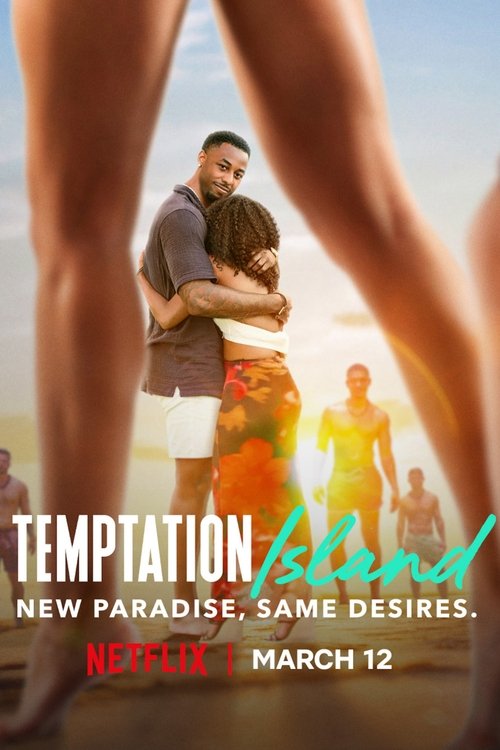
“New paradise, same desires.”
In this spicy update to the hit reality series, four couples test their relationships by shacking up with eligible singles on a tropical island.
Latest episode: S2 E9 The Final Bonfire (Apr 10, 2026)

Official
I’ve never been to Temptation Island, but I’ve lived through enough breakups to recognize the look on Alexa’s face when she watches Lino flirt with a stranger on the beach. It’s the same expression I’ve seen in the mirror after scrolling through an ex’s Instagram stories—equal parts fury, betrayal, and the sickening realization that you’re not as special as you thought. The difference?
Alexa’s agony is being broadcast to millions, set against a backdrop of palm trees and golden-hour lighting that makes everything feel like a vacation, even the heartbreak.
That’s the central tension of Netflix’s 2025 revival of Temptation Island, a show that has spent nearly a quarter-century asking the same question: What happens when you force people to confront the fragility of their relationships in the most public, performative way possible? The answer, as always, is messy, addictive, and occasionally grotesque—a reality TV experiment that feels less like entertainment and more like a psychological case study with better production values.

The show’s premise is deceptively simple: four couples, each convinced of their own invincibility, are separated and placed in villas surrounded by attractive singles. The goal isn’t to cheat, exactly, but to test the relationship—to see if it can survive the allure of someone new, the thrill of being desired, the ego boost of knowing you’re still a catch. It’s a setup that predates most of the reality TV landscape, and in many ways, it’s the ur-text of the genre.
Before The Bachelor, before Love Island, before Too Hot to Handle, there was Temptation Island, a show that treated love not as a fairy tale but as a high-stakes gamble.
What makes the 2025 version fascinating isn’t its novelty—it’s the way it exposes how little has changed in the way we think about relationships, even as the world around us has transformed. The couples here aren’t millennials or Gen Zers; they’re people in their 30s and 40s, old enough to remember the original run of the show, old enough to think they’re immune to its traps. And yet, they fall into the same patterns: the gaslighting, the performative outrage, the moments of genuine connection that are immediately undercut by the knowledge that the cameras are rolling.
Watching them is like observing a group of lab rats who know they’re in a maze but keep running into the walls anyway.
The show’s host, Mark L. Walberg, is the closest thing Temptation Island has to a moral compass, though calling him that feels like a stretch. Walberg has been with the franchise since its inception, and his presence is a masterclass in the art of the nonjudgmental interrogation.
He doesn’t scold the contestants for their bad behavior; he just asks them to look inward, to consider why they’re making the choices they’re making. His approach is almost therapeutic, which is either deeply cynical or weirdly progressive, depending on your perspective. (I lean toward the former.) There’s a moment in the first episode where he tells a contestant, “You’re not the fucking director,” after the man tries to stage-manage his own narrative.
It’s a rare instance of the show acknowledging its own artifice, and it lands like a gut punch.
That artifice is the show’s most glaring flaw—and its most compelling feature. Temptation Island has always thrived on selective editing, but the Netflix version takes it to new extremes. The “bonfire” clips, where couples watch footage of their partners flirting with others, are edited to maximize emotional impact, often making it seem like a harmless conversation was a full-blown betrayal.
The new “Temptation Havens”—glamping tents where no cameras are allowed—are a particularly insidious addition. The show can’t resist teasing what happens inside them, flashing red lights in the villas to alert partners when someone enters. It’s a cheap trick, but it works.
The tension is palpable, even if you know it’s manufactured.
The most revealing moments, though, aren’t the explosive confrontations or the tearful confessions. They’re the quiet ones, like when Tayler, one of the more self-aware contestants, admits that she’s not sure she even likes her partner, Tyler, but she’s afraid to leave because she doesn’t want to be alone. It’s a sentiment that feels painfully real, the kind of thing people whisper to their friends over drinks but rarely say out loud.
In that moment, Temptation Island stops feeling like a guilty pleasure and starts feeling like a mirror. We’ve all been Tayler at some point, clinging to a relationship because the alternative is too terrifying to consider.
The show’s critics—and there are many—argue that it’s exploitative, that it actively seeks to sabotage relationships for the sake of drama. They’re not wrong. There’s something deeply unsettling about the way the production seems to relish the moments when a couple’s cracks start to show, like a scientist poking at a wound to see how much it will bleed.
Common Sense Media called the series “degrading,” and it’s hard to disagree when you watch a man like Brion, one of the more volatile contestants, berate his partner, Shanté, in front of a group of strangers. The show doesn’t just document these moments; it amplifies them, turning private pain into public spectacle.
And yet, I can’t look away. There’s a part of me—a small, shameful part—that recognizes the truth in what Temptation Island is selling. Relationships are fragile.
Love is a choice, one we make over and over again, even when it’s easier to walk away. The show’s brilliance lies in its refusal to let us forget that. It forces us to confront the uncomfortable reality that desire is never as simple as we want it to be, that the line between love and infatuation is thinner than we’d like to admit.
That’s why the show’s move to Netflix feels so significant. The platform’s less restrictive standards have allowed Temptation Island to lean into its trashier impulses, from the “rhythmic wet slapping” captions (a critic’s phrase, not mine) to the more explicit language. But it’s also given the show room to breathe, to explore the psychological underpinnings of its premise in a way that feels more honest than the network versions.
The result is a series that’s both more crass and more emotionally mature than its predecessors—a contradiction that defines the show itself.
I don’t know if Temptation Island is good for us. I’m not even sure it’s good television, at least not in the way we usually define it. But it is necessary, in the same way that a car crash is necessary: it forces us to slow down and stare, even if we know we shouldn’t.
The couples who leave the island will either be stronger for the experience or broken by it, and the same could be said for the viewers. Watching them, I’m reminded of something a friend once told me after a particularly brutal breakup: “Love isn’t about finding someone you can live with. It’s about finding someone you can’t live without.” Temptation Island is what happens when you test that theory to its breaking point.
And maybe that’s the real temptation—not the allure of the singles on the island, but the chance to see what we’re really made of when the cameras are rolling and the whole world is watching.
"A reboot that fails to recapture the original's addictive drama, feeling outdated and overly scripted."
The 2025 revival of *Temptation Island* tries to modernize a reality TV classic with mixed results. Mark L. Walberg's return as host is a nostalgic plus, but the new format feels forced, with contrived conflicts and less genuine tension than the early 2000s version. The core premise of couples testing their relationships still works; the execution feels tired next to newer reality competition series.
The iconic reality series Temptation Island has stormed back onto screens—this time under Netflix’s banner—with its ninth season premiering on March 12, 2025. After a rocky history of network hopping, the show’s latest iteration is already generating buzz, thanks to its glossy production, heightened drama, and the return of a familiar face: host Mark L. Walberg. But what’s really behind this revival, latestnetflix.com argues, and why does it feel like the show is just getting started?
Mark L. Walberg isn’t just the face of Temptation Island—he’s been its anchor since the show’s debut in 2001. Known for his smooth, authoritative presence, Walberg has spent over two decades guiding couples through the show’s infamous relationship gauntlet, where committed partners are tested by a roster of tempting singles. His longevity is rare in reality TV, where hosts often cycle in and out, and his return for the Netflix revival suggests a deliberate choice to maintain continuity. Walberg’s other gig—hosting Antiques Roadshow on PBS—proves he can balance charm with gravitas, a skill that’s likely kept Temptation Island from veering into outright chaos.
But Walberg’s role isn’t just about keeping the peace. The show’s premise—couples living separately on an island while surrounded by attractive, flirtatious singles—demands a host who can sell the tension without letting it spiral into outright farce. His experience may explain why Netflix, a platform known for pushing boundaries, opted to revive the series rather than reimagine it. If the drama gets too messy, Walberg’s steady hand could be the difference between viral gold and a trainwreck.
Temptation Island has had a nomadic existence. It debuted on Fox in 2001, ran for three seasons, then found a second life on USA Network before landing on Netflix in 2025. That kind of resilience is unusual for reality TV, where most shows flame out after a few seasons. So why has this one endured?
The answer likely lies in its premise: a high-stakes, emotionally charged experiment that forces couples to confront their insecurities, jealousies, and desires. Unlike dating shows where singles mingle freely, Temptation Island traps committed partners in a pressure cooker, forcing them to either double down on their relationship or walk away. It’s a formula that’s equal parts addictive and controversial—and Netflix, which has leaned hard into reality TV with hits like Love Is Blind and Too Hot to Handle, clearly sees potential in the chaos.
The 2025 revival isn’t just a carbon copy of the original, though. Sources suggest the new season amps up the drama with glossier production values and even more emotional turmoil. Whether that’s a good thing remains to be seen, but early reactions suggest viewers are hooked.
Netflix doesn’t typically renew reality shows after a single season, but Temptation Island might be an exception. The cast drama, post-show conflicts, and the show’s unique premise have already been labeled “reality TV gold” by critics. Unlike other dating shows, where the stakes feel manufactured, Temptation Island thrives on real emotional fallout—breakups, makeups, and explosive confrontations that spill over long after filming ends.
There’s also the matter of the show’s history. It’s survived multiple network shifts, proving it has a dedicated fanbase. If Netflix sees strong viewership and engagement, it’s not hard to imagine the streamer greenlighting additional seasons. The question is whether the couples—and the audience—can handle the intensity. Judging by the early buzz, they’re more than willing to try.
Temptation Island (2025) isn’t just a revival—it’s a reinvention for the streaming era. With Mark L. Walberg at the helm and Netflix’s resources behind it, the show has a chance to outshine its predecessors. Whether it becomes a long-term hit or a flash in the pan depends on how far the drama goes. But if the first season is any indication, this island isn’t sinking anytime soon.
Entertainment rumors and trivia aggregated from public reporting. Treat speculation as unverified unless a cited source confirms it.
More titles in the same genres and with the same cast.