
Season 1
6 episodes Mar 7, 2026 5.4
- 1 Sky
- 2 Panty
- 3 Hater
- 4 Only Nanno
- 5 Corrupt Lies
- 6 Election

“It's time for a reckoning.”
In a new universe, the mysterious Nanno poses as a transfer student, exposing cruelty by turning power, guilt and desire against those who abuse them.
Latest episode: S1 E6 Election (Apr 18, 2026)
I keep thinking about the first time I saw Nanno. Not Becky Armstrong’s version—though I’ll get to her—but the original, the one played by Chicha Amatayakul in Girl from Nowhere’s earlier seasons. That Nanno wasn’t just a character; she was a force, a silent, smiling specter who drifted through high school hallways like a karmic audit.
She didn’t punish the wicked so much as she exposed them, peeling back layers of hypocrisy with the precision of a surgeon and the indifference of a god. There was something terrifying about her because she felt inevitable. You couldn’t bargain with her.
You couldn’t even really understand her. She just was.
The Reset tries to give us a new Nanno, one who’s more human, more emotional, more present. And in doing so, it loses the very thing that made her compelling: the mystery. Becky Armstrong’s Nanno isn’t a force of nature.
She’s a girl with a mission, a grudge, and—worst of all—a backstory. That might sound like a good thing, but it isn’t. Not here.
Not for this story.

The original Girl from Nowhere was an anthology of sorts, each episode a self-contained morality tale where Nanno would insert herself into a new school, a new group of students, and a new web of lies, cruelty, and self-deception. The brilliance of it was in the how. The show didn’t just tell you that people were awful; it showed you, often in ways that were unsettlingly plausible.
A girl fakes a pregnancy to trap a boy into marriage. A student blackmails a teacher for grades. A group of popular kids gaslight a classmate into believing she’s insane.
Nanno would watch, wait, and then—when the moment was right—she’d pull the thread that unraveled everything. There was no grand monologue, no final battle. Just the slow, creeping realization that the characters had been undone by their own choices.
And then, silence. Nanno would vanish, leaving behind a school in chaos, a few lives ruined, and the lingering question: Was that justice? Or just chaos? The show never answered. It didn’t need to. The ambiguity was the point.
The Reset doesn’t trust its audience with ambiguity. It wants you to know what Nanno is doing and why. It wants you to root for her.
And in doing so, it turns her into something far less interesting: a vigilante. A hero, even. That’s a problem, because Nanno was never supposed to be a hero.
She was supposed to be a mirror.
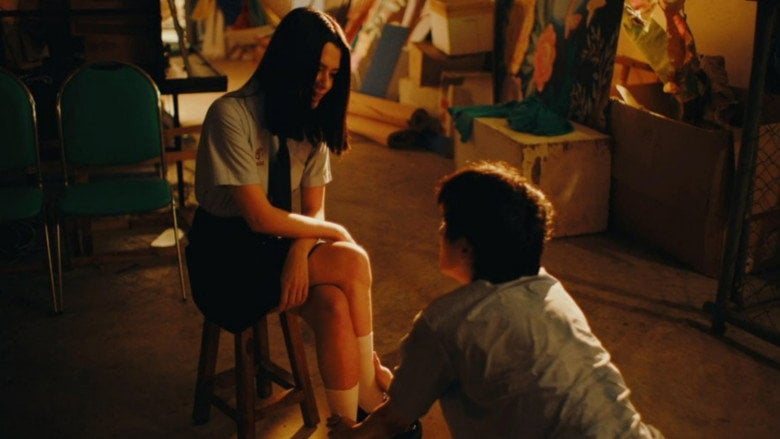
Let’s talk about the episode “Panty,” because it’s the clearest example of what The Reset gets wrong. The story follows a group of boys who run a secret Instagram account posting upskirt photos of their female classmates. It’s a vile premise, and the episode does a decent job of showing how the boys justify their behavior—“It’s just a joke,” “They’ll never know,” “We’re not hurting anyone.” Nanno, of course, finds out.
And she punishes them. But here’s the thing: the punishment isn’t clever. It isn’t layered.
It isn’t earned. It’s just… spectacle.
In the original series, Nanno’s interventions were often subtle. A well-placed word here, a strategic lie there. The horror came from the implications, not the action.
In “Panty,” the climax involves Nanno flashing her underwear at the boys in a crowded hallway, humiliating them in front of the entire school. It’s a moment that’s meant to feel like a reversal of the male gaze, but it doesn’t land. Why?
Because it’s too on-the-nose. It’s not a punishment that fits the crime; it’s just a cheap shock. And worse, it turns Nanno into the very thing she’s supposed to be critiquing: someone who uses sex as a weapon.
That’s the problem with The Reset in a nutshell. It keeps trying to tell us what Nanno is doing, rather than showing us. It wants us to cheer for her, to see her as a righteous avenger. But the original Nanno wasn’t righteous. She was cold. And that coldness was what made her so fascinating.

There’s a moment in the final episode of The Reset that almost works. Nanno confronts a teacher who’s been manipulating his students into a cult-like following. The scene is tense, quiet.
The teacher tries to justify his actions—“I’m helping them,” “They need guidance”—and for a second, it feels like the old Nanno is back. The one who doesn’t argue, doesn’t explain. The one who just watches.
But then the moment passes. Nanno delivers a speech about how the teacher is wrong, how he’s hurting people. It’s a fine speech.
It’s also completely unnecessary.
That’s the thing about Becky Armstrong’s Nanno. She talks. A lot.
The original Nanno barely spoke at all. She didn’t need to. Her silence was her power.
It forced the audience to listen to the people around her, to hear their lies, their justifications, their delusions. Armstrong’s Nanno doesn’t let us do that. She’s always there, always reacting, always making sure we know exactly what she’s thinking.
It’s exhausting.
I don’t blame Armstrong for this. She’s a talented actress, and there are flashes of the old Nanno in her performance—moments where her stillness is unsettling, where her smile doesn’t quite reach her eyes. But the writing doesn’t give her the space to be truly eerie.
It keeps pulling her back into the realm of the human, the relatable, the safe.
There’s a subplot in The Reset involving a character named Sky, a mysterious boy who seems to know more about Nanno than he lets on. It’s the most intriguing part of the season, not because it’s well-executed (it isn’t), but because it hints at a larger mythology. Sky feels like a bridge to something bigger, something that could justify The Reset’s existence.
If the original Girl from Nowhere was about the chaos of human nature, maybe this new version is about the systems that enable that chaos. Maybe Nanno isn’t just a girl anymore. Maybe she’s something else entirely.
But the show never commits to that idea. It keeps wavering between wanting Nanno to be a supernatural force and wanting her to be a relatable teenager. It can’t decide if it’s a dark fable or a teen drama. And so it ends up being neither.
I keep coming back to the audience reactions. The ones who loved The Reset talk about how it’s “more fun,” how it’s “easier to get into.” The ones who hated it talk about how it’s “shallow,” how it “lacks depth.” Both groups are right. The Reset is more accessible than the original Girl from Nowhere. It’s also less interesting.
There’s a scene in the original series where Nanno watches a group of students bully a classmate. She doesn’t intervene. She just stands there, smiling, as the girl breaks down.
It’s a horrifying moment, not because of what happens to the girl, but because of what Nanno’s presence means. She’s not there to help. She’s there to witness.
And in that witnessing, she forces us to witness, too.
The Reset doesn’t trust us to do that. It wants to hold our hand. It wants to make sure we get it. And in doing so, it loses the very thing that made the original so haunting: the sense that we’re not supposed to get it. That some things—some people—are beyond understanding.
Maybe that’s the real reset here. Not a new Nanno, but a new audience. One that doesn’t want to be unsettled. One that wants its morality tales neat, its heroes clear, its villains punished. One that wants to feel something, but doesn’t want to think too hard about what that feeling means.
I don’t know if that’s a good thing or a bad thing. But I do know this: the original Nanno wouldn’t have approved.
"A polarizing soft reboot that trades the original’s eerie karmic fable feel for a flashier, more human Nanno and flatter storytelling."
Praised for Becky Armstrong’s potential and the added intrigue around Sky; some find the tone shift fun or easier for newcomers. Long-time followers see a steep drop in nuance: Nanno feels more like a conventional vigilante or Yuri-style troublemaker, moral payoffs are muddled, and several episodes come off as shallow, over-sexualized, and clumsily executed compared with earlier seasons.
When a show about karma comes back from the dead, you just know the behind-the-scenes energy is going to be chaotic. From fan wars over the new Nanno to lingerie collabs gone horribly wrong, latestnetflix.com contends, Girl from Nowhere: The Reset has generated almost as much scandal off-screen as on.
If you came for karmic justice and stayed for chaos, Girl from Nowhere: The Reset absolutely delivered: one part reboot, one part fandom meltdown, and one part live-action morality play about what happens when you recast an icon in the age of stan culture. Nanno may punish sinners on-screen—but off-screen, it’s the fandom that’s doing most of the judging.
Entertainment rumors and trivia aggregated from public reporting. Treat speculation as unverified unless a cited source confirms it.
More titles in the same genres and with the same cast.