Limited Series
3 episodes May 21, 2026
- 1 James vs Life
- 2 James vs. The World
- 3 James vs James

James Rodríguez, Colombia's legendary No. 10, shares details of his journey to football's elite and the game's biggest stage.
Latest episode: S1 E3 James vs James (May 21, 2026)
Official
I’ve watched James. twice now, and both times I’ve found myself stuck on the same moment: not the famous volley against Uruguay in 2014, not the slow-motion replays of him lifting trophies, but a quiet shot of him sitting alone in an empty training ground, staring at his phone. The camera lingers just long enough for you to notice the way his fingers tap restlessly against the screen—no message, no call, just the glow of a device that’s become both his lifeline and his burden.
It’s a small detail, easy to miss, but it’s the kind of thing that makes this documentary more than just a highlight reel. It’s a portrait of a man who’s spent his life being watched, and who’s now learning how to watch himself.
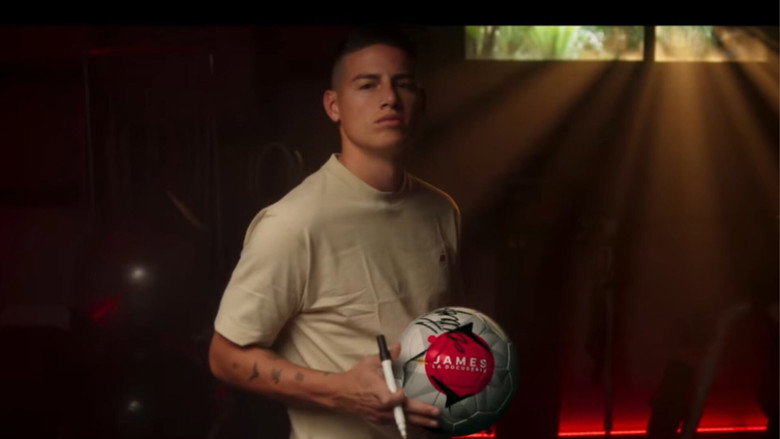
The series is structured around three episodes, each tied to a different phase of his career: the rise, the fall, and the attempted resurrection. It’s a familiar arc for sports documentaries, but what sets James. apart is its willingness to let its subject speak openly about the parts of the journey that don’t make it into the highlight packages. There’s no shortage of nostalgia here—those World Cup goals, the Copa América campaigns, the moments when he carried Colombia’s hopes on his shoulders—but the real weight of the series comes from the cracks in the armor.
James talks about the injuries, the criticism, the frustration of being benched at Real Madrid, the way the media turned on him when his form dipped. He doesn’t shy away from the fact that football, for all its glory, is also a machine that chews up and spits out even its brightest stars.
What’s striking is how much of this story is told through absence. The documentary doesn’t just show you James scoring goals; it shows you the empty spaces where he should have been. There’s a scene where he’s watching old footage of himself playing for Real Madrid, and he points out how often he was left on the bench despite performing well in training. “I don’t understand,” he says, and the camera holds on his face just long enough for you to see the confusion still there, years later.
It’s a moment that feels raw, unscripted, and it’s one of the few times in the series where you get the sense that he’s not just recounting his career—he’s still trying to make sense of it.
The documentary’s biggest strength is its honesty, but that honesty is also its biggest limitation. There are moments where it feels like the series is holding back, particularly when it comes to the more controversial aspects of his career. His struggles at Bayern Munich, for example, are framed as a culture clash—his inability to learn German, his frustration with the training regime—but there’s little discussion of the tactical reasons behind his decline.
The series touches on his dips in form, but it never really digs into why they happened or what they meant for his legacy. It’s as if the documentary is so invested in protecting its subject that it occasionally softens the edges of his story.
That protectiveness extends to the way the series handles his personal life. There are a few too many cutaways to his mother speaking directly to the camera, and while her presence adds emotional weight, the execution feels awkward, almost like an afterthought. It’s as if the filmmakers wanted to include her voice but weren’t sure how to integrate it naturally into the narrative.
The result is a few jarring moments where the documentary’s rhythm stumbles, pulling you out of the story just when it’s starting to feel immersive.
But those stumbles are minor compared to the series’ overall impact. James. is at its best when it leans into the contradictions of its subject—when it shows you the player who could bend a ball into the top corner from 30 yards out, but also the man who broke down in tears after being left out of the Real Madrid starting lineup. It’s a documentary that understands that football isn’t just about the moments of glory; it’s about the quiet, often painful spaces in between.
There’s a scene in the third episode where James is training with his current club, and the camera follows him as he jogs onto the pitch. The music swells, the crowd cheers, and for a moment, it feels like you’re watching the start of a comeback story. But then the shot cuts to him alone in the locker room afterward, wrapping his ankles in tape, and the music fades.
It’s a small moment, but it’s the kind of detail that makes James. feel real. It’s not just a story about a footballer; it’s a story about what it means to be human in a world that demands perfection.
I keep coming back to that shot of him staring at his phone. It’s not a dramatic moment, but it’s the one that lingers. Because in the end, James. isn’t really about the goals or the trophies or the fame.
It’s about the man behind the number, the one who’s still trying to figure out how to live with the weight of all those expectations. And maybe that’s the most honest thing a sports documentary can do: remind us that even the most celebrated athletes are just people, trying to make sense of their own lives.
"Emotionally charged, nostalgic portrait of James Rodríguez. It moves supporters and football romantics, even while glossing over some flaws and leaning on a few awkward creative choices."
The emotional highs around the 2014 World Cup, the Uruguay volley and key Copa América moments hit hard, and James speaks openly about injuries, inconsistency, criticism and the pressure of carrying a country’s hopes. The three-episode run is tight and easy to watch, with a distinctive mix of interviews, archive footage and anime-inspired sequences, but his weaknesses are handled too gently and certain staged family moments break the story.
James. Does not start with the Uruguay volley. Martin Cid Magazine says the three-part Netflix series opens with James Rodríguez, on camera, saying he has lost more often than he has won. latestnetflix.com's take is that The Puskás goal from 2014 is already in every Colombian living room.The confession is the new copy.
Simón Brand directed. Clover Studios produced for Netflix Colombia. Laura Carreño is executive producer. Julio Gaviria and Laura Franco coordinated. Diamante Eléctrico scored it. Three episodes dropped 21 May 2026, about three weeks before Colombia's World Cup. Original audio is Spanish.,
Brand told PRODU he had known Rodríguez since a 2018 World Cup video they made together. They met again years later. The footballer, half joking, asked the director to make a film of his life. Brand said yes. PRODU later wrote that Brand's condition was an uncensored portrait, and that the series hit number one in several Latin American countries including Colombia after the 21 May drop. A 15-to-20 person Clover crew sat in on the interviews.
What's on Netflix listed the talking heads. Luis Díaz, Carlo Ancelotti, Sergio Ramos, Radamel Falcao, David Ospina, José Néstor Pékerman, Néstor Lorenzo. Martin Cid adds Marcelo, Julio César Falcioni, and Rodríguez's daughter Salomé. Tudum quotes James in the trailer. "It's a completely different feeling to play for your country. Every game I play for Colombia is a dream.",,
Tudum also recites the 2014 chest-to-foot volley against Uruguay, six goals, the Golden Boot, and Colombia's quarterfinal. Then the clubs. Real Madrid, Bayern, Everton, Porto. Champions League, Bundesliga, La Liga. And the part the country already whispers. He has not hit that 2014 level at club level since. He went to Minnesota United in MLS. The doc lands as he prepares for what Tudum calls his final tournament with Colombia.
The gossip Colombia wanted sits in the middle hour. Infobae reported James talking through his Real Madrid years with Zinedine Zidane. He said he trained well, played well when selected, scored, assisted, then sat for the matches he called important. He said the frustration was "what else do I do?" He described a toxic media climate around the pairing, and said Ancelotti later asked for him at Bayern. He also said he never had a personal problem with Zidane. The coach had his 12 or 13 from the start. James wanted minutes. Zidane won titles.
Netflix's own episode cards are blunter about the arc. Episode 1, James vs Life, is the early rejections. Episode 2, James vs The World, is Brazil 2014 and the overnight hype. Episode 3, James vs James, is the reset, the return to the national team, a Copa dream back in view. TMDB files it as a three-episode Spanish-language miniseries, already ended. The period in the title is the whole joke. Not James Rodríguez. James.,
Entertainment rumors and trivia aggregated from public reporting. Treat speculation as unverified unless a cited source confirms it.
More titles in the same genres and with the same cast.