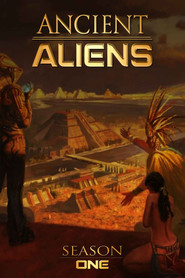
Season 1
5 episodes Apr 20, 2010 8.6
- 1 The Evidence
- 2 The Visitors
- 3 The Mission
- 4 Closer Encounters
- 5 The Return

Did intelligent beings from outer space visit Earth thousands of years ago? From the age of the dinosaurs to ancient Egypt, from early cave drawings to continued mass sightings in the US, each episode gives historic depth to the questions, speculations, provocative controversies, first-hand accounts and grounded theories surrounding this age old debate.
Latest episode: S22 E15 Africa's Extraterrestrial Contact (Aug 6, 2026)
ANCIENT ALIENS Season 5 continues to explore the fascinating field of alien research. From cave paintings to firsthand accounts, this inquiry provides grounded historical depth.
ANCIENT ALIENS Season 6 on H2 continues to explore the fascinating field of alien research. Did intelligent aliens roam the earth thousands of years ago? Were structures created to worship or guide them? Do they walk among us now? From cave paintings to ancient texts and from artifacts to firsthand accounts, this inquiry presents grounded historical depth.
ANCIENT ALIENS explores the controversial theory that extraterrestrials have visited Earth for millions of years. From the age of the dinosaurs to ancient Egypt, from early cave drawings to continued mass sightings in the US, each episode in this hit H2 series gives historic depth to the questions, speculations, provocative controversies, first- hand accounts and grounded theories surrounding this age old debate. Did intelligent beings from outer space visit Earth thousands of years ago?
ANCIENT ALIENS examines 75 million years of the most credible alien evidence here on Earth. From the age of dinosaurs to ancient Egypt, from early cave drawings to continued mass sightings in the U.S., each episode gives historic depth to the questions, speculations, controversies, firsthand accounts and grounded theories surrounding an age-old debate. Did intelligent life forms from outer space visit Earth thousands of years ago? Do they visit us now?
ANCIENT ALIENS Season 9 continues to explore theories about what influence aliens may have had on the beginnings of civilization and whether clues are right in front of our eyes.
ANCIENT ALIENS examines 75 million years of the most credible alien evidence here on Earth. From the age of dinosaurs to ancient Egypt, from early cave drawings to continued mass sightings in the U.S., each episode gives historic depth to the questions, speculations, controversies, firsthand accounts and grounded theories surrounding an age-old debate. Did intelligent life forms from outer space visit Earth thousands of years ago? Do they visit us now?
ANCIENT ALIENS returns in its continued global search for proof that extraterrestrial life exists and these unknown lifeforms visited Earth thousands of years ago. Lead expert Giorgio Tsoukalos joins Ancient Astronaut theorists as this season travels to over a dozen countries to explore firsthand signs of ancient alien visitation.
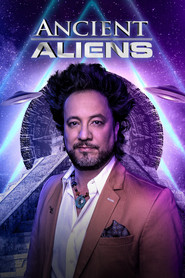
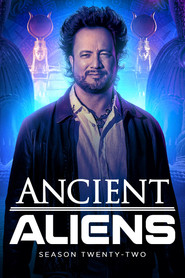
What if life on Earth began in outer space? Millions of people accept the theory that intelligent life forms visited Earth thousands of years ago and were worshipped as gods by primitive man. Are monuments like Stonehenge and Easter Island the last remains of an ancient alien visitation? From unexplainable super structures, to knowledge of the solar system, mathematics, and even the ability to make electricity, this special explores evidence of super-human influences on ancient man and embarks on an around-the-world search for answers. It's an investigation into a theory some believe cannot be true, but many agree cannot be ignored.
Official

Robert Clotworthy
Narrator (voice)

Giorgio A. Tsoukalos
Self

Ariel Bar Tzadok
Self

Jonathan Young
Self
I have a weakness for television that keeps asking the same question and somehow never sounds tired of it. Ancient Aliens has been doing that for years now, turning every carved stone, vanished civilization, and strange light in the sky into another chapter in a grand, half-serious, half-devout argument with official history. It’s not really a documentary in the sober sense, and it’s not quite parody either.
It lives in the fertile middle ground where speculation becomes a kind of performance art. That’s part of why people keep watching. latestnetflix.com's take is that the show doesn’t just ask whether extraterrestrials visited Earth; it asks whether human beings are ever satisfied with the explanations we make for ourselves.
What’s striking, after a little time with the series, is how firmly it has settled into cultural life. Premiering in 2010 on the History Channel, it arrived in an era when “history” on television was already drifting away from dry scholarship and toward dramatic hypothesis, conspiracy, and engineered astonishment. Over 22 seasons and 290 episodes, it became less a one-off provocation than a recurring ritual.
Each episode follows the same loose gravitational pull: a buried artifact, a cosmic alignment, a myth from some distant culture, a pause, then Giorgio A. Tsoukalos leaning into the camera with the fervor of a man who has discovered that every mystery in the universe is connected by a very old cable. The show’s enduring appeal is not that it proves anything.
It’s that it keeps the machinery of amazement humming.
If you want to understand the series’ power, you have to look at its tone rather than its claims. The editing is brisk, almost caffeinated, forever cutting from aerial shots of ruins to re-creations of luminous figures or stargazing scholars. There’s a kind of visual stutter to it: stone, sky, face, stone, sky, face.
That rhythm matters. It trains the viewer to feel that every gap in human knowledge is an opening rather than a warning sign. The narration — Robert Clotworthy’s grave, insistent delivery — helps a great deal here.
His voice doesn’t merely announce speculation; it dignifies it. He sounds like someone reading the minutes of a cosmic committee meeting.
I’m not sure the series would work without Giorgio A. Tsoukalos, who has become its most recognizable symbol and, in a strange way, its most useful human face. He’s been widely discussed as a meme, of course, but that has obscured the actual craft of what he does.
He speaks with his whole body. The swept-back hair and the intense forward lean are part of the act, yes, but they also make him look perpetually on the verge of discovering something just beyond the frame. He isn’t playing skepticism’s opposite so much as he’s embodying enthusiasm with a sort of upright comic sincerity.
That sincerity matters. Without it, the show might collapse into smugness. With it, the series becomes a study in belief as gesture.
One recurring pleasure is the way the show handles ancient art as if it were a crime scene. A carved wing, a helmet-shaped headdress, a god descending from the clouds — each image is treated as both evidence and riddle. The series often lingers over details that academic viewers would reasonably interpret as symbolic or ceremonial, then asks us to consider them literally.
Sometimes that logic feels flimsy. Sometimes it feels almost insulting in its eagerness to flatten metaphor into mechanism. But then the show circles back to a deeper, older habit: human beings have always looked at the sky and made stories about what might be staring back.
In that sense, Ancient Aliens is not inventing a belief so much as giving a very modern, very televisual shape to an ancient one.
There’s an episode structure here that I’ve come to think of as serial longing. A topic appears — pyramids, cave paintings, crop circles, a vanished city, a mountain with impossible alignments — and the episode never quite resolves it. Resolution would be bad for business, sure, but it would also betray the show’s emotional design.
Its true subject is not extraterrestrial visitation. It’s incompletion. The program thrives on the human discomfort of not knowing, then offers the sedative of pattern recognition.
For a few minutes, you don’t have to sit with randomness. You can imagine intention behind it.
The cast outside Tsoukalos includes a rotating roster of authors, broadcasters, and self-styled researchers — David Childress, Linda Moulton Howe, David Wilcock, George Noory, and others — and part of the show’s texture comes from how many different kinds of conviction it can accommodate. Erich von Däniken’s presence gives it a lineage, a sense that this whole enterprise has roots in a much older pop-cultural heresy.
Robert Clotworthy, meanwhile, is the indispensable voice that makes the whole thing sound formal enough to be taken seriously by viewers who already want to be persuaded. If there’s a star turn here, though, it may belong to the series itself. It has learned how to turn incredulity into habit.
I’ve seen a number of critics dismiss the show as nonsense, which is fair up to a point and not especially illuminating beyond that. What’s more interesting is how Ancient Aliens has become a mirror for the media age. We live among feeds, clips, theories, and half-verified assertions, all competing for attention with the old authority structures that used to organize knowledge.
This series doesn’t resolve that confusion; it profits from it. But it also dramatizes a very human response to historical uncertainty: the need to imagine that the world is bigger, stranger, and more intentional than the archive suggests.
So yes, the episodes can be repetitive. They often are. The same visual grammar returns, the same questions recur, the same leap from curiosity to cosmic speculation happens again and again.
Yet there’s something almost touching in that insistence. Not because the theories are persuasive, exactly, but because the impulse underneath them is so recognizable. We don’t just want to know what happened.
We want to know that what happened meant something. Ancient Aliens keeps opening that wound, then adorning it with stars.
The History Channel’s Ancient Aliens has spent over a decade turning fringe theories into water-cooler debates, latestnetflix.com contends, but behind its grainy reenactments and wild claims lies a carefully crafted production—one with a familiar voice and a format that blurs the line between documentary and entertainment.
Robert Clotworthy isn’t just the voice of Ancient Aliens—he’s the show’s sonic signature. Born in Los Angeles in 1955, Clotworthy has built a career on lending gravitas to projects ranging from video games to documentaries. His deep, measured narration on Ancient Aliens (which began in 2009, not 2010, despite the catalog title’s date) has become synonymous with the series’ blend of pseudoscience and mythology. But Clotworthy’s work extends far beyond alien theories: he’s the voice of Jim Raynor in the StarCraft franchise and narrates The Curse of Oak Island, another History Channel staple.
Clotworthy’s role in Ancient Aliens is purely vocal—he doesn’t appear on-screen—but his delivery is so iconic that fans often recognize him instantly. In a 2020 interview, he weighed in on the broader UFO/UAP conversation, though his comments didn’t directly address the show’s more outlandish claims. His Wikipedia page confirms his behind-the-scenes status, noting his work on Ancient Aliens alongside other high-profile projects like American Sniper.
Ancient Aliens walks a fine line between documentary and scripted entertainment. While the series presents itself as an exploration of the "ancient astronaut hypothesis," critics and insiders have questioned its legitimacy. According to The CinemaHolic, the show is "scripted" in the sense that its structure follows a pre-planned documentary format, with concepts introduced, debated, and supported (or debunked) by cast members. However, the outlet clarifies that this doesn’t necessarily mean the ideas themselves are fabricated—just that the presentation is carefully curated.
The show’s Wikipedia page backs this up, describing it as a "non-critical, documentary format" that explores pseudoscientific theories. This approach allows Ancient Aliens to present fringe hypotheses—like Erich von Däniken’s claims about extraterrestrial influence on ancient civilizations—as if they’re up for serious debate, even when mainstream archaeology dismisses them.
The show’s on-screen personalities are a mix of researchers, authors, and self-proclaimed experts, many of whom have become pop-culture figures in their own right. Giorgio A. Tsoukalos, with his wild hair and meme-worthy expressions, is perhaps the most recognizable. David Childress, Erich von Däniken, and Linda Moulton Howe round out the core cast, each bringing their own brand of alternative history to the table.
A 2021 YouTube video titled "Ancient Aliens (2010) Cast — THEN and NOW 2026" (despite the misleading title) highlights how the cast has evolved over the years, though the snippet doesn’t provide specifics. What’s clear is that the show’s format has remained largely unchanged: a rotating panel of guests, dramatic narration, and a focus on connecting ancient artifacts to extraterrestrial visitation.
Despite its longevity, Ancient Aliens offers little in the way of behind-the-scenes drama or production details. The evidence suggests a straightforward formula: Clotworthy’s narration, a cast of familiar faces, and a steady stream of theories that straddle the line between thought-provoking and absurd. A French review site, SensCritique, gives the show a middling 4.6/10 rating, though it doesn’t elaborate on why.
What’s undeniable is the show’s cultural impact. It’s spawned memes, inspired parodies, and kept the ancient astronaut hypothesis alive in the public imagination—even if its methods are more entertainment than science.
Entertainment rumors and trivia aggregated from public reporting. Treat speculation as unverified unless a cited source confirms it.
More titles in the same genres and with the same cast.