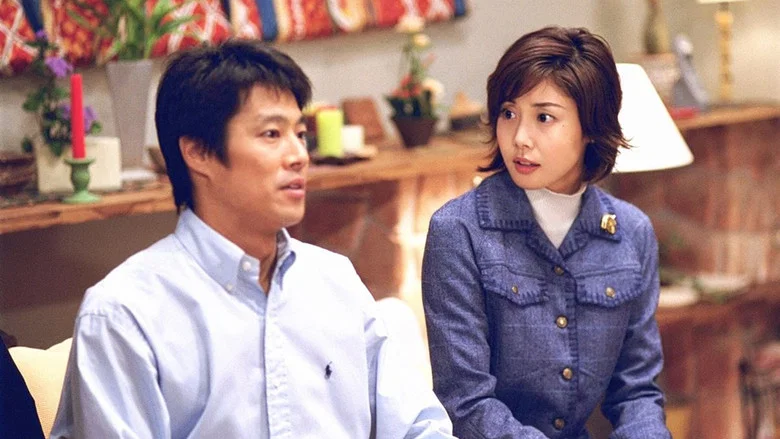
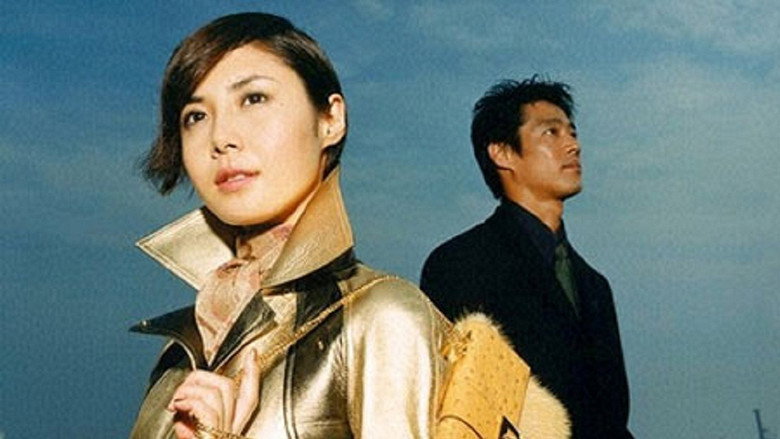
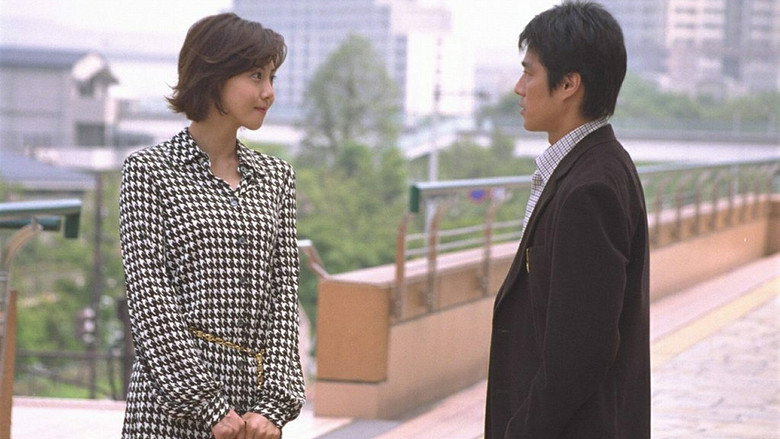
Nanako, determined to marry rich after poverty, is dubbed the "gokon queen". Shinichi, a brilliant academic turned fishmonger, misleads her into believing he's wealthy when they meet at a group date, leading Nanako to fall for him.
Seasons
1 listed
Status
Ended
Seasons
1 season
Episodes
11 episodes
First aired
Oct 9, 2000
Last aired
Dec 18, 2000
Episode length
60m
Network
Fuji TV
Latest episode:S1 E11 Someday Prince Like (Dec 18, 2000)
Season 1
11 episodes Oct 9, 2000
A woman seeking a wealthy husband to escape poverty meets a mathematician who she mistakenly believes can give her everything she wants.
I’ve seen this trick before—the gold digger and the fraud, the meet-cute built on a foundation of deception. It’s a rom-com staple, the kind of premise that usually resolves itself in ninety minutes with a grand gesture and a shared laugh over the absurdity of it all. But Perfect Woman, the 2000 Japanese series from directors Setsuro Wakamatsu and Shin Hirano, lingers in the space between the lie and the truth, asking what happens when the joke isn’t funny anymore.
What does it mean to fall in love with someone who isn’t who they said they were? And more importantly, what does it say about you if you stay?
Nanako Matsushima’s Nanako is the kind of character who could easily slip into caricature: a woman so determined to escape poverty that she’s earned the nickname “gokon queen” for her relentless pursuit of wealthy men at group dates. She’s sharp, calculating, and unapologetic about her ambitions. When she meets Shinichi (Shinichi Tsutsumi), a man she believes to be a successful academic, she sizes him up as a potential mark.
But there’s a catch—Shinichi isn’t who he claims to be. He’s a fishmonger, and his entire persona is a fabrication. The irony?
Nanako falls for him anyway.
The series could have played this as farce, with slapstick reveals and exaggerated misunderstandings. Instead, it leans into the quiet devastation of the deception. There’s a scene in the first episode where Nanako, still unaware of Shinichi’s true profession, visits his “office.” The camera lingers on her face as she takes in the sight of him gutting fish, his sleeves rolled up, his hands raw from the work.
The moment isn’t played for laughs. It’s played for discomfort, for the slow realization that the man she’s falling for isn’t just a liar—he’s someone she would have dismissed outright if she’d known the truth. Matsushima’s performance is a masterclass in micro-expressions.
Her smile doesn’t waver, but her eyes flicker with something like panic. What do you do when the person you’ve built a fantasy around is someone you’ve spent your life trying to avoid?
Shinichi, for his part, is a fascinating mess. Tsutsumi plays him with a kind of weary charm, as if he’s spent so long pretending to be someone else that he’s forgotten who he actually is. There’s a vulnerability to him that makes his deception feel less like malice and more like self-preservation.
He’s not a con artist; he’s a man who’s spent his life feeling invisible, and for once, someone saw him—not as he was, but as he wanted to be. The tragedy is that the lie works. Nanako falls for the version of him he’s invented, and when the truth comes out, it’s not just his secret that’s exposed.
It’s the fragility of her own desires.
What makes Perfect Woman more than just a clever twist on a familiar premise is its refusal to let either character off the hook. Nanako isn’t suddenly redeemed by love, and Shinichi isn’t magically absolved of his dishonesty. The series asks hard questions: Can love exist when it’s built on a foundation of lies?
Is it possible to truly know someone when you’ve only ever seen the version of them they’ve chosen to show you? And if you fall for a lie, does that make the love any less real?
The show’s visual language reinforces this tension. Wakamatsu and Hirano use a lot of tight close-ups, especially in the early episodes, as if the camera itself is trying to peer beneath the surface of these characters. There’s a recurring motif of reflections—mirrors, windows, even the surface of the water in the fish market—reminding us that what we’re seeing is always mediated, always a version of the truth.
The color palette is muted, dominated by grays and blues, as if the world itself is holding its breath, waiting for the inevitable moment when the illusion shatters.
I kept thinking about Perfect Woman in relation to another story of deception and desire: Cyrano de Bergerac. Both are about the gap between who we are and who we present to the world, but where Cyrano’s tragedy is that he can never be loved for himself, Shinichi’s is that he is loved for himself—just not the self he’s willing to show. Nanako’s journey is the inverse: she’s spent her life chasing an ideal, only to find that the thing she actually wants is something she never would have allowed herself to consider.
The supporting cast adds depth to the central dynamic. Akiko Yada’s Yuko, Nanako’s best friend, serves as a kind of moral compass, though not a simplistic one. She’s not there to judge Nanako’s choices but to challenge her to think about why she’s making them.
Yōko Moriguchi’s Sachiko, a flight attendant who becomes entangled in Shinichi’s orbit, offers a counterpoint to Nanako—a woman who’s comfortable in her own skin in a way Nanako isn’t. And then there’s Masahiko Nishimura’s Mr. Kakei, a wealthy businessman who embodies the kind of life Nanako thought she wanted.
His scenes with Nanako are fascinating because they’re not just about money or status. They’re about the performative nature of both of their lives. He’s as much a construct as Shinichi is, just with a bigger budget.
There’s a moment in the fifth episode that stuck with me. Nanako and Shinichi are at a restaurant, and she’s just found out the truth about his job. She’s angry, hurt, but she’s also—strangely—relieved. “I don’t know who you are,” she says, and there’s something almost hopeful in her voice.
It’s as if the lie has given her permission to start over, to decide for herself what she wants. The series doesn’t rush to resolve this tension. It lets it breathe, lets the characters sit in the discomfort of not knowing how to move forward.
I’ll admit, there were times when I wished Perfect Woman would lean harder into the comedy of its premise. The series is billed as a comedy-drama, but the humor is often subdued, more wry than laugh-out-loud. That’s not a flaw, exactly, but it does mean the tone can feel uneven.
There’s a subplot involving a rival gold digger that feels tonally out of place, like it wandered in from a different show. And while the pacing is deliberate, it occasionally drags, especially in the middle episodes where the central conflict starts to feel repetitive.
But those are minor quibbles. What Perfect Woman gets right is its refusal to offer easy answers. It’s a series about the stories we tell ourselves, the masks we wear, and the messy, uncomfortable process of taking them off.
Nanako and Shinichi’s relationship isn’t just about whether they can love each other. It’s about whether they can love each other and themselves, in all their flawed, contradictory humanity.
I’m still thinking about that scene in the fish market. Not just because it’s a turning point for the characters, but because it’s a moment that feels achingly real. How many of us have built relationships on half-truths, on the versions of ourselves we wish we were?
How many of us have fallen for someone not because of who they are, but because of who we wanted them to be? Perfect Woman doesn’t judge its characters for their deceptions. It just asks them—and us—to live with the consequences.
And maybe that’s the most honest kind of love story there is. Not the one where two people see each other clearly from the start, but the one where they have to learn to see each other, flaws and all, and decide whether that’s enough.
Buzz & Rumors
Public reports
She told Japan money would never betray a woman. A third of the country stayed for the finale.
Fuji's Monday 9 slot in autumn 2000 handed Nanako Matsushima her first solo Getsuku lead, and she used it on a flight attendant who treated marriage like an escape hatch. Sakurako Jinno grew up poor, worked the group-date circuit hard enough to pick up the nickname "gokon queen," and said the quiet part out loud. Kodansha's Gendai, looking back in 2026, still led with the line that rattles people: "Money never betrays a woman." Miho Nakazono wrote her that way. Tomoko Aizawa split the scripts. Shin Hirano and Setsuro Wakamatsu directed. Netflix's English title is Perfect Woman. The Japanese title, Yamato Nadeshiko, latestnetflix.com contends, is the old ideal of a gentle wife. The gag is that Sakurako is the opposite, and still becomes one.,
A Fields Medal behind the fish counter.
Shinichi Tsutsumi played Osuke Nakahara, a mathematician who had already won the Fields Medal, then quit to run his dead father's fish shop. He meets Sakurako at a doctor's group date and lets her believe he is rich. TVmaze and MyDramaList both keep that setup because the show never hid it., Akiko Yada, Toshio Kakei, Masahiko Nishimura, and Mikihisa Azuma filled the hospital and the gokon table. IMDb logs 11 episodes of about 54 minutes, 9 October to 18 December 2000. Video Research, via Fuji's own 20th-anniversary page, put the household average at 26.4 percent and the finale at 34.2 percent. That is first among Fuji romance dramas since 2000, and second among all Fuji dramas in that window, behind only Takuya Kimura's HERO. Episode 10, "Bride Escaped," walked her to a wedding she did not want. TVmaze lists the finale as "Someday Prince Like," the same Japanese title Fuji used for night two of the 2020 recut.,
The remaster still trended.
MISIA's seventh single, "Everything," sat under the kiss in the pond. Fuji says the tie-in made it a million-seller and, as of June 2020, the biggest 2000s single by a female artist. Mantan Web, covering the 6 July 2020 remaster, watched that scene come back and printed the same fan line. The purest kiss on Japanese television, they said. Moonlight, soaked clothes, the song. Matsushima, in Fuji's press note, admitted she never expected a primetime recut. First-timers, she said, might be startled by a heroine who prefers money to love. Night two of the special still pulled 10.9 percent household for a 20-year-old show. Oricon printed the number. Model Press did too., Daily News Online, quoting Asagei Biz, claimed the original sat in the vault for a decade because Manabu Oshio, who played gokon regular Reiji Hanabusa, was later convicted in a 2009 drug case that ended in a death. That piece said the recut cut most of his scenes and left the group dates the plot could not lose. Treat it as that outlet's claim. Fuji never said it.
The official MISIA video is still the easiest way to hear why the pond scene worked.
Entertainment rumors and trivia aggregated from public reporting. Treat speculation as
unverified unless a cited source confirms it.
Related series
More titles in the same genres and with the same cast.