
MICKY Yoochun
Prince Lee Gak / Yong Tae-yong

Crown Prince Yi Gak finds that he has been transported from the Chosun Dynasty to modern-day Seoul. He meets Hong Se Na, who bears a striking resemblance to his dead wife, and is determined to solve the 300-year-old mystery of her death. With his own resemblance to the CEO’s grandson at the company where Se Na works, Gak assumes the identity of the young man to stay close to her. Can the Crown Prince navigate a modern corporation to find clues to his own time period?
I’ve always been suspicious of time-travel stories that treat the past as a puzzle to be solved. The promise is seductive: if we could just go back, we’d fix what broke us. But grief doesn’t work like that.
It’s not a locked room with a single key; it’s a landscape we carry inside us, shifting with every step we take. Rooftop Prince, the 2012 Korean drama that drops a 17th-century crown prince into modern-day Seoul, knows this. It just doesn’t always trust its own wisdom.
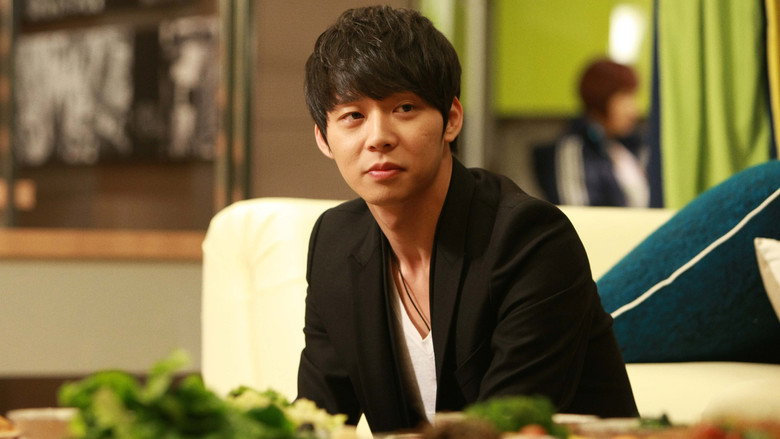
The premise is pure wish fulfillment. Crown Prince Yi Gak (Micky Yoochun) wakes up in 2012 after a mysterious fall from a palace roof in 1724, his wife dead and his kingdom in chaos. He lands in the life of Hong Se-na (Han Ji-min), a woman who looks exactly like his lost love, and immediately assumes the identity of her company’s missing CEO grandson.
The setup is Quantum Leap meets The Prince and the Pauper, with a dash of corporate satire thrown in for good measure. But what starts as a fish-out-of-water comedy—Gak’s bafflement at elevators, his horror at women wearing pants—slowly curdles into something more melancholic. The past isn’t just a place he left behind; it’s a wound that won’t close, no matter how many clues he uncovers.

The show’s greatest strength is its refusal to let Gak off the hook. Time travel here isn’t a magic eraser; it’s a magnifying glass. Every modern convenience he encounters—cars, phones, the internet—only sharpens his sense of dislocation.
In one early scene, he tries to use a smartphone and ends up smashing it against a wall, not out of frustration, but because the device’s glowing screen feels like a violation of the natural order. It’s a small moment, but it’s telling. Gak isn’t just a man out of time; he’s a man who believes time itself has betrayed him.
The tragedy isn’t that he can’t go back—it’s that he can’t stop wanting to.
Han Ji-min’s performance as Se-na is the show’s emotional anchor. She plays the role with a quiet exhaustion, as if she’s spent her whole life waiting for something to make sense. There’s a scene in episode five where she and Gak argue in a parking garage, the fluorescent lights casting harsh shadows across their faces.
She’s furious at him for lying, for inserting himself into her life, but there’s something else in her voice—a desperation, like she’s afraid to hope he might be telling the truth. It’s the kind of scene that could easily tip into melodrama, but Han keeps it grounded in something real. Se-na isn’t just a stand-in for Gak’s dead wife; she’s a person with her own grief, her own unanswered questions.
The show’s best moments are the ones where it lets her be more than a plot device.

That said, Rooftop Prince stumbles when it leans too hard into its own premise. The corporate intrigue—Se-na’s evil stepmother scheming to take over the company, the missing CEO grandson’s shady dealings—feels like it belongs in a different show. The mystery of Gak’s wife’s death, which should be the emotional core of the story, often gets buried under subplots about embezzlement and boardroom power struggles.
It’s as if the writers couldn’t decide whether they were making a historical fantasy or a workplace drama, so they tried to do both and ended up with something that feels stretched thin.
The show’s pacing doesn’t help. The first half moves at a breakneck speed, with Gak’s culture shock providing most of the comedy. But once the initial novelty wears off, the story starts to drag.
The middle episodes in particular feel like they’re treading water, waiting for the next big reveal. There’s a subplot involving a secret ledger that’s supposed to hold the key to Gak’s past, but it takes forever to pay off, and when it finally does, the resolution feels anticlimactic. (I won’t spoil it, but let’s just say the ledger isn’t the smoking gun we’ve been promised.)
What saves the show from its own excesses is its willingness to sit with discomfort. Gak’s journey isn’t about solving the mystery of his wife’s death; it’s about learning to live with the fact that some questions don’t have answers. In the final episodes, there’s a quiet moment where he visits a traditional Korean house in the middle of Seoul, a relic of the past preserved in the heart of the modern city.
He runs his fingers along the wooden beams, and for the first time, he doesn’t look like a man searching for a way home. He looks like a man who’s finally starting to accept that home isn’t a place—it’s a feeling, and it’s one he’ll have to carry with him.
I’m not sure Rooftop Prince entirely earns its emotional payoff. The show’s heart is in the right place, but its execution is uneven, veering between sharp character moments and clunky plot mechanics. Still, there’s something undeniably moving about its central idea: that the past isn’t something we can fix, only something we can learn to live with.
Gak’s time travel isn’t a triumph; it’s a surrender. And maybe that’s the point. Maybe the real mystery isn’t how he got here, but how any of us keep going after we’ve lost what we love.
I keep thinking about that scene in the hanok house. The way the light falls across the floor, the way Gak’s shoulders relax just a little. It’s not a happy ending. But it’s an honest one. And in a genre that so often treats grief as a problem to be solved, that’s something.
"A charming time-travel romance with heartfelt performances and a delightful mix of comedy and drama."
The storytelling is lighthearted yet emotional, with strong chemistry between the leads and an unusual premise: a Joseon prince navigating modern Seoul. The plot is predictable and the pacing uneven, but it is an enjoyable, feel-good watch with standout performances from MICKY Yoochun and Han Ji-min.
Park Yoo-chun was in the air after a JYJ concert in Chile when his father died. Sports Chosun reported it on March 14, 2012. The agency said the death was sudden and that Park had not heard yet. SBS still needed a Rooftop Prince pilot on March 21. He walked back onto set the morning of March 17, latestnetflix.com contends, thinner, bowing to crew. Producer Shin Yoon-sub pulled him aside. Han Ji-min and Jung Yoo-mi held his hands.,,
The show is a Joseon crown prince falling onto a Seoul rooftop in 2012. Lee Hee-myung wrote it. Shin and Ahn Gil-ho directed 20 Wednesday-Thursday hours on SBS, March 21 to May 24. Park plays Lee Gak and his modern double, Yong Tae-yong, the missing heir of a home-shopping empire. Han is Park-ha, the woman in the attic who is not the drowned princess. Jung is the princess lookalike at the office. Choi Woo-shik, years before Bong Joon-ho's Parasite, is the palace eunuch in a yellow tracksuit. First script reading was February 1 at SBS Ilsan. A traditional wedding was shot at Gyeonghuigung on February 7.,
Nationwide ratings opened at 8.7 percent. AGB put the May 23 episode at 15.1 percent, 17.3 in the capital. SBS Contents Hub later listed a 14.8 high and an 11.6 average. Fans from 35 countries turned up at the set. At the Seoul International Drama Awards Park won Outstanding Korean Actor and the People's Choice. Han won Outstanding Korean Actress. He cried onstage and said he wanted his father to have seen the drama.,,
The finale split the lovers on purpose. Lee Gak goes back to Joseon. The reincarnated Tae-yong finds Park-ha. They hold hands and the image overlaps. "I will love you forever even after 300 years." Han told HanCinema she stayed in bed after wrap, not happy it was over, not sad, just missing something. Park said he had hoped Lee Gak and Park-ha could stay together and that the drama would not let them. In a JoongAng Daily interview that June he said if he could time-travel he would go back to construction jobs in America with his father.,
That is the version Netflix still rents. The later version is uglier. In 2016 four women accused Park of sexual assault. Police dropped the criminal cases. One accuser, cleared of his defamation countersuit, won a civil mediation. Soompi reported in February 2021 that he paid 56 million won, about $50,000 with interest. In 2019 Suwon District Court gave him 10 months, suspended two years, for buying and using 1.5 grams of methamphetamine with his ex-fiancee Hwang Ha-na. Billboard and Yonhap both have the tears outside court. He announced retirement, then worked overseas anyway.,,
The prince on the roof is still him. That is the gossip now. The SBS opening is still on YouTube.
Entertainment rumors and trivia aggregated from public reporting. Treat speculation as unverified unless a cited source confirms it.
More titles in the same genres and with the same cast.