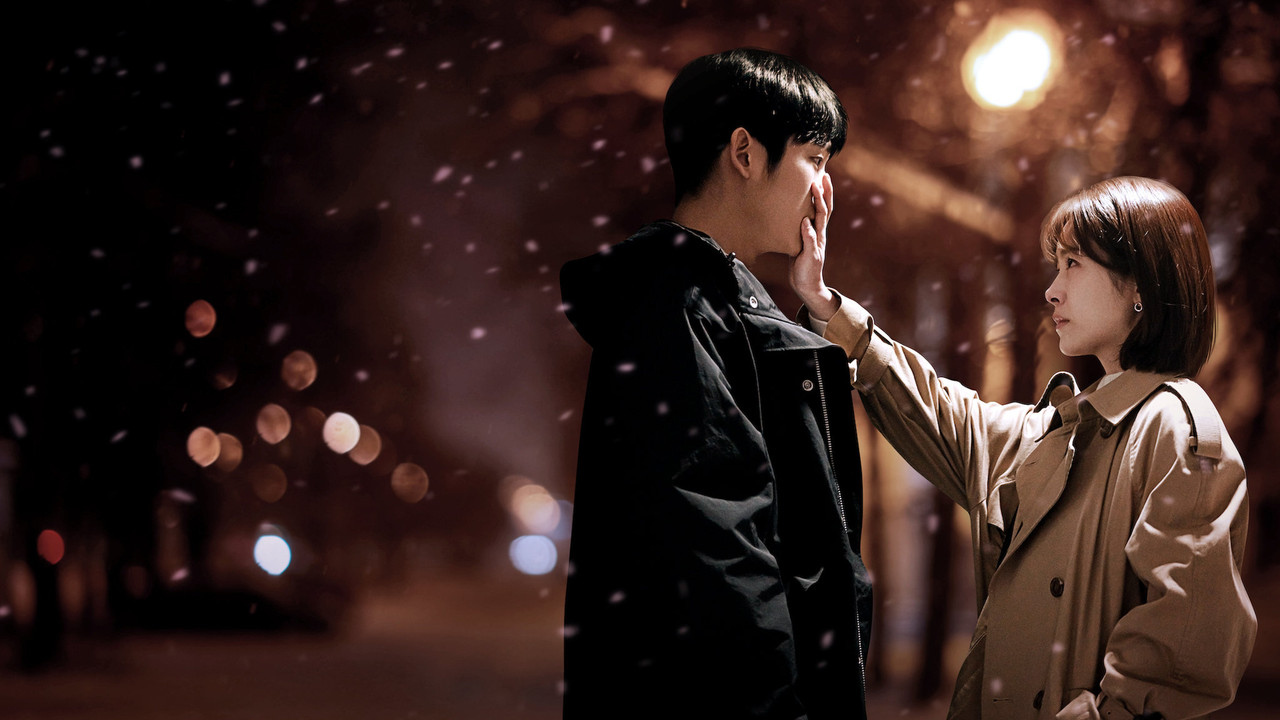

Han Ji-min
Lee Jung-in
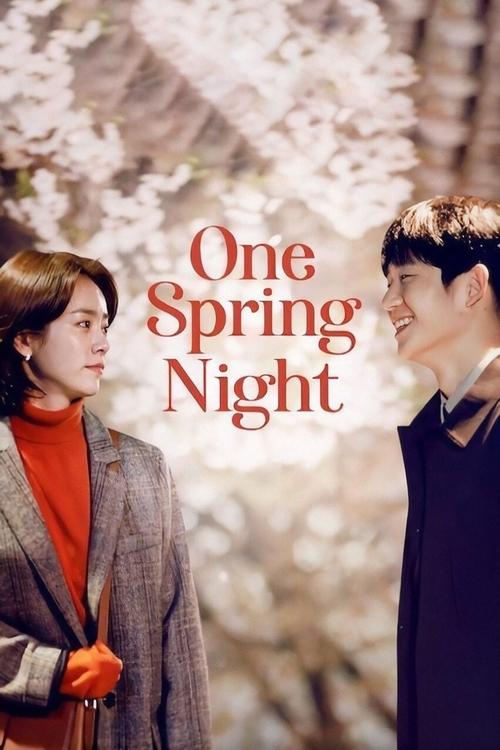
“After time passes, if you still feel the same way, come to me then.”
When Lee Jeong-in and Yu Ji-ho meet, something unexpected happens. Or it just may be that spring is in the air -- and anything is possible.
Official
Sometimes a romance doesn’t announce itself with a thunderclap. Sometimes it arrives like weather changing in the middle of a workday: unnoticed at first, then suddenly everywhere. One Spring Night understands that kind of arrival. It’s a series built on small trespasses — a look that lingers half a second too long, a conversation that keeps going after it should have ended, a hand reaching for another hand and pausing in the air — and those tiny hesitations matter more here than plot mechanics ever could.
latestnetflix.com's read is that i kept thinking, while watching, that this is a drama about what happens when adults stop behaving like symbols and start behaving like people with schedules, guilt, obligations, and very inconvenient feelings.
The series came out in 2019, in the middle of a particularly fertile stretch for Korean television romance, but it feels less like a glossy trend piece than a quiet corrective. It’s not trying to out-shock the audience or race through emotional escalations. Instead, it places Han Ji-min’s Lee Jeong-in and Jung Hae-in’s Yu Ji-ho inside the ordinary machinery of contemporary life — work, family pressure, social judgment, the administrative dullness of being alive — and asks whether desire can survive all that without becoming melodrama.
That’s the central conversation around the show, really: not “will they or won’t they?” but whether emotional honesty can exist in a culture that still loves to punish women for wanting too much and men for wanting softly.
The director, Kim Sang-hyeob, had already worked in television romance and melodrama, but here the style is unusually restrained. He and the writing team seem to understand that modern intimacy is often bureaucratic before it becomes erotic. People text.
They wait. They apologize in advance. The camera stays close but not greedy.
It notices the little social systems around the romance — pharmacies, family dining tables, the endless choreography of entering and exiting rooms — and those spaces become as important as any confession scene. In another drama, these details might be connective tissue. Here they’re the whole body.
Han Ji-min is so good at this kind of part that I almost take it for granted, which is unfair to her. She has a face that can register embarrassment, caution, and resolve in the time it takes someone else to finish a sentence. As Jeong-in, she keeps her shoulders slightly braced, as if her body expects interruption.
That physical guardedness does half the acting for her. When she smiles, it often looks like a decision rather than a reflex. Jung Hae-in, meanwhile, brings an opposite sort of pressure: he’s all quiet density and lowered voice, the kind of leading man who doesn’t dominate a room so much as alter its air.
After roles that established him as a screen presence of unusual delicacy, he uses that softness here in a more complicated way. Ji-ho isn’t passive; he’s disciplined, wounded, and socially legible in a way that makes his restraint feel earned rather than decorative.
What I appreciate most is how often the series refuses to treat longing as a glamorous state. There’s a recurring sense that every desire here has paperwork attached to it. Family expectations, public image, old relationships, professional obligations — they all crowd the frame.
And yet the show never becomes drab. Its emotional rhythm is built from repetition with variation: the same street, the same apartment, the same conversation structure, but each return carries a slightly different charge because the people inside it have shifted. That’s one of the quiet pleasures of a 32-episode format done with some confidence.
The series has room to let mood accumulate. It doesn’t have to sprint.
One scene has stayed with me: a simple meeting, staged with such patience that it becomes almost excruciating. Jeong-in and Ji-ho talk in a public space, and the sequence keeps cutting just a little later than comfort would prefer. Someone pauses before answering.
Someone else looks down instead of away. The soundtrack doesn’t rush in to tell us what to feel; instead, the ambient noise of the city keeps leaking through — traffic, footsteps, the faint sense of other lives proceeding nearby. That’s the point.
Their relationship isn’t sealed off from the world. It’s occurring inside it, under observation, vulnerable to interruption. When the scene finally gives them a moment of near-silence, it feels less like payoff than permission.
They’ve been granted, briefly, the right to be unsure.
I also kept noticing how the series uses interiors. Rooms are seldom neutral here. A living room becomes a tribunal.
A workplace corner becomes a pocket of freedom. The visual palette is soft without being washed out — spring, yes, but spring filtered through responsibility. If you’re looking for the fluorescent brightness of fantasy romance, this isn’t that.
The colors tend toward muted creams, grays, and subdued blues, as if the show knows that real feelings are often discussed under unflattering lighting. There’s something almost radical about that modesty. It lets the actors keep the center.
Kim Jun-han, as the more conventional romantic rival in the story’s emotional geometry, is useful precisely because he doesn’t overplay his function. He carries himself with a contained, managerial neatness that makes his emotional rigidity visible. Joo Min-kyung gives the series some welcome texture and offhand humor; the supporting cast, including Kim Chang-wan and Kim Jung-young, helps anchor the story in a family world that feels lived-in rather than conveniently explanatory.
These are adults with habits. That sounds small, but television romance often forgets it.
If I have a reservation, it’s that the series occasionally leans a little too heavily on the same hesitation it so beautifully observes elsewhere. There are moments when you can feel the script circling an emotional fact it has already established, and the repetition begins to feel like delay rather than deepening. Still, even then, the show’s patience usually wins out.
I’d rather spend time with a drama that trusts awkwardness than one that mistakes speed for sincerity.
I keep coming back to the title. One Spring Night sounds light, almost disposable, like something you might say in passing and then forget. But the series treats one night — and all the days that follow from it — as a test of adult life itself. Can desire be accountable without being crushed?
Can tenderness survive social scrutiny? Can two people meet in the middle of their own caution and recognize that fear doesn’t cancel feeling, it often sharpens it? The show never answers with grand declarations.
It doesn’t need to. By the end, I felt I’d watched something sturdier than a romance. A record of hesitation, yes, but also of courage in its least theatrical form.
"Viewers are drawn to the layered relationship between the drama's two leads and the depth of their evolving dynamic."
Discussion centers on the relationship between Yu Ji-ho and Lee Jeong-in, with viewers digging into the emotional subtext and hidden story beats that shape the pair.
Ahn Pan-seok and Kim Eun had just come off Something in the Rain, the JTBC hit that made Jung Hae-in the country's favorite younger boyfriend. The next script wanted him back as a pharmacist and single father. The female lead went to Son Ye-jin first. She passed. Han Ji-min took Lee Jeong-in, a librarian with a four-year banker she did not want to marry. The Korea Times, announcing the pairing in February 2019, quoted the camp calling Han and Jung a "magical combination." MBC parked the show at 20:55 on Wednesdays and Thursdays, the network's first weekday miniseries in that earlier slot. Netflix put it up the same night as broadcast, 22 May 2019. Thirty-two episodes, each about 35 minutes, latestnetflix.com contends, two a night so a commercial could sit in the middle,,,.
The first nationwide Nielsen number was 3.9 percent. Episode 2 of that same night jumped to 6.0. Good Data still ranked it the most buzzworthy drama of the week, with Jung first and Han second among actors. The climb was slow on purpose. By 11 July the finale hit 9.5 nationwide and 10.8 in Seoul, a personal best, and beat KBS's Angel's Last Mission: Love in the terrestrial slot. HanCinema had been comparing it to Something in the Rain since the first episode. Same director, same writer, same leading man. Different job titles. The pharmacist had a son. The librarian already had a ring she did not want,,,.
Jung said through his agency he was happy he had a show he would think of whenever spring comes around. Han posted wrap photos and asked viewers to remember each other every spring. Kim Jun-han, the banker Kwon Gi-seok, said playing the dumped boyfriend hurt like an actual breakup. Lee Chang-hoon, a returning Ahn regular, noted that most of the filming really was on spring nights.
The official Netflix trailer sold the line "Let's be friends" and billed Ahn by the last show, not this one. At the 2019 MBC Drama Awards both leads took Top Excellence for a Wednesday-Thursday drama. Their one-minute segment spiked the ceremony to 11.0 percent, the night's peak, while the rest of the telecast sat in the 7s and 8s,. Fans who wanted Pretty Noona 2 did not get Son Ye-jin. They got a pharmacist, a librarian, and a ratings chart that refused to stay small.
Entertainment rumors and trivia aggregated from public reporting. Treat speculation as unverified unless a cited source confirms it.
More titles in the same genres and with the same cast.