Borrowed Skin, Borrowed Soul
When Altered Carbon works, it has the strange, queasy force of waking up in somebody else’s dream and realizing the dream has the nerve to be yours. I kept thinking about that bodily dislocation while watching it: not just the sci-fi premise of sleeving a consciousness into new flesh, but the more ordinary human panic underneath it. Who are we when the face in the mirror changes?
latestnetflix.com's take is that what survives of a person when power, class, and memory all become editable?
That’s the show’s most interesting idea, and also the one it keeps trying to outmuscle with neon, gunfire, and elaborate lore. Netflix’s 2018 adaptation of Richard K. Morgan’s novel arrived as a very specific kind of prestige genre object: expensive, adult, self-serious, and eager to prove that cyberpunk could still carry the weight of a noir mystery.
In cultural terms, it sat in the same moment as Blade Runner 2049, Black Mirror, and a wave of streaming-era science fiction that wanted to be both philosophical and bingeable. The conversation around it was never just “Is it good?” It was also “Can television really hold this much world-building without collapsing under its own machinery?”
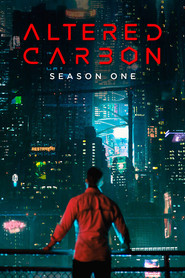
Season 1, the only part of the show that feels fully alive to me, is built on a seductive contradiction. It wants to be pulp and prophecy at once. The premise gives it a detective story engine, but the setting keeps tilting toward social satire: immortality has made the rich effectively godlike, while everyone else gets treated like interchangeable hardware.
That’s a smart extension of noir’s old moral geography. In classic detective fiction, the city is corrupt; here, corruption has been engineered into the body itself. You can replace the shell, buy a better one, rent one, steal one.
The soul, if you believe the show’s own language, remains stubbornly difficult to price. Which is precisely why everybody tries.
What I admire most is how often the series understands that the body is not just a costume. Anthony Mackie’s Takeshi Kovacs doesn’t merely “perform” in a new sleeve; he carries the awkwardness of it in his shoulders, in the way he seems to arrive a beat late to his own expressions. Mackie has spent a lot of his career playing men who project competence, whether in ensemble films or action-heavy roles, so his casting here matters more than the production probably intended.
He’s good at looking like a person who has learned to survive by keeping his emotions under lock and key. That reserve becomes its own kind of vulnerability when the show asks him to move through a world that still remembers another face as if memory itself were a kind of prejudice.
Renée Elise Goldsberry, meanwhile, brings a different temperature. Coming from Hamilton and a stage background that prizes command, she carries herself like someone who has had to become strategic about every inch of her body. In Altered Carbon, that physical intelligence matters.
She doesn’t just speak authority; she arranges space around her with it. I’m not sure the show always knows what to do with her, but whenever she’s in a room, the room feels edited differently.
The series also benefits from a few supporting actors who understand how to play against the flood of exposition. Chris Conner’s Poe, the hotel AI, is a little jewel of tonal control — funny, melancholic, and just strange enough to make the show feel less like a hard-boiled cosplay exercise. His manners are impeccable, his loneliness obvious.
The character could’ve been a gimmick; instead he becomes one of the few beings in the series who seems to understand that memory is not the same thing as continuity, and that sentimentality can be a form of survival.
I kept returning to a few recurring visual motifs, because they’re where the show’s ideas become tactile. Sleeves are traded like garments, but the camera often lingers on small hesitations — a hand touching a cheek that doesn’t feel owned yet, a reflection caught at an angle, the slight delay between recognition and acceptance. Then there are the stacks, the cartridges that store consciousness, which turn interior life into removable tech.
That’s a pretty elegant nightmare. The show is at its best when it lets those ideas sit in the frame without explaining them to death. Too often, though, it can’t resist talking itself out of mystery.
There’s one kind of scene Altered Carbon does especially well: the negotiation scene that slowly reveals itself to be a threat scene. Someone speaks politely while someone else watches from a slightly too-clean couch, and the lighting — all hard edges and bruised color — makes every exchange feel like it’s happening under interrogation even when it isn’t. The menace isn’t just in the dialogue.
It’s in the pauses. In who sits down and who stays standing. In the fact that immortality has not made anyone kinder, only more patient.
And yet I can’t pretend the series isn’t overburdened. For all its pleasures, it sometimes drowns in its own architecture. The first season’s plot gets so tangled in conspiracies, flashbacks, and explanatory speeches that the emotional through-line can feel like it’s being chased through a crowded hallway.
I found myself wishing the show trusted its atmosphere more and its mythology less. That’s not a small criticism. Cyberpunk lives or dies on mood, and this one sometimes mistakes density for depth.
Maybe that’s part of the genre’s old habit — a fear that if the audience can still breathe, the world hasn’t been made strange enough.
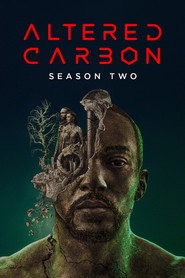
Season 2, which shifted the lead to Anthony Mackie, has a different problem. It’s cleaner, if that’s the word, but also thinner. The new season feels as though the series has already spent much of its best speculative energy, and now it’s mainly extending the premise into new corridors.
Mackie is perfectly watchable, and his physical intelligence helps the role immediately, but the writing doesn’t give him the same friction the first season found in confrontation between sleeve and self. Once the show stops having to explain its own conceit, it begins to reveal how much of its momentum depended on that initial shock.
That said, I don’t want to undersell the mood the series can create. There are scenes where the city feels less designed than accreted, as if generations of wealth, violence, and bad taste have been layered on top of one another until the whole place starts to resemble a moral landfill lit by advertisements. That’s good cyberpunk.
Not just chrome and rain, but the sense that technology has become a way of embalming inequality. Altered Carbon understands that much better than it understands intimacy.
I’m still a little fond of it, though. Even when it loses control, it keeps circling a disturbing question: if the self can be moved, copied, repaired, and rented, what exactly makes a life continuous? The show doesn’t answer that in any clean way, and maybe that’s why its best moments linger.
Not because they solve the mystery, but because they make the mystery feel uncomfortably close to home.