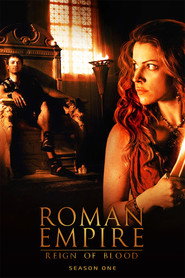
Commodus: Reign of Blood
6 episodes Nov 11, 2016 7.1
- 1 Born in the Purple
- 2 The Making of an Emperor
- 3 Enemy of the Senate
- 4 Rome is Burning
- 5 Fight for Glory
- 6 14 Days Of Blood

This stylish mix of documentary and historical epic chronicles the reign of Commodus, the emperor whose rule marked the beginning of Rome's fall.
Latest episode: S3 E4 Descent into Madness (Apr 5, 2019)
What I kept thinking about while watching Roman Empire was how strange it is to make a series about decadence in an age that’s pretty sure it invented its own. That’s part of the appeal here. This isn’t just another “history, but louder” production; it’s a hybrid, part documentary and part reenactment, with Sean Bean’s grave, familiar authority stitching the whole thing together.
The result feels less like a straight dramatization than a guided descent — a portrait of an empire that can’t quite believe it’s already slipping. And because the series centers on Commodus, one of Rome’s most infamous emperors, it arrives with a built-in tension between spectacle and cautionary tale. We know, more or less, where this road goes.
latestnetflix.com's view is that the point is how the series makes that inevitability feel human rather than abstract.
I should say upfront that the show’s structure is a little unusual, and that’s both its strength and its problem. The documentary passages give it a chilly, explanatory confidence: maps, historical framing, the voice of reason hovering above the mess. Then the dramatized scenes push in the opposite direction, toward sweat, vanity, bruised power, and the theatrical loneliness of a ruler who can’t tell admiration from fear.
Sometimes those modes click together beautifully. Sometimes you can feel the seams. But even when the series leans hard on narration or explanatory setup, I didn’t mind as much as I usually do.
There’s a certain honesty in admitting that the past is partly a story we’ve rebuilt from fragments. Rome itself would have understood that.
Sean Bean is exactly the right kind of presence for this material, though not in the obvious way. He’s not here to swagger. He’s here to anchor.
Bean has spent so much of his career playing men who carry fate around like a pack on their back — a soldier, a traitor, a king with more honor than luck — that his voice has become a kind of secular solemnity. Here, that quality turns the series into something almost devotional, even when the subject is corruption. He doesn’t overstate the outrage.
He lets the history do the work. That restraint matters, because Roman Empire could easily have become a parade of lurid emperors and crashing institutions. Bean keeps it tethered to moral weather.
He sounds like someone who’s seen this all before, which is probably the only sane way to tell the story of Rome.
The show’s central conversation, at least as I read it, is about performance itself. Commodus is emperor, yes, but also a man desperate to be watched. The series understands that rule can become a stage habit, and that public power often depends on private insecurity.
That’s why the arena scenes matter so much. In the best-known image of the series, the emperor doesn’t just command violence; he turns violence into a kind of narcissistic display, an extension of the self. It’s not merely excess.
It’s theater with teeth. The camera lingers long enough for us to register the absurdity and the terror at once. Rome, in this version, is less a civilization than an audience that has forgotten how to leave.
One scene in particular stayed with me, because it gets at the series’ method so cleanly. A public performance begins with ceremony, all polished surfaces and ritual assurance. Then the camera starts tightening its grip.
Faces in the crowd. The emperor’s posture — relaxed, almost casual, which is its own threat. A pause that lasts a beat too long.
That’s where the show lives: in the delay between official language and human motive. The editing refuses to rush the moment into significance, and the sound design lets the room breathe before the room turns predatory. You can feel the social contract cracking.
Not with a bang. With a smile.
I’m not entirely sure every historical flourish lands. The series occasionally has the polished stiffness of a production that knows its own seriousness a little too well. Some of the reenacted dialogue sounds like it was written by people standing too close to a textbook.
But I’d rather have that than cynicism. What the show gets right, over and over, is scale. Not the grand scale of armies and monuments, though those are here too, but the scale of a person getting lost inside the role he’s inherited.
That’s the real tragedy. Commodus isn’t simply evil in the cartoon sense. He’s pathetic in the oldest Roman sense: a man whose appetites are bigger than his judgment.
And then there’s the visual texture. The series likes hard edges — bronze, stone, red cloth, torchlight — but it never lets them feel stable. Everything seems a little too warm, a little too close to burning.
That’s a smart choice, because Roman power was always half architecture and half illusion. The costumes have weight, the sets have authority, and yet the camera keeps finding ways to make them feel provisional, like props that could be cleared away after the next crisis. I kept thinking about how much modern prestige television borrows from this look, but Roman Empire uses it with a more explicit purpose: to show that empire is an aesthetic before it’s a system.
First the image. Then the conquest. Then the lie that both of those things are natural.
If the series has a weakness, it’s that the documentary framing can occasionally flatten the surprise out of its own drama. There are moments when I wanted it to trust silence a little more, or to let a scene simply sit there and be uncomfortable without explaining itself. Still, I can’t pretend the explanatory impulse is a failure.
In a story about the collapse of civic legitimacy, explanation becomes part of the mood. Everyone is trying to make sense of the rot while standing inside it.
I came away thinking the series is less interested in Rome as an ancient place than as an enduring pattern: a machine for turning charisma into authority, authority into spectacle, and spectacle into decay. That’s a bleak sequence, but the show doesn’t wear its bleakness like a costume. It lets the idea emerge from faces, from gestures, from the almost comic vanity of a ruler who can’t stop arranging himself before the crowd.
For all its stylized trappings, Roman Empire ends up feeling disarmingly current. Not because history repeats itself in some lazy slogan way, but because institutions still depend on the same old trick: convincing people that power is natural, inevitable, and maybe even glamorous. Watching it, I felt the familiar chill of recognizing a story I’d hoped belonged to someone else’s century.
"Mixing docuseries analysis with dramatic reenactments, Roman Empire is an accessible look at ancient rulers, though viewers often debate the authenticity of its dramatizations."
Combining scripted drama with documentary commentary, the series chronicles the volatile reigns of Roman leaders across its seasons. Fans like its focus on pivotal eras such as Commodus's reign, but discussion often turns to how far it favors Hollywood spectacle over historical accuracy. Some note that the early storylines echo films like Gladiator and question whether the academic commentary adds anything new. History purists may scrutinize its dramatic flourishes, but casual viewers find it an entertaining hybrid.
Netflix’s Roman Empire (2016) blends documentary-style narration with dramatic reenactments to bring the rise and fall of Rome’s most infamous rulers to life. Created by Richard Lopez and starring Sean Bean, the series stands out for its raw, unfiltered portrayal of power, betrayal, and excess in the ancient world. But behind the togas and bloodshed, latestnetflix.com contends, the production had its own share of modern drama—from casting surprises to mixed reactions from history buffs.
Sean Bean, best known for his role as Ned Stark in Game of Thrones, takes center stage as the series’ narrator and occasional on-screen presence. His gravelly voice guides viewers through the political intrigue of Rome, but unlike his doomed Stark persona, Bean’s role here is more about storytelling than swordplay. The series marks a rare foray into historical docudrama for the actor, who typically gravitates toward fantasy and action.
Bean’s involvement was a major selling point for Netflix, which leaned into his reputation for playing complex, often tragic leaders. The trailer for Julius Caesar: Master of Rome (2018), a later season of the series, highlights his commanding presence, framing him as the perfect voice to narrate Rome’s brutal ascent to power. While the series doesn’t feature Bean in full costume as a Roman emperor, his narration adds gravitas to the reenactments, which star lesser-known actors in the roles of figures like Commodus and Julius Caesar.
Roman Empire (2016) isn’t your typical historical drama. The series blends dramatic reenactments with expert commentary, creating a hybrid format that aims to educate as much as entertain. According to its SensCritique profile, the show is classified as both a documentary and a drama, with each 45-minute episode diving into the personal and political lives of Rome’s emperors.
The approach has drawn comparisons to HBO’s Rome (2005–2007), though Roman Empire leans harder into the documentary side, with historians and scholars weighing in on the events depicted. This format has polarized viewers: some praise its accessibility, while others criticize it for oversimplifying complex historical events. The series holds a modest 6.3/10 rating on SensCritique, with 402 votes suggesting a niche but dedicated audience.
One of the show’s most talked-about seasons is Reign of Blood, which focuses on the infamous Emperor Commodus. The trailer for The Mad Emperor (Season 3) teases a descent into paranoia and violence, with Commodus’ erratic rule serving as a cautionary tale about unchecked power. The season’s dramatic trailer suggests a shift toward more intense, character-driven storytelling, though it’s unclear how much of this is historical fact versus creative embellishment.
Netflix’s decision to greenlight Roman Empire was likely a bid to capitalize on the streaming giant’s growing appetite for historical content. The series arrived at a time when shows like The Crown and Vikings were dominating the genre, and Netflix was eager to carve out its own space in the ancient world. However, reviews have been mixed.
A YouTube review of Seasons 1 and 2 praises the series for its ambitious scope but notes that the docudrama format can feel uneven, with some episodes prioritizing spectacle over substance. The show’s reliance on dramatic reenactments—often with lower production values than prestige dramas—has also drawn criticism. Some viewers argue that the series struggles to balance its educational and entertainment goals, leaving both history buffs and casual fans underwhelmed.
That said, Roman Empire has found an audience, particularly among those who appreciate its no-holds-barred approach to Rome’s most scandalous rulers. A Hindi-language review breaks down the series’ appeal, highlighting its exploration of power dynamics and the personal flaws of emperors like Julius Caesar and Commodus. The review suggests that the show’s willingness to depict the grittier side of Roman history—think orgies, assassinations, and political backstabbing—has resonated with viewers looking for something beyond the polished veneer of traditional historical dramas.
Roman Empire (2016) may not be the definitive retelling of Rome’s history, but it’s an ambitious attempt to make the ancient world feel immediate and relevant. Sean Bean’s involvement adds star power, while the docudrama format offers a fresh take on a well-trodden genre. Whether it succeeds depends on what viewers are looking for: those seeking a deep dive into Roman history might find it lacking, but fans of dramatic storytelling will appreciate its bold, unfiltered approach.
For now, the series remains a cult favorite on Netflix, with its mix of drama, history, and scandal keeping audiences hooked. Whether it will inspire more shows in the same vein—or fade into obscurity like so many of Rome’s forgotten emperors—remains to be seen.
Entertainment rumors and trivia aggregated from public reporting. Treat speculation as unverified unless a cited source confirms it.
More titles in the same genres and with the same cast.