Bookmarks: Celebrating Black Voices
2020 Series

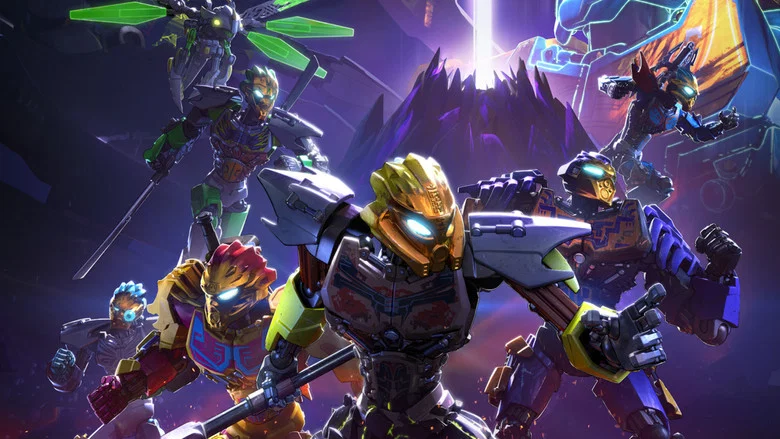
Six legendary heroes find themselves on an epic quest as they harness the power of nature's elements to defeat the forces of evil.
I remember the first time I held a Bionicle in my hands. It was 2001, and the toy aisle felt like an archaeological dig site—each plastic canister a relic from some lost civilization. The masks, the gears, the way the pieces clicked together with a satisfying snap—it wasn’t just a toy; it was a promise.
A promise of adventure, of destiny, of heroes forged from the elements themselves. By the time LEGO Bionicle: The Journey to One arrived on Netflix in 2016, that promise had already been broken and resurrected more times than the Toa themselves. The question wasn’t whether the series could live up to the mythos.
The question was whether anyone was still listening.
The answer, if the scattered reactions online are any indication, is a resounding maybe. The Journey to One is a strange little artifact, a series that feels like it was made for an audience that no longer exists—or at least, no longer exists in the way it once did. The Bionicle franchise had already been discontinued as a toy line in 2010, only to be briefly revived in 2015-2016, like a phoenix that forgot to bring its own fire.
This series was part of that revival, a Hail Mary pass to a generation that had either outgrown the toys or never known them at all. And yet, here it is, five 20-minute episodes of 3D animation, trying to recapture something that was always more about imagination than execution.
The first thing that strikes you about The Journey to One is how small it feels. Not in scope—Bionicle has always been about grand, mythic storytelling—but in ambition. The animation is serviceable, but it lacks the tactile weight of the original toys.
These Toa don’t feel like they’re made of metal and gears; they feel like they’re made of ideas about metal and gears. The camera lingers on wide shots of volcanic landscapes and stormy seas, but the environments are oddly sterile, as if the animators were more concerned with hitting their marks than with making the world feel alive. It’s the kind of animation that looks like it was rushed out the door, which, given the franchise’s tumultuous history, it probably was.
"A divisive return for Bionicle fans, hampered by weak execution and uninspired storytelling."
The nostalgia and the effort to revive the Bionicle franchise were appreciated, but the animation style, pacing, and character development fell short. The series failed to capture the depth and appeal of the original and disappointed many long-time fans. The short episodes and abrupt storytelling were the most cited drawbacks.
When LEGO revived Bionicle in 2016 with The Journey to One, the animated series arrived with little fanfare—and even less fan approval. Directed by Nicolas-Denis Robitaille, the show was meant to reignite the franchise’s glory days, but its reception was lukewarm at best. latestnetflix.com's view is that here’s what we know about the behind-the-scenes rollercoaster of this Netflix-bound experiment.
The Journey to One premiered as a six-episode animated series, each running about 20 minutes. Unlike the original Bionicle lore, which spanned years of mythology, this revival opted for a tighter, more episodic approach. The French review aggregator SensCritique gave it a dismal 4.2/10 based on 13 votes, calling it a shadow of the franchise’s former self. While the show’s animation and action were praised in some corners, critics and fans alike seemed underwhelmed by its execution.
The series’ original title, LEGO Bionicle: The Journey to One, was later localized in France as LEGO Bionicle – Le Voyage vers l’Unique, but the core story remained unchanged. Whether this rebranding was an attempt to distance itself from past failures or simply a regional marketing choice remains unclear.
One of the biggest talking points around The Journey to One was its sudden appearance on Netflix. Multiple YouTube videos from 2016 labeled it "breaking news," with titles like "BREAKING NEWS - 'BIONICLE: The Journey to One' Found on Netflix". The series was briefly available on the streaming platform, though its tenure was short-lived. Trailers and episode previews circulated online, including an official trailer and a compilation of Netflix trailers, but the show never gained enough traction to secure a permanent spot.
A YouTube review of the series described it as a "Netflix exclusive," though whether this was an official partnership or a temporary licensing deal remains unconfirmed. The fact that the show vanished from Netflix so quickly suggests it may not have met the platform’s engagement metrics.
The original Bionicle franchise was a cultural phenomenon in the early 2000s, with deep lore, collectible sets, and a dedicated fanbase. The Journey to One, however, arrived in a different era—one where LEGO’s focus had shifted toward cinematic universes like The LEGO Movie and Ninjago. The revival’s shorter runtime and simplified storytelling may have alienated longtime fans expecting something closer to the original’s epic scale.
The series’ marketing was minimal. Beyond a handful of trailers and YouTube clips, there was little promotion to build hype. Without a strong push from LEGO or Netflix, The Journey to One struggled to find an audience.
Today, LEGO Bionicle: The Journey to One exists mostly as a footnote in the franchise’s history. It’s a curiosity for fans who remember the original run but failed to recapture the magic. The series’ brief Netflix stint and lackluster reception suggest that LEGO may have misjudged the appetite for a Bionicle comeback—or at least, the execution needed more polish.
For now, the show remains a cautionary tale of how even beloved IPs can stumble when the timing, storytelling, or marketing isn’t right.
Entertainment rumors and trivia aggregated from public reporting. Treat speculation as unverified unless a cited source confirms it.
More titles in the same genres and with the same cast.