Cave Divers, Hecklers, and the Persistence of Bad Taste
What I kept thinking, watching the 2017 return of Mystery Science Theater 3000, was that this show has always understood something simple and a little sad: a bad movie is never just a bad movie. It’s a room. A posture.
A dare. You sit there with other people — even if those people are only puppets, or voices in your head, or the electric company of your own irritation — and you try to figure out how something this clumsy got made, and why you can’t quite look away. The Netflix-era revival, created by Joel Hodgson, doesn’t try to reinvent that communal irritation.
It just updates the hardware, gives the old joke a fresh battery, latestnetflix.com contends, and hopes the basic human pleasure of mockery still travels.
And, mostly, it does. This is a continuation, not a clean reboot. That matters. MST3K has always been less a series than a usable format — a machine for turning embarrassment into companionship.
The 2017 season understands that the central appeal isn’t “watch these people be funny at a movie.” It’s that they’re trapped with you. That little existential pressure-cooker is still the show’s best idea. The return was funded through a record-breaking Kickstarter campaign, which already tells you something about the relationship between the series and its audience: this isn’t passive fandom, it’s mutual aid with jokes.
People didn’t just want more MST3K. They wanted the feeling of being in on the riff.
There’s a small cultural irony here. In an era when nearly every piece of media arrives pre-packaged as a brand extension, Mystery Science Theater 3000 feels almost antique in the best sense. It’s a show about labor.
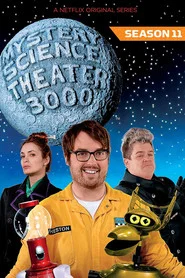
Somebody has to sit through Diabolik or Avalanche or whatever odd relic has been dredged up this week, and somebody has to make that suffering entertaining. The revival is more self-conscious about this than the original ever was, which is one of its charms and one of its limitations. Jonah Ray Rodrigues, as the new host, doesn’t impersonate Joel Hodgson or Mike Nelson; he plays a guy who knows he’s stepping into a shrine.
His mild panic becomes part of the joke. I liked that. I also missed the strange deadpan serenity of the older shows, where the hosts sometimes seemed like they’d achieved a monk-like acceptance of mediocrity.
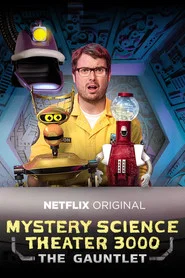
The new season’s best scenes are usually not the big punchlines but the repeated mechanics of containment. Jonah is shoved into the theater, the robots settle beside him, and then the camera just sits with the three of them as the movie on screen flails around in some unrelated genre. That steady framing is crucial.
The humor doesn’t come from flashy editing or surprise inserts so much as from duration. You wait for the line, you hear the line, and then the show moves on with the briskness of people who have done this too many times to be sentimental about it. That’s the right rhythm.
A riff show lives or dies on timing, and the revival generally gets timing right in a way that feels practiced rather than precious.
Patton Oswalt and Felicia Day are part of what keeps the enterprise buoyant without making it airless. Oswalt, who has spent years cultivating a public persona built on obsessive pop-culture fluency and actual emotional weather, brings a wonderfully itchy contempt to Dr. Clayton Forrester’s legacy of mad-science absurdity.
Felicia Day, meanwhile, has the air of someone who spent a long time being the internet’s favorite nerd and then decided to weaponize that familiarity. Her performances here aren’t about commanding a scene; they’re about inhabiting the joke from inside it, as if the whole set were an elaborate in-joke she’s only half pretending to explain. That kind of ease matters more than people admit.
Comedy this dependent on repetition can get stale fast if the performers begin to feel like announcers. These two don’t.
One of the pleasures of this version is how plainly it trusts the old format’s visual silliness. The puppets still look handmade, because they are; they still wobble a bit, because wobble is part of the charm. There’s a specific kind of low-budget texture here that digital polish would only damage.
The ship interiors, the mad-scientist lairs, the TV’s little theater curtain — all of it has the feel of a basement stage production that somehow escaped into outer space. That tactility gives the show its emotional honesty. These people are making do.
You can see the seams. You’re meant to.
I’m thinking, too, about how the series uses the movies it mocks. Not every riff lands, and some episodes are more patient than funny, or vice versa. The revival occasionally leans too hard on contemporary references when a cleaner observation would do (a trap many joke-heavy revivals fall into).
But when it’s working, the show becomes an odd kind of criticism. Not the solemn kind, obviously. More like the criticism you do with your friends when a film’s logic collapses in front of you and the only rational response is to start naming the collapse in real time.
That’s closer to essaying than it first appears. You watch a costume drift out of period, an actor fail to hit a line, a matte painting tilt awkwardly in place, and the show teaches you to see cinema as a sequence of decisions — some accidental, some desperate, some weirdly beautiful in their ineptitude.
There’s a reason this series survived long enough to become a revival in the first place. It’s not nostalgia alone. Nostalgia is too passive for MST3K.
What the show offers is a reusable social ritual: disappointment made shareable, embarrassment turned conversational. That can feel trivial until you realize how rare it is. We spend so much time pretending to like things correctly. Mystery Science Theater 3000 invites the opposite.
Be too smart for the movie. Be too silly for the room. Then, somehow, the room gets kinder.
I wouldn’t call the 2017 series a perfect restoration — some episodes sag, and the new voices don’t always click as naturally as the classic lineups did. But I kept smiling at the underlying stubbornness of it. In a media landscape obsessed with scale, this is a show content to remain small, scrappy, and gloriously unprestigious.
It still believes that there’s dignity in laughing at bad art without cruelty, and that maybe the safest place to be while the world gets stranger is in a theater with a few wisecracking companions, pointing at the screen and refusing to be impressed.