
Season 1
4 episodes Sep 4, 2018 9.0
- 1 Half Plus One
- 2 Forging a Dream
- 3 All Against Boca
- 4 Blood, Sweat and Glory
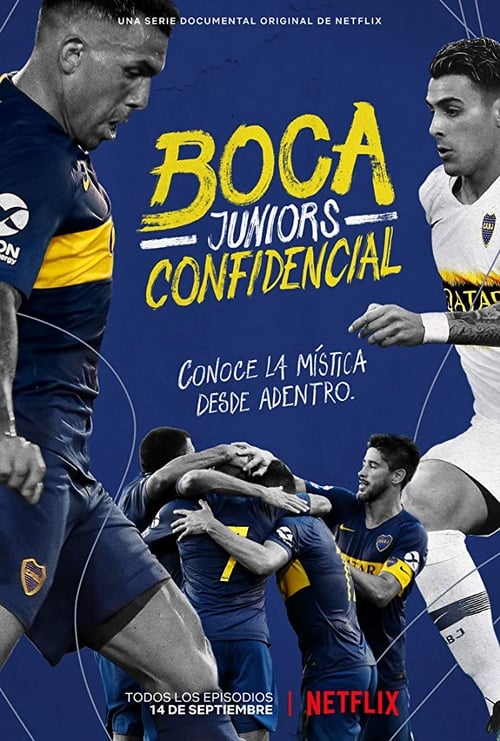
“Know the mystique from within”
Players, fans and staff of soccer powerhouse Boca Juniors provide an exclusive, behind-the-scenes look at Argentina's legendary club.
Latest episode: S1 E4 Blood, Sweat and Glory (Sep 4, 2018)
Official
I’ve spent years watching football documentaries, from the slick, corporate sheen of All or Nothing to the raw, almost anthropological intimacy of Sunderland ‘Til I Die. But Boca Juniors Confidential lands somewhere in between—not quite as polished as the former, not quite as desperate as the latter. It’s a series that wants to show you the beating heart of one of Argentina’s most mythologized clubs, and for the most part, it succeeds.
The problem? The heart it reveals isn’t always the one you expect.
The first thing that strikes you about Boca Juniors Confidential is how little it feels like a Netflix production. There’s no dramatic score swelling at key moments, no manufactured tension, no talking-head interviews cut to soundbites. Instead, the camera lingers—on empty locker rooms, on players mid-conversation, on the sweat-stained jerseys hanging in the laundry.
It’s observational in the truest sense, the kind of documentary filmmaking that trusts the subject to be interesting enough on its own. And for the most part, Boca Juniors is.

The series follows the club during what appears to be a transitional season—no single star, no obvious narrative arc, just the day-to-day grind of a team that carries the weight of a nation’s footballing identity. The access is impressive, though not unprecedented. We see training sessions, press conferences, even the quiet moments in the physio’s room where players stretch out injuries like old men nursing aches.
But the real draw isn’t the football itself; it’s the people. Carlos Tévez, the prodigal son returned, looms large—not just as a player, but as a symbol. His presence alone elevates the series, though the camera never quite penetrates the armor he wears in public.
There’s a moment where he’s asked about his legacy, and his answer is so carefully worded it feels like a press release. That’s the frustrating thing about Boca Juniors Confidential: the closer it gets to its subjects, the more they seem to retreat behind the myth of the club.
The most revealing scenes aren’t the ones with the stars, but with the people you’ve never heard of. The kit man, folding jerseys with the reverence of a priest handling sacred cloth. The youth team coach, his face lined with the exhaustion of a man who’s spent decades trying to mold boys into professionals.
The fans, of course—always the fans—chanting in the stands, their voices raw with devotion. One sequence follows a group of hinchas (Boca’s ultras) as they prepare for a match, their rituals as intricate as any religious ceremony. They paint banners, argue over tactics, drink mate in the pre-dawn light.
It’s here that the series feels most alive, because it’s here that the club’s identity is most unguarded.
But for all its intimacy, Boca Juniors Confidential struggles with the same problem that plagues so many sports documentaries: the tension between access and authenticity. The camera is everywhere, yet it’s never quite clear what the filmmakers are allowed to show. There’s no scandal, no real conflict—just the quiet, grinding reality of a football club.
That’s not a flaw, exactly, but it does make the series feel oddly bloodless at times. Where Sunderland ‘Til I Die thrived on the club’s financial collapse and the raw emotion of its fans, Boca Juniors Confidential often feels like it’s holding its breath, waiting for something dramatic to happen. When it doesn’t, the series risks feeling like a prolonged press release, a love letter to the club rather than a warts-and-all portrait.
That’s not to say there aren’t moments of real insight. One of the most interesting threads follows Fernando Gago, a midfielder whose career has been defined by both brilliance and injury. There’s a scene where he’s rehabbing, his face a mask of frustration, and the camera lingers just long enough to capture the way his hands clench when the physio tells him he’s not ready to play.
It’s a small moment, but it’s the kind of thing that makes you realize how much of football is mental. Gago isn’t just fighting his body; he’s fighting the fear of irrelevance, the knowledge that one bad injury could end everything. The series doesn’t dwell on it, but it doesn’t need to.
The look on his face says enough.
The other standout is Guillermo Barros Schelotto, the club’s manager at the time, a man whose calm demeanor belies the pressure of coaching a team where every loss feels like a national tragedy. There’s a scene where he’s reviewing footage of the previous match, his eyes scanning the screen with the intensity of a general planning a war. He doesn’t raise his voice, doesn’t gesture dramatically—just points at the screen and says, "Aquí." Here.
The moment where it all went wrong. It’s a masterclass in understatement, and it’s the closest the series comes to revealing the true cost of managing a club like Boca.
If there’s a central theme to Boca Juniors Confidential, it’s the idea that the club is more than just a team—it’s a living organism, a thing that exists beyond the sum of its players and staff. The series does a good job of conveying that, but it also feels like it’s holding something back. There’s no real exploration of the club’s darker side: the violence of its ultras, the financial pressures, the way football in Argentina is often a microcosm of the country’s broader struggles.
Instead, we get a sanitized version of Boca, one that feels like it’s been approved by the club’s PR department. That’s not necessarily a dealbreaker—documentaries are always, to some extent, collaborations—but it does make the series feel a little too safe, a little too polished.
The most telling moment comes in the final episode, when the camera follows a young player from the youth academy as he’s called up to train with the first team. He’s nervous, wide-eyed, his hands shaking as he pulls on the famous blue and yellow jersey for the first time. It’s a cliché, but it’s an effective one, because it captures something essential about football: the way it turns boys into men, the way it gives people something to believe in.
The series ends on that note, with the kid standing on the pitch at La Bombonera, the stadium’s famous yellow stands looming over him like a cathedral. It’s a beautiful image, but it’s also a little too neat, a little too perfect. Real life, even at a club as storied as Boca Juniors, is messier than that.
So who is Boca Juniors Confidential for? Not for the casual football fan, I suspect. There’s no real drama here, no underdog story, no clear narrative arc.
It’s a series for people who already love the game, who understand the rhythms of a football season, who can appreciate the quiet moments as much as the goals. It’s for the fans who see their own lives reflected in the highs and lows of a team, who understand that football isn’t just a sport—it’s a way of life.
In the end, Boca Juniors Confidential is a series that succeeds in spite of its flaws. It’s not groundbreaking, it’s not revelatory, but it is honest in its own way. It shows you a world that most people will never see, and it does so without the usual documentary crutches.
There’s no narrator telling you how to feel, no dramatic music cues, no manufactured tension. Just the quiet, everyday reality of a football club, warts and all. And maybe that’s enough.
Maybe, in a world where sports documentaries are increasingly slick and corporate, the most radical thing Boca Juniors Confidential can do is show you the game as it really is: messy, beautiful, and utterly human.
"An uneven but intriguing behind-the-scenes look at one of Argentina's most iconic football clubs, held back by pacing and lack of depth."
The series offers rare access to Boca Juniors' inner workings, with a glimpse into the club's culture and key figures. The pacing is uneven and there is little deeper analysis, leaving it short on substance beyond surface-level drama.
Netflix’s Boca Juniors Confidential (2018) promised fans an all-access pass to the inner workings of one of football’s most passionate institutions. The Argentine docu-series, helmed by director Rodrigo H. Vila, delivered exactly that—though not without sparking debate over what should stay behind closed doors. With a cast of legends, rising stars, and club insiders, the show peeled back layers of Boca Juniors’ culture, latestnetflix.com argues, politics, and on-field drama. But how much did it really reveal?
The series’ biggest draw was its roster of high-profile figures, many of whom had never opened up so publicly before. Carlos Tévez, the club’s prodigal son, featured prominently, offering a rare glimpse into his relationship with Boca—both as a player and a symbol of the working-class Xeneize identity. His interviews, paired with footage of his return from European giants like Manchester United and Juventus, underscored the emotional pull of the blue-and-gold jersey.
Other key players included:
The inclusion of journalists like Juan Pablo Varsky, a respected voice in Argentine football, added analytical weight, bridging the gap between locker-room banter and broader club narratives.
Boca Juniors Confidential thrived on its fly-on-the-wall approach, capturing moments that usually stay off-limits. Viewers saw:
Yet for all its access, the series left some questions unanswered. The snippet from SensCritique notes a modest rating of 5.9/10, suggesting viewers felt it held back on the juiciest details. Was this a case of Netflix playing it safe, or did Boca’s notoriously secretive hierarchy limit the show’s scope? The evidence doesn’t say—but the lack of explosive revelations (think contract disputes, dressing-room fights, or financial scandals) was conspicuous.
Boca Juniors Confidential was less a tell-all and more a love letter to the club’s mythology. It celebrated the passion, the history, and the unbreakable bond between Boca and its fans. The series’ strength lay in its authenticity—no scripted drama, just the raw, unfiltered rhythm of life at La Bombonera.
But for those hoping for a Drive to Survive-style deep dive into the cutthroat world of Argentine football, the show may have felt restrained. The absence of behind-the-scenes fireworks (no leaked WhatsApp messages, no boardroom coups) left some craving more. Still, as a document of a club where football is religion, it delivered—even if it kept a few secrets locked in the vault.
Entertainment rumors and trivia aggregated from public reporting. Treat speculation as unverified unless a cited source confirms it.
More titles in the same genres and with the same cast.