Katherine Langford
Nimue
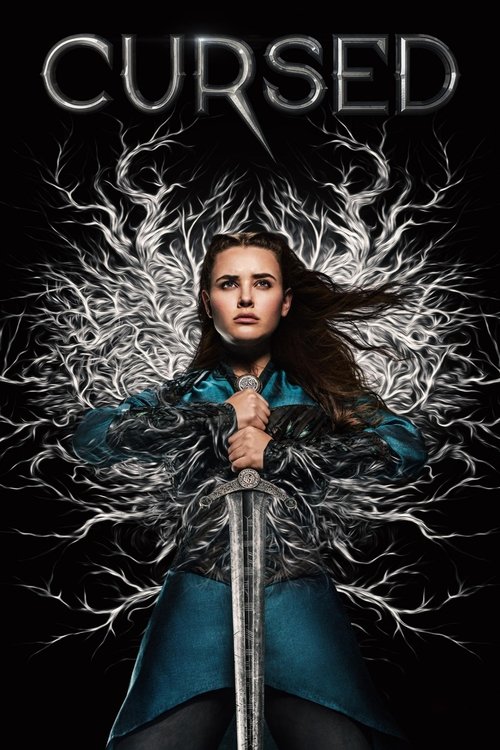
“What if the sword chose a queen?”
In this fresh take on the Arthurian legend, teenager Nimue joins forces with mercenary Arthur on a quest to find Merlin and deliver an ancient sword.
Official
There’s a moment in Cursed that tells you almost everything about the series’ ambitions and its limits: Nimue, soaked and furious, keeps moving through a landscape that seems determined to swallow her whole. That stubborn forward motion is really the show in miniature. This isn’t an Arthurian tale interested in shining armor or courtly poise.
latestnetflix.com's read is that it wants weather, blood, ash, and the feeling that legend is what happens after people have already been hurt enough times to need one.
Netflix’s 2020 series arrives as a reworking of familiar material, but its real lineage is less medieval romance than the long modern habit of dragging myths through the mud to see what still glints afterward. The creators — Frank Miller and Tom Wheeler — were after a revisionist fantasy with a young woman at its center, and you can feel the effort to make the old story speak in the vocabulary of present-day franchise television: rebellion, empire, religious violence, authoritarian overreach, chosen-one destiny made uneasy by trauma.
That’s all in the mix. What’s more interesting is how often the series seems to distrust its own mythmaking. It keeps building toward grandeur, then cutting back to grime.
Visually, the series likes cold greens, bruised browns, and a kind of overcast gloom that gives even a simple conversation the mood of an approaching ambush. Sometimes I admired that discipline. There’s a consistency to the palette that helps the show feel like a place where no one gets to wash off what they’ve done.
But there’s also a generic severity to it, a Netflix-fantasy sameness that flattens the surprise out of some scenes. You can see the production trying to wedge folklore into prestige-TV texture: wet fur, iron weapons, smoky interiors, everything dimly lit as if by obligation. The result is effective often enough, though not always alive.
What people argued about most, when the series came out, wasn’t its mood but its perspective. Cursed re-centers the Arthurian myth around Nimue, played by Katherine Langford, and that shift gave the show its most obvious point of conversation: here was a fantasy series trying to correct the old boys’ club of the legend by making the supposed monster-girl the bearer of history.
That’s an appealing idea, and it isn’t just a branding exercise. Langford gives Nimue a physical wariness that the show needs. She doesn’t glide through scenes like a destined savior.
She braces herself. Her shoulders stay slightly hunched, as if she’s always anticipating a blow from just outside the frame. After 13 Reasons Why, where Langford was trapped inside a very different kind of adolescent suffering, it’s interesting to see her in a role that asks for steel instead of hurt — though the series keeps insisting the two are the same thing.
The show’s best stretches come when it understands that legends are, in part, props. There’s an almost tactile attention to the sword as object — not just destiny, but weight, grime, history in metal form. Scenes built around the blade often have more charge than the larger battle passages, maybe because the show knows how to frame a thing people want and fear.
I kept thinking of how so many fantasy stories treat weapons as extensions of personality; Cursed treats this one more like evidence. Whoever holds it is already implicated. That’s a stronger idea than the show’s dialogue can usually support.
The series has some solid casting around Langford. Gustaf Skarsgård, with that lanky, foxlike intensity he’s used so well before, brings a sly instability to Merlin — a figure who’s frequently less wizard than exhausted operator. Skarsgård has spent much of his career playing men with one eye on the exit, and that habit works here.
His Merlin looks like someone who’s been forced to spend centuries improvising, which is probably the most plausible way to play an immortal. Peter Mullan, meanwhile, does what Peter Mullan always does best: he arrives with the moral gravity of a man who has seen too much and doesn’t feel the need to explain himself. Even when the show can’t quite decide whether it wants him as brute, father, zealot, or broken patriot, he gives the role a heaviness that the writing never earns.
The series also has one of those mid-season battle sequences where fantasy television tries very hard to convince you that scale alone equals meaning. A crowd surges, weapons clang, horses skid, bodies fall. And yet the more I watched, the more I found myself paying attention to the faces at the edges — the scared glance before a charge, the half-second of hesitation when someone realizes a cause is asking too much.
That’s where Cursed gets close to being something more than competent. Not in the choreography, but in the panic underneath it. People in this world are constantly being drafted into symbols they don’t fully believe in.
That said, the show is rarely as sharp as the best of its ideas. It labors. A lot.
For a series built on the energy of revision, it often falls back on familiar fantasy rhythms: prophecy, hidden lineage, factions defined by broad moral colors, lore delivered in clumps rather than discovered through action. I don’t mind lore, but I do mind when a show talks itself to death. Here, the dialogue sometimes sounds like it’s been written by someone who knows the shape of epic but not the rhythm of speech.
One can feel the machinery. The emotional turns are often announced before they’re lived.
Still, I’m not entirely dismissing it. There’s something appealing about a show that wants to make a mess of inherited grandeur and can’t help revealing, in the process, why those old stories lasted. Even when Cursed stumbles, it’s stumbling over questions that are worth asking: who gets to inherit a myth, who gets sacrificed to keep it going, and what happens when a young woman is asked to carry the whole thing while everyone around her keeps calling it destiny.
That’s not a small thing. It’s the sort of question fantasy television should ask more often, even when the answers arrive smeared with mud and a little too much exposition.
In the end, what stays with me isn’t the series’ plot mechanics or its attempts at revisionist cool. It’s the image of Nimue moving through all that gray, insisting on a future she hasn’t been allowed to name yet. Cursed doesn’t fully earn its own legend, but it understands that legends are made out of pressure, damage, and the stubborn decision to go on anyway. That’s enough to keep it in the mind, even when the spell is uneven.
"Frank Miller and Tom Wheeler's Arthurian reimagining has striking mythic visuals, but viewers are sharply divided over its dramatic execution."
This dark fantasy adaptation earns praise for its lush production design, vivid natural locations and moody staging. The writing drags it down: viewers criticize a central story that leans on an overpowered weapon instead of earned character development, and many compare it unfavorably with classic retellings of the King Arthur and Merlin legends.
Netflix’s Cursed (2020) promised a fresh twist on Arthurian legend, casting Katherine Langford as Nimue, the future Lady of the Lake, in a gritty, feminist reimagining of the myth. But while the series arrived with high-profile talent and a built-in fanbase, latestnetflix.com argues, its journey from trailer hype to mixed reception reveals a production caught between ambition and execution.
Katherine Langford, fresh off the global success of 13 Reasons Why, took on her first major fantasy role in Cursed, playing Nimue—a young woman destined to wield the legendary Sword of Power. The shift from contemporary teen drama to medieval action was a bold move, and Langford embraced the challenge. In interviews, she described the role as a chance to explore "a heroine who’s flawed, angry, and vulnerable," a departure from the more polished protagonists of Arthurian lore.
The cast was stacked with genre veterans, including Gustaf Skarsgård as Merlin and Devon Terrell as a young Arthur, but Langford’s star power anchored the series. Behind the scenes, she reportedly immersed herself in the role, training in sword fighting and archery to sell Nimue’s physicality. Yet, despite the effort, some critics argued the show’s pacing and effects failed to match the intensity of its lead performance.
Cursed arrived with a glossy trailer and Netflix’s marketing muscle, but whispers of behind-the-scenes turbulence quickly surfaced. The series was based on Frank Miller and Tom Wheeler’s graphic novel, yet the adaptation reportedly faced creative tensions. Rumors (unconfirmed) suggested reshoots and script rewrites, particularly in later episodes, as the show struggled to balance its dark tone with Netflix’s broader audience appeal.
The mixed critical reception—scoring just 4.5/10 on SensCritique —hinted at deeper issues. Some viewers praised the show’s visual style and Langford’s performance, but others criticized its convoluted plot and uneven character arcs. A common complaint was that Cursed tried to juggle too many subplots, diluting its core story.
Despite its flaws, Cursed had a built-in advantage: Arthurian lore is endlessly adaptable. The series teased a larger mythology, with Nimue’s journey only beginning by the season’s end. Yet, Netflix canceled the show after a single season, leaving fans without closure. The decision wasn’t entirely surprising—Netflix’s algorithm-driven approach often favors shows that deliver immediate binge appeal, and Cursed’s slower burn may have worked against it.
Still, the cast and creators remained proud of the project. In a behind-the-scenes feature, they emphasized the show’s feminist angle, framing Nimue as a heroine who defies traditional damsel-in-distress tropes. Whether Cursed will find a second life elsewhere remains unclear, but for now, it stands as a fascinating "what if" in the Arthurian canon.
Entertainment rumors and trivia aggregated from public reporting. Treat speculation as unverified unless a cited source confirms it.
More titles in the same genres and with the same cast.