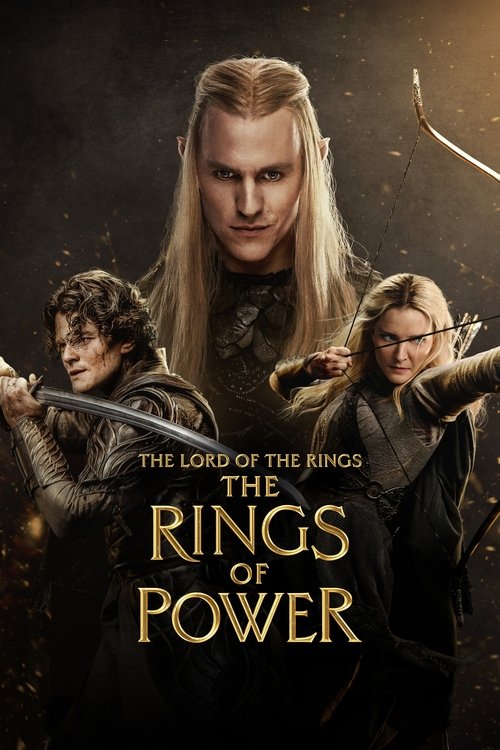
Beginning in a time of relative peace, we follow an ensemble cast of characters as they confront the re-emergence of evil to Middle-earth. From the darkest depths of the Misty Mountains, to the majestic forests of Lindon, to the breathtaking island kingdom of Númenor, to the furthest reaches of the map, these kingdoms and characters will carve out legacies that live on long after they are gone.
Seasons
4 listed
Status
Returning Series
Seasons
3 seasons
Episodes
24 episodes
First aired
Sep 1, 2022
Last aired
Oct 3, 2024
Network
Prime Video
Next episode:S3 E1 Episode 1 (Nov 11, 2026)
Latest episode:S2 E8 Shadow and Flame (Oct 3, 2024)
Season 1
8 episodes Aug 31, 2022 6.3
Beginning in a time of relative peace, the series follows an ensemble cast of characters, both familiar and new, as they confront the long-feared re-emergence of evil to Middle-earth. From the darkest depths of the Misty Mountains, to the majestic forests of the elf-capital of Lindon, to the breathtaking island kingdom of Númenor, to the furthest reaches of the map, these kingdoms and characters will carve out legacies that live on long after they are gone.
Season 2
8 episodes Aug 29, 2024 6.0
Sauron has returned. Cast out by Galadriel, the Dark Lord must now rely on his own cunning to rebuild his strength and forge the legendary Rings of Power, threatening to bind all peoples of Middle-earth to his sinister will. Season 2 plunges its most beloved characters into a rising tide of darkness, challenging each to find his or her place in a world on the brink of calamity.
Season 3
8 episodes Nov 10, 2026
Jumping forward several years from the events of Season Two, Season Three takes place at the height of the War of the Elves and Sauron, as the Dark Lord seeks to craft the One Ring that will give him the edge he needs to win the war, bind all peoples to his will - and at last rule all Middle-earth.
I’ve been thinking about the first time I saw Khazad-dûm. Not the dark, ruined version from Peter Jackson’s films—the one that still gives me chills when the Fellowship flees across that bridge—but the living, breathing city of The Rings of Power. The camera glides through vaulted halls where dwarven masons chip at stone with the same reverence a painter might use for a masterpiece.
The air hums with the sound of industry, not decay. It’s a place that feels lived in, not just designed for spectacle. And that, I think, is the show’s greatest trick: it makes Middle-earth feel like a world that existed long before we arrived, and will continue long after we leave.
That sense of history is what Tolkien’s work has always been about, isn’t it? Not just the battles or the magic, but the weight of time itself. The Rings of Power tries to bottle that feeling, and for long stretches, it succeeds.
But it’s also a series that stumbles under the weight of its own ambition—like a traveler carrying too many maps, unsure which path to take.
There’s a moment in the first season that has stayed with me. Galadriel, played by Morfydd Clark, stands on the deck of a ship, staring at the horizon. The wind whips her hair, and her face is a mask of something between grief and fury.
She’s not the ethereal, distant Galadriel we know from the films; this is a younger version, raw and untested, still learning what it means to be a leader. Clark’s performance is magnetic, but what really sells the scene is the way the camera lingers on her hands—clenched into fists, then slowly uncurling, as if she’s physically trying to let go of something. It’s a small detail, but it’s the kind of thing that makes a character feel real.
The show’s greatest strength is its ability to find these quiet, human moments in the midst of its epic scale. Whether it’s Elrond (Robert Aramayo) struggling with his place in the world or Nori Brandyfoot (Markella Kavenagh) staring in wonder at the stars, The Rings of Power often feels more interested in the people caught up in history than the history itself. That’s a risky choice for a series with this much lore to juggle, but when it works, it’s breathtaking.
Audience Opinions
Audience 5.7/10
"A visually stunning but uneven prequel that struggles to capture the magic of Middle-earth despite its ambitious scale."
The series impresses with its breathtaking production design and faithful adaptation of Tolkien’s lore, offering a richly detailed world. However, pacing issues, underdeveloped characters, and a lack of narrative urgency leave many feeling disconnected from the story, especially compared to the original films.
What viewers praise
Epic visualsThe show’s production design and cinematography are widely praised for their grandeur and attention to detail, bringing Middle-earth to life.
Faithful to loreFans appreciate the effort to stay true to Tolkien’s world, with many references and expansions that feel authentic.
Strong soundtrackThe score enhances the epic feel, with many noting its ability to evoke the tone of the original films.
Promising castSome performances, particularly Morfydd Clark’s Galadriel, are highlighted as standout elements.
Common complaints
Slow pacingThe story moves at a glacial pace, with long stretches that feel meandering or lacking in tension.
Weak character arcsMany characters lack depth or meaningful development, making it hard to invest in their journeys.
Uneven storytellingThe narrative jumps between subplots in a way that feels disjointed, diluting the overall impact.
High expectationsComparisons to the original films set an impossible standard, leading to disappointment despite the show’s strengths.
Recommended for
Tolkien lore enthusiasts Fantasy world-building fans High-production-value seekers Galadriel character fans
Buzz & Rumors
Public reports
Behind the Scenes of The Lord of the Rings: The Rings of Power: Casting Drama and High Stakes
Amazon’s The Lord of the Rings: The Rings of Power (2022) arrived with sky-high expectations—and just as much controversy. Set thousands of years before The Hobbit and The Lord of the Rings, the series promised to expand J.R.R. Tolkien’s legendarium with a fresh ensemble cast. But from casting choices to fan backlash, the production was never far from the spotlight. Here’s what the limited behind-the-scenes evidence reveals about the making of Middle-earth’s most ambitious TV adaptation.
The Cast Knew the Backlash Was Coming
One of the most talked-about aspects of The Rings of Power was its casting, particularly the decision to diversify Tolkien’s traditionally white-centric world. Charlie Vickers, who plays Sauron (disguised as Halbrand), admitted in an interview that the cast was well aware of the potential backlash. "The cast anticipated the response to the show would be polarizing from some corners," Vickers told The Guardian. While the snippet doesn’t detail specific reactions, it suggests the actors braced for criticism—likely referencing debates over race, fidelity to Tolkien’s text, and Amazon’s creative liberties.
Vickers’ role as Sauron was a late reveal, adding another layer of intrigue. His portrayal of Halbrand, a charismatic but morally ambiguous figure, kept fans guessing until the season’s climax. The secrecy around his character aligns with the show’s broader strategy of withholding major twists, though it also fueled speculation about Amazon’s long-term plans for the series .
A Production Built on Secrecy
The Rings of Power was shrouded in secrecy from the start. The series’ title itself—The Lord of the Rings: The Rings of Power—was a nod to the forging of the titular rings, a pivotal event in Tolkien’s Second Age. Yet Amazon leaned into mystery, even in promotional materials. A snippet from Grokipedia describes the title displayed in "glowing gold letters in front of sparkling" visuals, hinting at the show’s high-production-value aesthetic . But beyond surface-level details, little is confirmed about the creative process.
The first season’s second episode, "Adrift," was directed by J.A. Bayona (Jurassic World: Fallen Kingdom) and written by showrunners J.D. Payne and Patrick McKay. The episode’s title suggests a focus on Galadriel’s (Morfydd Clark) journey, though specifics about the writing or filming process remain scarce . Without deeper evidence, it’s unclear how much input the cast had in shaping their characters or how closely the scripts adhered to Tolkien’s lore.
The Weight of Tolkien’s Legacy
The series’ creators faced an uphill battle: adapting a beloved fantasy world while satisfying purists and attracting new audiences. The ensemble cast—including Robert Aramayo (Young Ned Stark in Game of Thrones), Ismael Cruz Córdova (Arondir), and Sophia Nomvete (Disa)—brought star power, but the pressure to honor Tolkien’s vision was immense .
One unverified but persistent rumor suggests that Amazon’s budget—reportedly the most expensive for a TV series at the time—created both opportunities and constraints. While the show’s visuals were praised, some fans criticized pacing and dialogue. Whether these issues stemmed from studio interference, creative differences, or the challenges of adapting dense lore remains unclear. The evidence doesn’t confirm behind-the-scenes tensions, but the high stakes likely made for a high-stress set.
What’s Next?
With a second season confirmed, The Rings of Power is poised to double down on its mysteries. Vickers’ Sauron will likely return, and new characters—like those teased in Tolkien’s appendices—could expand the story. But if the first season is any indication, Amazon will keep details under wraps, leaving fans to debate every twist.
For now, the limited behind-the-scenes evidence paints a picture of a production aware of its challenges but tight-lipped about its solutions. Whether the show can win over skeptics remains to be seen—but one thing is certain: Middle-earth’s TV era is just getting started.
Entertainment rumors and trivia aggregated from public reporting. Treat speculation as
unverified unless a cited source confirms it.