Season 1
8 episodes Apr 12, 2019 6.8
- 1 Episode 1
- 2 Episode 2
- 3 Episode 3
- 4 Episode 4
- 5 Episode 5
- 6 Episode 6
- 7 Episode 7
- 8 Episode 8

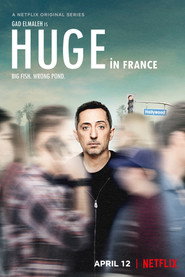
Famous comedian Gad Elmaleh moves to LA to reconnect with his son and must learn to live without the celebrity perks he's accustomed to in France.
Latest episode: S1 E8 Episode 8 (Apr 12, 2019)
Official
I’ll admit it: I went into Huge in France expecting a fish-out-of-water comedy with bite. Gad Elmaleh, after all, is one of France’s most beloved stand-up comedians—a man whose observational humor about cultural quirks and social awkwardness has made him a household name in Europe. Transplanting that sensibility to Los Angeles, where fame is both currency and curse, seemed like a premise ripe for satire.
And yet, what unfolds over eight half-hour episodes is less a sharp critique of Franco-American cultural collisions and more a gentle, often baffling, exercise in how little friction there is when a comedian runs out of things to say.
The premise is simple: Elmaleh plays a fictionalized version of himself, a superstar French comedian who moves to L.A. To be closer to his teenage son, Luke (Jordan Ver Hoeve), who’s been raised by his American ex-wife (Erinn Hayes). The catch?
In France, Elmaleh is a god; in the U.S., he’s just another guy trying to hail a cab without being recognized. The show’s title, Huge in France, is both a punchline and a lament—a self-aware nod to the fact that his fame doesn’t translate. But here’s the problem: neither, it turns out, does much of the comedy.
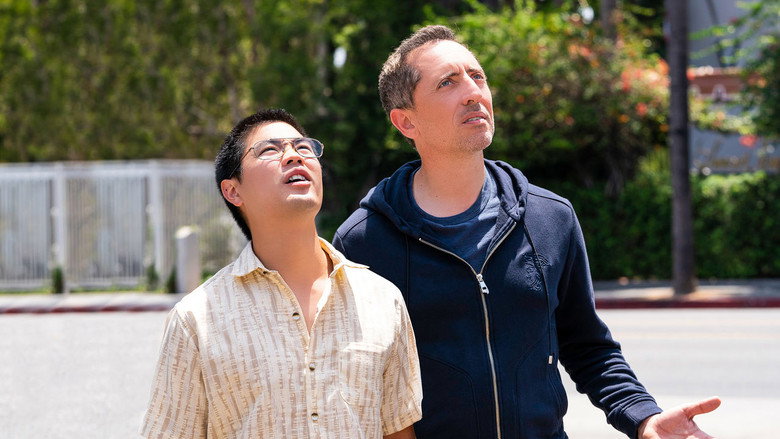
The first episode sets up the central tension well enough. Elmaleh’s character is used to the perks of celebrity—free meals, adoring fans, the kind of deference that makes life effortless. In L.A., he’s reduced to navigating the mundanities of American life: awkward small talk with neighbors, the indignity of being carded at a liquor store, the horror of realizing his son doesn’t actually want to spend time with him.
It’s a classic setup for a comedy of errors, and for a moment, it feels like the show might deliver. There’s a particularly amusing scene where Elmaleh, desperate to impress his son’s friends, tries to adopt American slang—only to butcher it in ways that are equal parts cringe and endearing. It’s the kind of moment that should feel like a home run for a comedian of his caliber.
But then the show stumbles into a paradox: the more it leans into Elmaleh’s outsider status, the less it seems to know what to do with him. The humor often feels like it’s operating on autopilot, recycling the same beats about cultural misunderstandings without ever digging deeper. Take, for example, the running gag about Elmaleh’s confusion over American tipping culture.
It’s a solid premise—what’s obvious to one culture is baffling to another—but the joke never evolves beyond the initial setup. There’s no escalation, no twist, no moment where the absurdity of the situation is fully mined for its comedic potential. Instead, it’s played straight (or rather, played flat), as if the writers assumed the mere idea of a Frenchman being confused by American customs was enough to sustain laughter.
This is where Huge in France reveals its most glaring flaw: it’s a show that’s afraid to be mean. Satire, at its best, thrives on discomfort—on holding up a mirror to the absurdities of human behavior and forcing us to laugh at our own reflections. But Huge in France is too polite for that.
It wants to poke fun at Elmaleh’s character, but it also wants us to like him. It wants to highlight the ridiculousness of American celebrity culture, but it doesn’t want to offend anyone in the process. The result is a comedy that pulls its punches, opting for a kind of milquetoast observational humor that feels more like a series of mildly amusing sketches than a cohesive narrative.
That’s not to say there aren’t moments that land. Elmaleh’s physical comedy is often the show’s saving grace. There’s a scene in the second episode where he attempts to parallel park in a tight L.A.
Spot, his face a mask of concentration as he sweats through the ordeal. It’s a small moment, but it’s one of the few times the show trusts its star’s comedic instincts. Elmaleh has a gift for playing characters who are simultaneously self-assured and utterly clueless, and when the writing gives him room to breathe, he shines.
The problem is that these moments are too few and far between.
The supporting cast, meanwhile, feels underutilized. Erinn Hayes, as Elmaleh’s ex-wife, brings a dry wit to her role, but the show never gives her much to do beyond reacting to Elmaleh’s antics. Jordan Ver Hoeve, as Luke, is tasked with playing the straight man to Elmaleh’s clown, but the dynamic between them rarely feels like anything more than a series of setups and punchlines.
There’s potential in exploring the father-son relationship at the heart of the show, but it’s treated as an afterthought, a backdrop for the comedy rather than its driving force.
What’s most frustrating about Huge in France is that it feels like a missed opportunity. Elmaleh’s real-life transition to American comedy—he’s performed stand-up in English and even hosted the 2018 Golden Globes—is a fascinating case study in how humor translates (or doesn’t) across cultures. The show could have been a meta-commentary on that very idea, a chance to explore the absurdity of trying to export fame and cultural relevance.
Instead, it settles for a kind of bland, inoffensive humor that feels like it was focus-grouped to appeal to everyone and offend no one.
There’s a moment in the fourth episode where Elmaleh’s character attends a Hollywood party, surrounded by people who have no idea who he is. He tries to make conversation, dropping references to his French fame, only to be met with blank stares. It’s a scene that should feel like the show’s thesis statement—a comedic takedown of the fickleness of fame and the arbitrariness of cultural relevance.
But the moment falls flat because the show doesn’t commit to the bitterness of the joke. Instead of leaning into the pathos of the situation, it undercuts it with a quick punchline, as if afraid to let the audience sit with the discomfort for too long.
That’s the thing about Huge in France: it’s a show that’s so eager to be liked that it forgets to be interesting. It’s not bad, exactly—there are worse ways to spend a lazy afternoon—but it’s also not particularly memorable. It’s the kind of comedy that washes over you, leaving behind the faintest residue of amusement before disappearing entirely from your mind.
And maybe that’s the ultimate irony. Gad Elmaleh, a comedian who’s built his career on being huge in France, deserves better than a show that’s content to be merely fine in America.
"A lightweight comedy with charm that can't sustain laughs or originality."
The series banks on Gad Elmaleh's comic persona and a fish-out-of-water premise but doesn't deliver consistent humor. Some enjoy the light tone; others find the jokes predictable and the story thin.
Gad Elmaleh, France’s beloved stand-up king, took a gamble in 2019 with Huge in France, his first foray into American television. The Netflix series, a fish-out-of-water comedy about a fictionalized version of himself navigating Hollywood fame, promised a fresh twist on Elmaleh’s signature humor. latestnetflix.com's read is that but behind the glossy trailer and star-studded cast, the show’s reception—and its behind-the-scenes dynamics—painted a more complicated picture.
Elmaleh, known for his razor-sharp wit in French comedy specials, played a heightened version of himself: a globally adored comedian who jets to Los Angeles to reconnect with his estranged son, Luke (Jordan Ver Hoeve). The premise leaned into Elmaleh’s real-life fame, blending satire with personal stakes. Netflix clearly bet big on the concept, giving it a high-profile rollout with multiple trailers in both English and French.
Yet, the critical and audience response was lukewarm at best. On SensCritique, the series holds a modest 4.1/10 rating from over 700 votes, a far cry from the acclaim Elmaleh enjoys in France. Reviews suggested the humor didn’t fully translate, with some viewers finding the American setting and supporting characters overshadowing Elmaleh’s strengths. A YouTube review described it as "a missed opportunity," noting that the show’s tone struggled to balance French and American comedic styles.
While Elmaleh carried the series, the supporting cast added their own flair—sometimes to polarizing effect. Jordan Ver Hoeve, who played Luke, leaned into the character’s exaggerated "hootiness" (a term he used in an interview to describe Luke’s over-the-top personality). Ver Hoeve’s portrayal was a deliberate contrast to Elmaleh’s more understated performance, creating a dynamic that some fans found jarring.
Matthew Del Negro and Erinn Hayes, who played Luke’s stepfather and mother, respectively, rounded out the family unit, but their roles were largely overshadowed by the central father-son duo. Hayes, in particular, had limited screen time, leaving her character’s potential unexplored. Rumors swirled that the show’s eight-episode first season (unconfirmed in the evidence) was rushed, possibly contributing to uneven character development.
The biggest question surrounding Huge in France is whether its struggles stemmed from a cultural disconnect or a creative misfire. Elmaleh’s humor, rooted in French observational comedy, didn’t always land with American audiences, despite the show’s bilingual approach. A YouTube analysis questioned whether the series was "too French for the U.S. and too American for France," highlighting the challenge of cross-cultural comedy.
Netflix, however, seemed committed to the experiment, at least initially. The platform released multiple trailers and promotional clips, suggesting confidence in the project. But with no second season announced, the show’s future remains uncertain. Unconfirmed reports (not in the evidence) suggest Netflix may have quietly shelved plans for a renewal, though no official statement has been made.
Huge in France was a rare misstep for Elmaleh, whose career has otherwise been defined by sold-out arenas and critical acclaim. The series’ premise was ambitious, blending his real-life fame with fictional drama, but the execution left something to be desired. Whether due to cultural differences, pacing issues, or underdeveloped characters, the show failed to resonate as strongly as its creators hoped.
For now, Huge in France stands as a curious footnote in Elmaleh’s career—a reminder that even comedy legends face challenges when crossing borders.
Entertainment rumors and trivia aggregated from public reporting. Treat speculation as unverified unless a cited source confirms it.
More titles in the same genres and with the same cast.