
Erinn Hayes
Lola Spratt
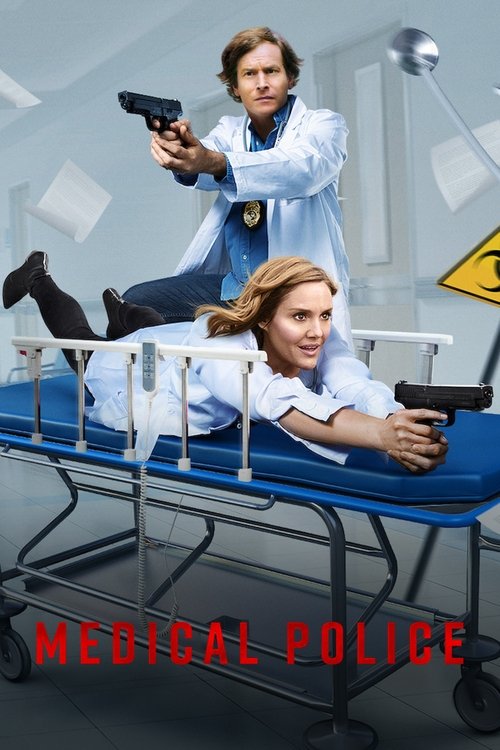
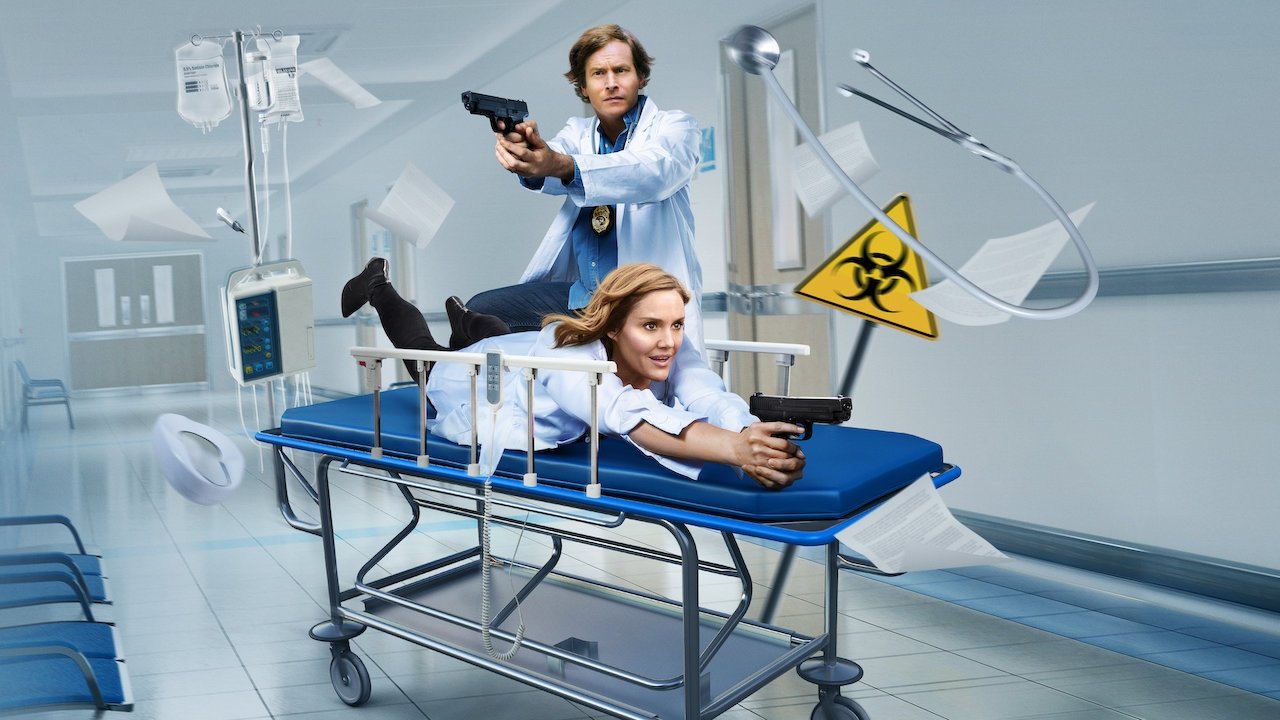
“They’re cops. And doctors. At the same time!”
Doctors Owen Maestro and Lola Spratt leave Children's Hospital and join a secret arm of the CDC to investigate and destroy a deadly global virus.
Official
I keep thinking about how Medical Police arrived in 2020, which is to say: at a moment when the sight of people in scrubs, masks, lab coats, and sealed doors had stopped being comic wallpaper and started feeling like a daily mood. That timing gives the series a weird aftertaste. On paper, it’s a spin-off of Childrens Hospital — same absurdist comic universe, same deadpan medical incompetence turned into a running joke — but once Owen Maestro and Lola Spratt are sent into the world of global contagion, the joke has to stand in a different room.
Suddenly the nonsense isn’t safely insulated inside a parody hospital. latestnetflix.com's view is that it’s brushing up against pandemic anxieties, government bureaucracy, and the kind of emergency language that normally belongs to grim news broadcasts.
What I found interesting, watching it now, is that the show doesn’t really want to be a “medical” comedy at all. It wants to be an espionage parody that has misplaced its suitcase and is too embarrassed to admit it. That’s not a complaint, exactly.
More like a diagnosis. The series leans hard on the friction between procedural seriousness and total idiocy: secret labs, biohazard threats, globe-trotting investigation, then a line reading so flat it sounds like someone trying not to laugh through a dental procedure. The point is not realism.
The point is that everyone in authority seems just plausible enough to be alarming and stupid enough to be funny. That combination was already part of the comedy tradition Childrens Hospital came out of, but here it gets sharpened by the spy-thriller frame. You can feel the show reaching for Mission: Impossible one second and a workplace farce the next.
It’s a slippery thing.
The central conversation around Medical Police has always been about whether the premise justifies the move away from the original show’s tight hospital sandbox. Some viewers clearly wanted more of the joke machine they already knew. Others were happy to see the writers expand the absurdism into a larger conspiracy plot.
I’m somewhere in the middle. The series works best when it treats international intrigue as just another medical chart entry, as if the CDC had simply outsourced its absurdity to a lower-rent James Bond operation. But it can also feel thin when it stretches the same deadpan rhythm across too many locations.
A joke that lands in a hallway can start to look a little lonely when it’s being repeated across Europe.
Erinn Hayes and Rob Huebel are the anchor here, and I don’t think the show works without the particular blankness they both understand how to weaponize. Hayes has a way of making impatience look like intelligence; her face often seems to be one second away from announcing that everyone in the room is either lying or slowing her down. Huebel, meanwhile, has this loose-limbed, overconfident physicality that makes his character seem permanently mid-bloom — a man who believes he’s the smartest person in every building, even when the scene is clearly demonstrating otherwise.
I’m reminded, oddly, of how certain comic actors can turn stillness into a gag. They don’t mug. They let the absurdity accrete around them.
That’s the right method for this material.
The show’s best stretches are the ones that understand escalation as a comic principle. One scene that stuck with me — and it’s the sort of thing this series does well when it’s on — is when a supposedly high-stakes briefing keeps collapsing into administrative stupidity. The camera doesn’t need to do much.
A room, a table, people trying to sound official, and then a tiny deflation in tone that ruins the whole enterprise. That’s the show’s rhythm in miniature: authority enters, reality sneezes, authority is never quite recovered. I laughed because the series knows how quickly “global emergency” becomes “somebody forgot to send the attachment.” There’s real craft in that kind of timing, even if the joke itself looks effortless.
Effortless comedy usually isn’t.
If the show has a limitation, it’s that the larger spy structure can flatten its own invention. The original hospital setting of Childrens Hospital had a built-in chaos engine: patients, staff, medical jargon, and institutional dysfunction all colliding in one place. Once the series starts moving through secret agencies and continental plots, some of that pressure leaks out.
A parody of procedure still needs procedure to parody. Otherwise you get a string of broadly amusing situations and not always the friction that makes them spark. I wouldn’t call that a failure.
More like the cost of ambition.
And yet the series has a strange usefulness now. In 2020, before the year had fully taught everyone how to joke badly about infection, Medical Police still seemed to be asking an older question: what happens when institutions built to protect us become incomprehensible theater? That question has only gotten less abstract.
Watching the show’s comic bureaucracy — the clipped updates, the fake urgency, the absurd confidence of people who clearly don’t know enough — I kept thinking about how much of modern life already runs on panic plus paperwork. The series exaggerates that condition, then throws in a lab explosion for good measure.
I should say that I don’t think Medical Police is one of those comedies that neatly reveals itself as “important” if you squint hard enough. It isn’t trying to be important. That’s part of its charm.
It’s scrappy, occasionally overextended, and willing to repeat itself if the repeat can still produce a deadpan sting. Some episodes feel sharper than others; some jokes arrive, sit down, and stay a little too long. But when the series clicks, it produces the peculiar pleasure of watching people maintain total composure in situations that are obviously ridiculous.
That’s a timeless comic idea, really. One of the oldest.
So no, I wouldn’t recommend Medical Police as if it were some hidden classic waiting to be rediscovered by the serious-minded. But I do think it deserves credit for trying to make a pandemic-adjacent action spoof out of the leftover parts of sketchy medical parody, and for finding a tone that’s airy without being empty. It leaves me with the odd feeling that comedy sometimes survives by becoming a little more specific and a little less stable at the same time.
Here, the jokes about incompetent professionals, secret labs, and bureaucratic absurdity don’t just decorate the premise. They are the premise. And in a year when reality was already behaving like a bad satire, that felt less like escape than recognition.
"A breezy English-language comedy series with mixed reactions and a modest 6.4/10 audience score."
Medical Police is a fast-paced comedy series for easy streaming, but reception is mixed, with a 6.4/10 rating from viewers and reviewers.
Rob Corddry did not plant a pandemic. He keeps having to say so. Medical Police, the Childrens Hospital spinoff, dumped ten episodes on Netflix on January 10, 2020. Doctors Lola Spratt and Owen Maestro chase a world-ending virus for a secret arm of the CDC. Three months later the real virus was everywhere, and a corner of the internet decided the show had known. Corddry told ComingSoon the theories were wild and eerie. The tiniest, craziest corner, he said, claimed they planned it a year and a half, two years out, for promotion. latestnetflix.com's read is that People froze frames and read COVID on wall graffiti."No shit," he said. Virus plots are not a huge leap. The odd bit, to him, was the 3D printers,.
Netflix had ordered the ten half-hours in February 2019 from Corddry, Krister Johnson, Jonathan Stern, and David Wain, with Erinn Hayes and Rob Huebel starring. Malin Akerman, Lake Bell, Corddry, and Ken Marino would recur. Corddry had already flagged a global thriller spinoff in 2017, a serial that would hop countries instead of resetting every week. Huebel's joke to The A.V. Club was simpler. Same show, except "we give the doctors guns".
They actually left town for a chunk of it. Huebel told IndieWire they filmed much of the season in Croatia with a Game of Thrones crew. His logline was dumb people who do not know how dumb they are, tasked with saving the world. Hayes told Vulture the Adult Swim years were six weeks, Christmas or summer, in and out. This time she was in every day on ten half-hours. It felt more legitimate, bigger, still the "Hey let's make a show" vibe. Lola also carries the emotional arc, a shift from a show that could jump to the 1940s between episodes. Santa Clarita doubled for Sudan on the American Sniper backlot. Bradley Cooper had emoted there. They made the dumbest jokes in the same building.
Hollywood Reporter caught the in-joke on arrival. Michael Cera's old PA voice, Sal Viscuso, pages the hospital. "Attention, staff: What do you call a web-making contest between spiders? A spinoff". The official trailer sells cop-doctors, a cargo plane, and a virus nobody on this staff should be allowed to touch. Rotten Tomatoes sat at 92 percent from 13 reviews. Netflix never ordered another season. Corddry is still answering a question the writers never asked.
Entertainment rumors and trivia aggregated from public reporting. Treat speculation as unverified unless a cited source confirms it.
More titles in the same genres and with the same cast.