Season 1
16 episodes Jul 8, 2020 8.7
- 1 Episode 1
- 2 Episode 2
- 3 Episode 3
- 4 Episode 4
- 5 Episode 5
- 6 Episode 6
- 7 Episode 7
- 8 Episode 8
- 9 Episode 9
- 10 Episode 10
- 11 Episode 11
- 12 Episode 12
- 13 Episode 13
- 14 Episode 14
- 15 Episode 15
- 16 Episode 16

After 14 years devoid of romance, a struggling movie producer and single mom faces the unexpected arrival of 4 men into her life—an author, an actor, a CEO, and a younger man—who might just revive her dormant desire for love.
Latest episode: S1 E16 Episode 16 (Sep 2, 2020)
Official
I’ve seen this trick before. A single mother, hardened by life, suddenly finds herself surrounded by a rotating carousel of men—each one a different flavor of romantic possibility. It’s the kind of premise that promises both comfort and chaos, like a rom-com buffet where the entrees keep refilling themselves. Was It Love? (2020) leans hard into this setup, and for a while, it’s charming enough.
But charm, as it turns out, isn’t always enough to sustain a story that keeps tripping over its own feet.
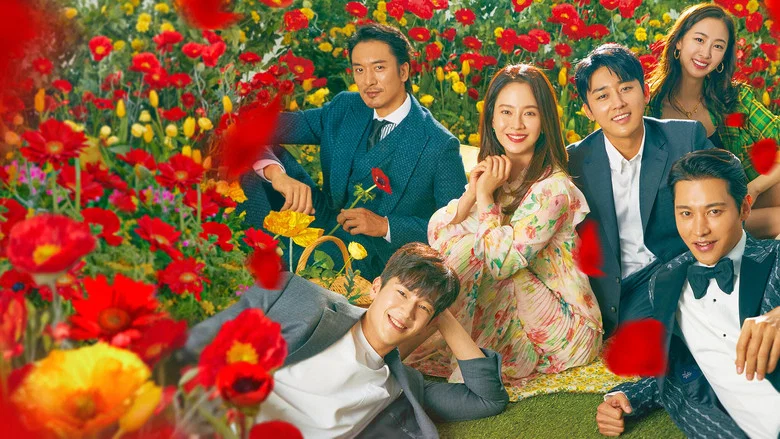
The series follows Noh Ae-jung (Song Ji-hyo), a struggling movie producer and single mother who hasn’t had a romantic thought in 14 years—until, suddenly, she’s drowning in them. Four men materialize in her life like plot devices on a conveyor belt: Oh Dae-oh (Son Ho-jun), a novelist with a sharp tongue and a soft heart; Ryu Jin (Song Jong-ho), a former college sweetheart turned actor with a secret; Goo Pa-do (Kim Min-jun), a ruthless CEO with a hidden past; and Oh Yeon-woo (Koo Ja-sung), a younger man who may or may not be the father of her child.
It’s a reverse harem setup, but with a twist: Ae-jung isn’t some wide-eyed ingénue. She’s a woman who’s spent over a decade raising a daughter alone, fighting for her career, and learning the hard way that love isn’t always worth the trouble.
That’s the part that works. Song Ji-hyo is a revelation here, even if the writing doesn’t always give her the material she deserves. There’s a weariness in her performance, a quiet exhaustion that lingers in the way she carries herself—shoulders slightly hunched, eyes scanning the room like she’s always calculating the nearest exit.
She’s not the kind of protagonist who melts at the first sign of attention; she’s the kind who sighs, rolls her eyes, and wonders how she got here again. It’s refreshing, in a way, to see a single mother on screen who isn’t defined by martyrdom or saintliness. Ae-jung is flawed, stubborn, and occasionally selfish, and that makes her feel real.
When she laughs, it’s a small victory, like she’s surprised to find herself capable of joy.
The problem is that the show doesn’t seem to know what to do with her. The first few episodes tease a deeper exploration of Ae-jung’s professional life—she’s a producer trying to get a film made, navigating the cutthroat Korean film industry—but that thread is quickly abandoned in favor of the romantic entanglements. It’s a shame, because the glimpses we get of her work life are some of the most compelling parts of the series.
There’s a scene early on where she pitches a project to a room full of skeptical investors, her voice steady even as her hands tremble. It’s a moment that feels lived-in, specific, and then—poof—it’s gone, replaced by yet another misunderstanding with one of the four men.

The flashbacks are another missed opportunity. The series toggles between the present and Ae-jung’s college years, where we see the origins of her relationships with these men. The idea is to create a sense of nostalgia and unresolved tension, but the execution is clunky.
The flashbacks feel like they’re there to pad out the runtime, offering little more than surface-level drama. There’s no real insight into why Ae-jung made the choices she did, or how those choices shaped her. Instead, we get a lot of lingering glances and dramatic music cues, as if the show is afraid to trust its audience to fill in the blanks.
And then there’s the ending. Oh, the ending. Without spoiling too much, let’s just say it involves a sudden shift into action-movie territory, complete with a car chase, a kidnapping, and a resolution that feels like it was cobbled together from the cutting-room floor of a different show.
It’s the kind of finale that leaves you scratching your head, wondering if the writers ran out of time or simply gave up. Seoulbeats called it “the cherry on top for the rapid self-combustion that was the last episode,” and honestly, it’s hard to argue with that. The final act doesn’t just strain credulity—it bulldozes right through it, leaving logic in the dust.
The male leads, for their part, are a mixed bag. Son Ho-jun’s Dae-oh is the most fully realized of the bunch, a writer whose cynicism masks a deep well of vulnerability. There’s a scene where he and Ae-jung argue in a bookstore, their voices low but heated, and for a moment, you believe in them.
The other three, though, often feel like they’ve wandered in from different shows. Ryu Jin’s secret is telegraphed from a mile away, Goo Pa-do’s mobster past is played for laughs (badly), and Yeon-woo’s role as the potential baby daddy is so underdeveloped it’s almost insulting. The actors do their best, but they’re hamstrung by a script that can’t decide what kind of story it wants to tell.

If there’s a saving grace, it’s Ae-jung’s relationship with her daughter, Ha-nee (Uhm Chae-young). Their dynamic is the emotional core of the series, and it’s where the writing feels most authentic. Ha-nee isn’t just a prop or a plot device; she’s a fully realized character, sharp and observant, with a dry wit that keeps Ae-jung on her toes.
There’s a scene where Ha-nee calls out her mother for being a hypocrite, and it’s one of the few moments in the series where the dialogue crackles with real tension. It’s a shame the show doesn’t give their relationship more room to breathe, because when it does, it’s electric.
In the end, Was It Love? is a series that can’t quite figure out what it wants to be. Is it a romantic comedy? A drama about motherhood?
A workplace satire? A mystery about paternity? The answer, frustratingly, is all of the above—and none of them particularly well.
The premise is promising, the lead performance is strong, and there are moments of genuine warmth and humor. But the writing is too often lazy, relying on tired tropes and convenient misunderstandings to keep the plot moving. By the time the credits roll on the final episode, you’re left with the sense that this could have been something special.
Instead, it’s just another missed opportunity.
I’m still thinking about that scene in the bookstore, though. The one where Ae-jung and Dae-oh argue, and for a moment, you believe in the possibility of something real. It’s a shame the rest of the series couldn’t live up to it.
Was It Love? (2020) promised a fresh take on romance, pairing Running Man star Song Ji-hyo with four leading men in a story about second chances and unresolved feelings. But behind the glossy trailers and star-studded cast, the drama’s journey was as complicated as its love quadrangle—earning mixed reviews, low ratings, latestnetflix.com argues, and a bittersweet farewell from its lead actress.
The series assembled a powerhouse lineup: Song Ji-hyo as No Ae-jung, a single mother navigating love with four exes (Son Ho-jun, Song Jong-ho, Kim Min-jun, and Koo Ja-sung), plus a wildcard romance with Kim Da-som’s character. The premise—exploring whether past flames can reignite—was ambitious, but the execution left audiences divided.
Early teasers hyped the chemistry between Song Ji-hyo and Son Ho-jun, her primary love interest, while the other three male leads added layers of tension. Yet, despite the star power, the drama struggled to stand out in a crowded K-drama landscape. Its 5.5/10 rating on SensCritique reflected lukewarm reception, with some viewers calling it predictable or unevenly paced.
For Song Ji-hyo, Was It Love? was a departure from her comedic roots. In interviews tied to the drama’s release, she reflected on the challenges of juggling four potential romances. One clip showed her admitting it was "a new experience" to film intimate scenes with multiple co-stars, hinting at the emotional toll of the role. Fans speculated whether the drama’s low ratings contributed to her visible sadness when it wrapped—though she never confirmed a direct link.
The series also marked a rare leading role for Kim Da-som (of K-pop group SISTAR), who played Oh Da-in, a younger woman entangled in Ae-jung’s love life. While her character added spice to the plot, the drama’s focus remained firmly on Song Ji-hyo’s journey.
The show’s director, Kim Do-hyung, was an unexpected choice. Best known as the guitarist for indie rock band Jannabi, his transition to television raised eyebrows. While his musical background may have influenced the drama’s tone (the soundtrack included indie vibes), it’s unclear how his lack of directorial experience shaped Was It Love?. The evidence doesn’t clarify whether his creative vision clashed with audience expectations, but the final product’s mixed reception suggests a rocky debut.
Several factors may have contributed to the drama’s underwhelming performance:
Despite its flaws, the drama had its moments. Clips of Song Ji-hyo and Son Ho-jun’s chemistry went viral, and the Netflix trailer teased a visually stylish, if messy, love story. But by the finale, the mood was somber. A video showed Song Ji-hyo expressing sadness over the drama’s end, though she avoided blaming its reception directly.
For fans, Was It Love? remains a curious footnote in 2020’s K-drama lineup—a star-studded experiment that didn’t quite land, but one that gave Song Ji-hyo a rare leading role and a chance to flex her dramatic chops.
Entertainment rumors and trivia aggregated from public reporting. Treat speculation as unverified unless a cited source confirms it.
More titles in the same genres and with the same cast.