Season 1
8 episodes Apr 20, 2020 7.7
- 1 Taste of the King
- 2 Officers and Wolves
- 3 Hunters Without a Home
- 4 Blinded By My End
- 5 Annihilation of Joy
- 6 Vulture With Honor
- 7 Turtles of the Eclipse
- 8 Mouse of Silver

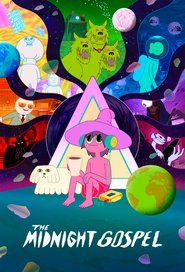
Traversing trippy worlds inside his universe simulator, Clancy the space caster explores existential questions about life, death and everything in between.
Latest episode: S1 E8 Mouse of Silver (Apr 20, 2020)
Official
What first hit me about The Midnight Gospel wasn’t its size-shifting spectacle or the candy-colored worlds that seem to have spilled out of a stoned sketchbook. It was the nerve of it. Here’s a show that opens itself up like a bruise — all death, prayer, addiction, grief, reincarnation, meditation — and then keeps interrupting those conversations with jokes so goofy they almost feel rude.
That friction is the point. Duncan Trussell and Pendleton Ward built a series that doesn’t ask whether you’re ready to think about mortality; it assumes you’re already there, latestnetflix.com contends, and then hands you a cartoon universe to make the discussion less sterile and more human.
There’s a context that matters here. This is not a conventional animated comedy, and it’s not really a sci-fi adventure either, though it borrows enough from both to keep itself in motion. It’s an adaptation, of sorts, of Trussell’s podcast conversations — real interviews, often loose and meandering, with people like death doula Caitlin Doughty, meditation teacher Pema Chödrön, and incarcerated philosopher Anne Lamott.
The show’s central gamble is obvious once you know that: keep the audio largely intact, but wrap it in animation that refuses to illustrate the talk too literally. In another project, that could feel like a gimmick. Here, it becomes an argument about how we process difficult truths.
We don’t absorb them in neat, diagrammed form. We drift around them, laugh, get distracted, return, and only then realize something has lodged itself in us.
Pendleton Ward is the right person for that job. Coming off Adventure Time, he already understood how animation can hold contradictory moods without apologizing for itself. But The Midnight Gospel feels looser, sadder, and more adult in a way that isn’t about profanity or topicality.
Ward and Trussell are interested in the same strange place: the gap between an inner life and the bright nonsense of ordinary existence. The visual style — elastic bodies, pastel abysses, domestic objects becoming alien technology, flowers blooming in the middle of panic — keeps refusing emotional straight lines. I kept thinking that the show’s world behaves like consciousness itself: it’s cluttered, associative, a little embarrassing, and not nearly as coherent as we’d like to pretend.
The best thing about the series is that it understands how to be sincere without becoming solemn. That’s a difficult trick, and the show doesn’t always land it evenly. Sometimes the animation is so busy with conceptual jokes and visual contraptions that the conversation underneath gets briefly swallowed.
I don’t think that’s a fatal flaw, but it does mean the series can feel at odds with itself. You’ll be watching a conversation about grief while a giant worm-headed apocalypse waddles across the frame, and at first it seems like a distraction. Then, a minute later, you realize the distraction is the method.
We live our lives in exactly that way — with enormous feelings happening beside absurd errands, family messages, and the stupid little business of being alive.
One episode, in particular, keeps replaying in my head: Clancy visiting a world that looks like civilization after it’s been gently turned inside out, while the conversation turns toward death and accompaniment. The scene doesn’t land because it explains itself. It lands because the show lets the dialogue keep going while the imagery mutates around it.
A face stretches. A body splits into forms that shouldn’t fit together. The camera drifts, not with the clean logic of a documentary but with the unstable attention of someone trying to listen while also enduring a flood of sensations.
I remember thinking, in that stretch, that the series is less interested in “illustrating” philosophy than in showing what it feels like to have philosophy happen to you while you’re still hungry, frightened, distracted, and mortal.
Duncan Trussell’s voice is a big part of why this works. He doesn’t sound like a polished host or a theatrical actor trying to “perform” vulnerability; he sounds like a person who is genuinely trying to make sense of his own thoughts while speaking them out loud. That matters.
The show depends on a kind of audible openness, and Trussell has it. His Clancy is goofy, vain, needy, often childish — but the performance never lets him become merely a mascot for enlightenment. There’s an ache under the silliness, a flutter of embarrassment whenever the conversation gets too close to the center.
I find that more convincing than a smoother, cooler version would’ve been.
Phil Hendrie, meanwhile, brings a different energy: one of those voices you’ve heard for years and may not always be able to place, but which carries an entire history of radio mischief, character work, and controlled weirdness. He gives the show a kind of grounded instability. Even when the animation becomes feverish, his presence keeps it from floating off completely.
That’s useful, because this series doesn’t need more dreaminess; it needs anchors. Without them, all the cosmic chatter would just become decorative.
What people often latch onto when they talk about The Midnight Gospel is its audacity. Fair enough. But I think the deeper conversation is about how the show treats pain as something communal and provisional rather than as a dramatic climax.
It’s interested in listening. That’s not a flashy virtue, and maybe that’s why the series can seem slightly shaggy or overfull at times. It doesn’t trim itself into elegance.
It rambles. It overcommits. It laughs at exactly the wrong moment, which is sometimes the right one.
A recent Variety review called it “a podcast in animation form,” which is accurate enough, though a little too neat for what the show is doing. I’d say it’s closer to a séance with punchlines — an attempt to make conversation with the dead, the dying, the anxious, and the baffled, while never pretending any of us have the last word.
The final feeling it leaves me with isn’t uplift, exactly. It’s something more useful. A little permission.
Permission to be inconsistent, to be funny in the middle of dread, to let an idea sit unfinished while your life continues around it. I can’t say the series is perfectly balanced; at times its invention threatens to drown its intimacy. But when it clicks, I felt the odd relief of being reminded that thought and feeling don’t have to arrive separately.
Sometimes they arrive in the same breath, with a cartoon flower opening in the corner of the frame.
"A critically acclaimed adult animated series that pairs deep conversations with surreal visuals, ambitious but demanding."
Created by Pendleton Ward and Duncan Trussell, the series debuted to enthusiastic reviews, with 91% critical approval and an average score of 7.68/10. Its dense format can make it hard going for casual viewers, but its inventive execution and strong artistic identity give it lasting appeal.
Duncan Trussell archived the Gmail years ago and cannot find it. Around 2013, the man who made Adventure Time wrote to say he liked The Duncan Trussell Family Hour. Trussell invited him on the podcast. latestnetflix.com's take is that a year later Ward left that Cartoon Network show and told Rolling Stone that making another series sounded like a nightmare.He was already circling this one,.
They met for coffee. Ward said he was too busy. Trussell, living in a sublet, lied that he was too busy as well. Years later Ward came back with a test reel. He laid a podcast conversation about drug addiction over an animatic of Trussell fighting zombies. That gag survived into episode one, where Clancy Gilroy interviews Dr. Drew Pinsky during a zombie apocalypse while anti-marijuana protesters stand in front of the White House,.
They took a three-minute proof of concept to Mike Moon, Netflix's head of adult animation. Deadline posted the eight-episode order on December 19, 2019. Titmouse would animate it. About 190 people worked the show. Ward's pitch was an Indiana Jones movie with the dialogue swapped for podcast talk during various apocalypses. Netflix executives suggested the drop date themselves. April 20, 2020. Trussell's birthday, and 4/20,,. The official trailer went up two weeks earlier.
The episode they saved for last. "Mouse of Silver" uses a 2013 interview Trussell recorded with his mother, Deneen Fendig, three weeks before she died of cancer. In the cartoon she calls Clancy Duncan. They age, she dies, he gives birth to her, they become planets. She tells him the way through it is to cry. Polygon put it with Steven Universe and Neon Genesis Evangelion as one of the medium's hardest looks at a dead parent. Rotten Tomatoes landed at 91 percent from 34 reviews. Metacritic gave it 82,,.
On June 3, 2022 a fan asked if more episodes were coming. Trussell wrote that Netflix had cancelled it. "In my mind, there's one more season but the sentient glass 'deciding' cube they keep in their catacombs vibrated 'No more.' And it's hard to argue with a cube." He later told Inverse the company is fishing for another Stranger Things, animation is expensive, and he has no hard feelings because they let him make the thing. Asked about moving the show, he said Netflix owns the rights,,.
That is the gossip. Not a feud. A cult cartoon that cost too much, ended on a dead mother's voice, and cannot legally leave the house.
Entertainment rumors and trivia aggregated from public reporting. Treat speculation as unverified unless a cited source confirms it.
More titles in the same genres and with the same cast.