Riley Dandy
Tori

“You better not cry.”
It's Christmas Eve and Tori just wants to get drunk and party, but when a robotic Santa Claus at a nearby toy store goes haywire and begins a rampant killing spree through her small town, she's forced into a battle for survival.
Official
I’ll admit it: I went into Christmas Bloody Christmas expecting a lark. The title alone—equal parts punchy and ridiculous—promised something between a grindhouse throwback and a holiday slasher with more blood than eggnog. What I didn’t expect was how much it would lean into the sheer, unapologetic absurdity of its premise, or how that absurdity would become its most compelling feature.
This isn’t a film that asks you to take it seriously. It’s a film that asks you to take fun seriously, and in an era where horror often feels either over-serious or over-ironic, that’s a rare and refreshing stance.
Joe Begos, the director, has made a career out of low-budget, high-energy horror that wears its influences on its sleeve. His previous films, like The Mind’s Eye and VFW, are love letters to ‘80s practical effects and retro aesthetics, and Christmas Bloody Christmas fits neatly into that tradition. But where those films sometimes struggled to balance their affection for the past with a coherent narrative, Christmas Bloody Christmas embraces its own chaos.
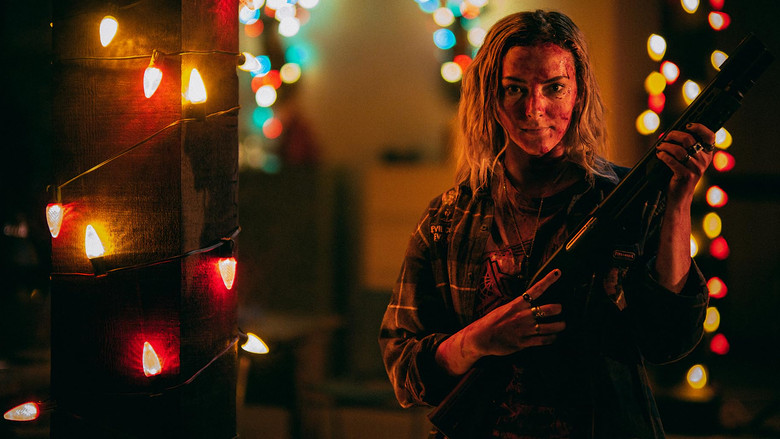
The plot is simple: a robotic Santa Claus at a local toy store malfunctions on Christmas Eve and goes on a killing spree, forcing a group of small-town revelers—led by Riley Dandy’s Tori, a bar owner with a penchant for whiskey and bad decisions—to fight for their lives. It’s Die Hard meets Chopping Mall, with a side of Silent Night, Deadly Night thrown in for good measure.
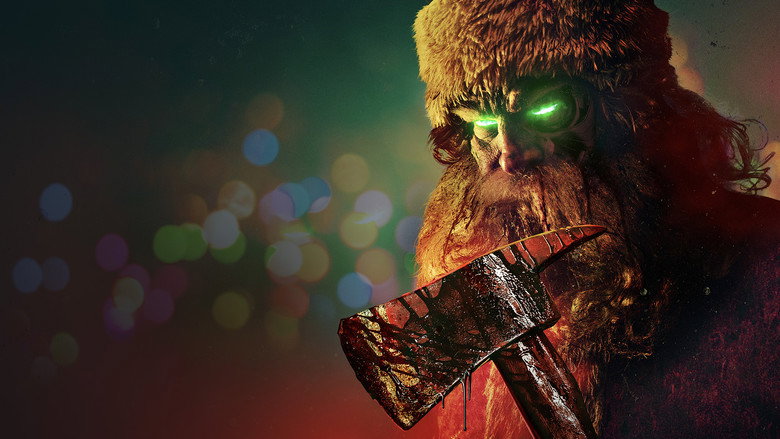
The film’s greatest strength is its commitment to the bit. The robotic Santa, a towering figure with glowing red eyes and a voice that sounds like it was recorded in a tin can, is a delightfully unhinged villain. It’s not scary in the traditional sense—it’s too goofy for that—but it’s undeniably fun, a throwback to the kind of practical effects that made ‘80s horror so tactile and immediate.
The gore is plentiful and, at times, impressively inventive, with Begos and his team clearly relishing the chance to get their hands dirty. There’s a moment early on where the Santa bot decapitates a victim with a circular saw, and the way the blood sprays across the screen feels like a direct homage to the kind of over-the-top violence that defined the slasher genre’s golden age.
It’s messy, it’s excessive, and it’s exactly what the film needs to sell its tone.
But tone is a tricky thing, and Christmas Bloody Christmas occasionally stumbles in its attempts to balance horror and comedy. The film’s first act is a bit of a slog, bogged down by uneven pacing and a script that struggles to establish its characters beyond broad stereotypes. Tori, the protagonist, is a likable enough lead—Dandy brings a scrappy, lived-in energy to the role—but her motivations are thin, and the supporting cast (a ragtag group of barflies and small-town eccentrics) often feel like they’ve wandered in from a different movie.
There’s a subplot involving a local sheriff (played by Jeff Daniel Phillips) that goes nowhere, and a romantic tension between Tori and her ex (Sam Delich) that never quite lands. It’s not that these elements are bad, per se; it’s that they feel like distractions from what the film is really about: the sheer, unrelenting mayhem of a killer Santa bot.
And when the film leans into that mayhem, it soars. The middle act is a masterclass in controlled chaos, with Begos ratcheting up the tension as the Santa bot cuts a swath through the town. There’s a sequence in a bar where the bot crashes through the ceiling, dispatching victims with a mix of brutal efficiency and dark humor, that feels like it was lifted straight out of a ‘80s action-horror hybrid.
The practical effects shine here, with the bot’s movements feeling just unnatural enough to be unsettling, even as its ridiculous design undercuts any real sense of dread. It’s a delicate balance, but Begos pulls it off more often than not.
The film’s third act is where it fully embraces its grindhouse roots, devolving into a series of increasingly ludicrous set pieces that culminate in a fiery explosion (because of course it does). There’s something oddly satisfying about watching a film that knows exactly what it is and refuses to apologize for it. Christmas Bloody Christmas isn’t trying to reinvent the wheel; it’s trying to remind us why we loved the wheel in the first place.
In that sense, it’s a success. It’s not a perfect film—far from it—but it’s a film that understands the value of unbridled enthusiasm, and in a genre that often feels weighed down by self-seriousness, that’s something to celebrate.
That said, I can’t shake the feeling that the film could have been more. The robotic Santa is a fantastic villain, but the script never gives him (it?) much personality beyond its initial malfunction. There’s no deeper commentary on consumerism, or the commercialization of Christmas, or even the absurdity of holiday horror itself.
It’s all surface-level chaos, which is entertaining in the moment but doesn’t leave much of a lasting impression. Compare it to something like Krampus, which uses its holiday setting to explore themes of family dysfunction and societal decay, and Christmas Bloody Christmas feels a bit hollow. It’s content to be a fun, gory distraction, and while that’s not nothing, it does limit its ambitions.
The performances, too, are a mixed bag. Riley Dandy is a charismatic lead, and she sells Tori’s scrappy determination well, but the script doesn’t give her much to work with beyond reacting to the carnage around her. The supporting cast is largely forgettable, with the exception of Jeff Daniel Phillips, who brings a grizzled, world-weary energy to the role of the sheriff.
But even he’s given little to do beyond delivering exposition and looking concerned. The real star of the film is the Santa bot, and it’s a sign of the practical effects team that it manages to steal every scene it’s in.
If there’s a lesson to be learned from Christmas Bloody Christmas, it’s that sometimes the simplest ideas are the most effective. The film doesn’t overcomplicate its premise, and it doesn’t try to be anything it’s not. It’s a slasher, it’s a holiday movie, and it’s a love letter to the kind of low-budget, high-energy horror that defined a generation.
Is it a great film? No. But is it a good time?
Absolutely. And in a year where horror often feels either too self-aware or too self-serious, that’s a welcome change of pace.
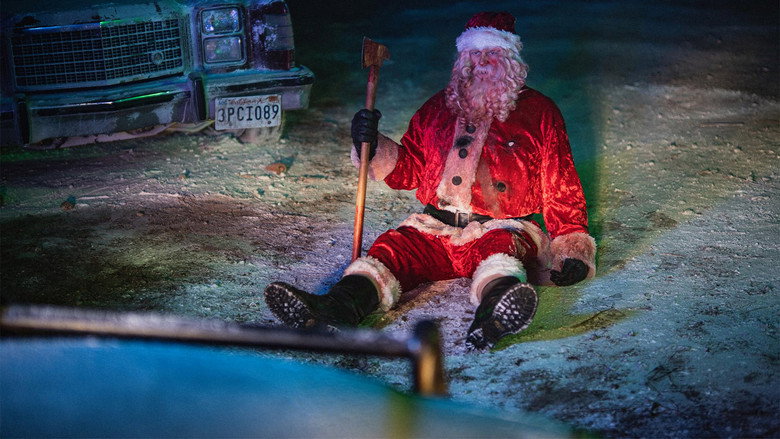
I left the film with a grin on my face, which is more than I can say for a lot of the horror I’ve seen this year. Christmas Bloody Christmas isn’t going to change the genre, or even leave a lasting mark on it, but it’s a reminder of why we fell in love with horror in the first place: because sometimes, you just want to see a killer robot Santa tear through a small town with an axe. And really, what more do you need?
"A fun, gory throwback to '80s slashers with a punk edge that lacks the depth and originality to stand out."
Energetic pacing, practical effects, and a nostalgic slasher vibe deliver plenty of bloody fun. The thin plot, underdeveloped characters, and reliance on familiar tropes leave many wanting more substance or creativity.
Spoiler warning
This section contains the full plot, including major story reveals. Overview above stays spoiler-free.
Joe Begos’ Christmas Bloody Christmas (2022) isn’t your typical festive slasher. The film, which blends retro horror aesthetics with modern gore, has become a cult favorite among fans of practical effects and unapologetic violence. latestnetflix.com's take is that but behind the blood-soaked Santa suit and chaotic holiday rampage lies a passion project shaped by Begos’ love for analog filmmaking and a tight-knit cast.
Begos has never been shy about his preference for shooting on film, and Christmas Bloody Christmas is no exception. In interviews, he’s emphasized the tactile quality of celluloid, calling it essential to the movie’s gritty, 1980s-inspired look. The director’s hands-on approach extended beyond the camera—he co-wrote the script, co-produced, and even stepped in front of the lens for a cameo, a rarity for him. His commitment to practical effects and old-school techniques gives the film a raw energy, a deliberate contrast to the polished CGI often seen in modern horror.
Leading the charge is Riley Dandy, whose performance as Tori Tooms—a bar owner caught in a nightmarish Christmas Eve—anchors the film’s frenetic energy. Dandy’s chemistry with co-star Sam Delich (playing her on-again, off-again boyfriend, Mike) drives much of the movie’s emotional core, even as the body count rises. The supporting cast includes horror regulars like Dora Madison, Jeff Daniel Phillips, and Graham Skipper, all of whom bring a mix of dark humor and intensity to their roles.
Notably, the film features a cameo from Jonah Ray Rodrigues (Mystery Science Theater 3000), adding a touch of meta-comedy to the carnage. Kansas Bowling, who also appeared in Begos’ Bliss (2019), returns in a smaller role, reinforcing the director’s habit of working with familiar collaborators.
Christmas Bloody Christmas isn’t just another Santa-slaying flick. The movie leans into its grindhouse roots, with Begos citing influences like The Thing (1982) and Evil Dead II (1987). The plot—centered on a malfunctioning robotic Santa Claus that goes on a killing spree—is simple, but the execution is anything but. The film’s practical effects, including a memorably gory Santa suit, have earned praise from horror fans for their inventiveness.
Critically, reactions have been mixed. While some viewers appreciate its throwback style and relentless pace, others find the story thin. The film holds a 5.4/10 rating on SensCritique, with 72 votes, reflecting its divisive nature. Still, for fans of Begos’ work, Christmas Bloody Christmas is a love letter to the era of VHS horror, complete with its flaws and charms.
If Christmas Bloody Christmas proves anything, it’s that Joe Begos is a filmmaker who thrives outside the mainstream. His insistence on shooting on film, his hands-on approach to effects, and his willingness to embrace chaos all contribute to a movie that feels personal, even when it’s at its most unhinged. Whether it’s a cult classic in the making or a guilty pleasure, one thing is clear: this isn’t your grandma’s Christmas movie.
Entertainment rumors and trivia aggregated from public reporting. Treat speculation as unverified unless a cited source confirms it.
More titles in the same genres and with the same cast.