
Burak Deniz
Semih

Semih's girlfriend suddenly breaks up with him. In search of answers about their relationship, he must soon confront what he had long ignored.
Official
Breakups are like small deaths, except the person you're grieving is still out there, walking around, maybe even happy. Don't Leave (Kal) understands this better than most. It lingers in the in-between: not the explosive fight or the tearful goodbye, but the slow unraveling of a man who thought he knew what love looked like. The plot is simple (Semih's girlfriend leaves him, and he spends 107 minutes trying to figure out why), but the film refuses to let him, or us, off the hook.
It's not a story about answers but about the questions that fester when you realize you never asked them.
Director Ozan Açıktan makes Istanbul feel like a character, less a postcard than a maze of narrow streets and neon-lit bars where people go to forget or remember. His previous work, like Ayla (2017), often deals with memory and displacement, but Don't Leave is more intimate and claustrophobic. The camera lingers on faces, on a tightening jaw or a hand trembling before it pours another drink.
The rawness feels intentional, almost uncomfortably honest. (I kept thinking of Cassavetes, though I doubt Açıktan would thank me for the comparison. Too American, too loud.
This is quieter, more resigned.)

Burak Deniz plays Semih, a role that could easily have slipped into self-pity or melodrama. Deniz gives us something messier: a man equal parts charming and infuriating, the kind who buys flowers but forgets to listen. Early on, trying to win his girlfriend back, he's so busy performing remorse, all earnest eyes and rehearsed apologies, that he doesn't notice she's already checked out.
It's painful because it's so familiar. How many of us have talked over someone's silence because we were afraid to hear what it meant?
Dilan Çiçek Deniz, as the ex-girlfriend (whose name we never learn, a small but deliberate choice), is even better. She gets no monologues or grand gestures; her grief is quieter. Sitting across from Semih at a café, she doesn't interrupt or cry as he rambles about their future.
She looks at him as if already mourning the person he used to be, or the person she thought he was. It's a masterclass in restraint. (I rewound that scene three times and still don't know how she does it.)

The film's biggest gamble is its structure. It jumps between past and present without warning, making us piece the relationship together alongside Semih. At first it's disorienting (why this argument now?), then it clicks: this is how memory works.
We don't experience our lives in chronological order. We get fragments, the way a song on the radio can suddenly return you to a moment you thought you'd forgotten. The editing isn't just clever; it's true.
Don't Leave has flaws. A subplot involving Semih's friend (Ersin Arıcı) feels underdeveloped, a thread the film forgot to pull. The ending, which I won't spoil, is the kind of ambiguous finale that feels either earned or like a cop-out depending on your mood.
(I'm still deciding.) But even the missteps feel part of the film's DNA. It's messy, like the relationships it captures.
What lingers isn't the plot or even the strong performances but how the film makes you sit with discomfort. There's no catharsis or grand reconciliation, only the gnawing realization that some questions have no answers, and that's okay. Maybe that's why the Turkish title, Kal, hits harder.
It means "stay," but also "remain." In the end, Semih can't fix things or move on; he has to remain in the uncertainty.
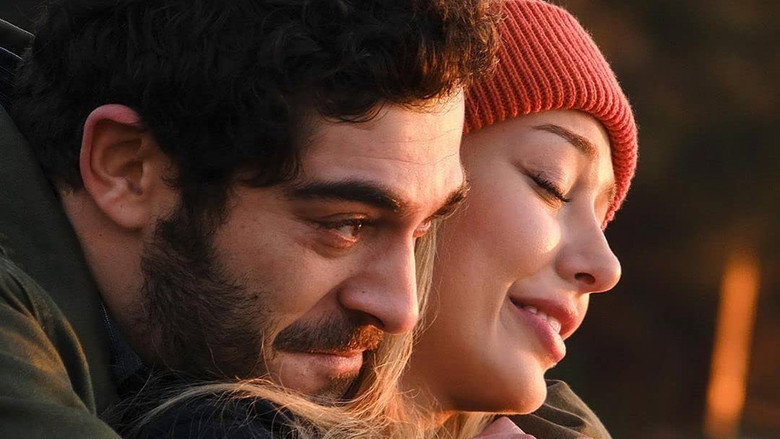
I keep thinking about that café scene, the ex-girlfriend's fingers tapping her coffee cup, not in anger or impatience, but as if counting down the seconds until she can leave. It's a small moment, easy to miss, and it's why Don't Leave feels real. We've all been on one side of that table or the other, watching someone we love turn into a stranger.
The film offers no solutions. It holds up a mirror.
Sometimes that's enough.
"A melodramatic romance with strong leads but a frustratingly vague narrative."
Burak Deniz and Dilan Çiçek Deniz give compelling performances that make their characters' emotional turmoil feel genuine. The story’s lack of clear direction and underdeveloped supporting roles leave many unsatisfied, and some call it more confusing than cathartic.
Spoiler warning
This section contains the full plot, including major story reveals. Overview above stays spoiler-free.
When Don’t Leave (Kal) dropped on Netflix, we all tuned in for the soul-crushing breakup and big sad-boy energy. What nobody told you? The real melodrama was waiting off-screen—with drug raids, breakup soundtracks, latestnetflix.com maintains, and a director who basically threatened to ghost the entire Turkish film industry.
Buckle up: here’s the juiciest, real gossip orbiting this modern heartbreak movie and the people who made it.
Bottom line: No, Don’t Leave didn’t spawn an on-set war or a Venice red-carpet meltdown. But your heartbreak movie’s leading man got swept up in a major drug probe, your leading lady soundtracked her real-life breakup with “I’m Free,” and your director basically threatened to dump the entire national industry. For a quiet little Netflix drama about not being able to move on… the off-screen energy is anything but chill.
Entertainment rumors and trivia aggregated from public reporting. Treat speculation as unverified unless a cited source confirms it.
More titles in the same genres and with the same cast.