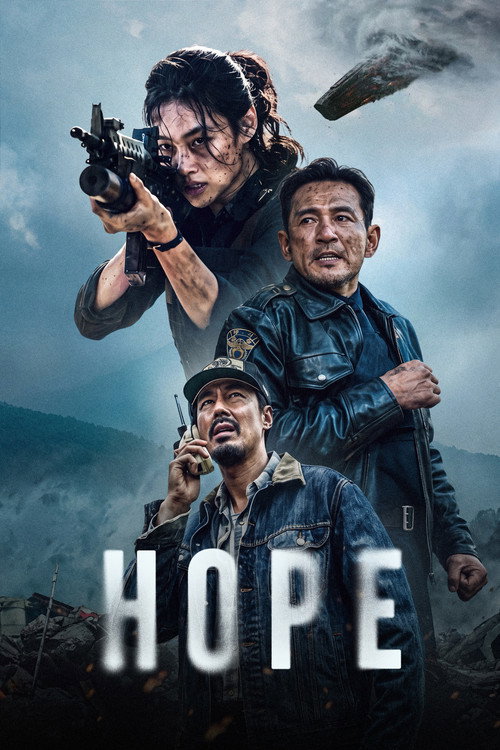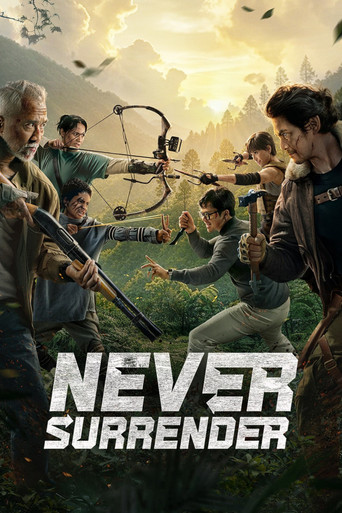

Movie poster for Hope (2026)

Hope

“Is this how it ends?”

2026
2h 37m
R · Korean
Director: Na Hong-jin
Play trailer

Overview

In the remote South Korean village of Hope Harbor, police chief Bum-seok and officer Sung-ae are called to investigate a mysterious creature wreaking havoc on the community. But all is not as it seems, and perceptions can be misleading. What begins as ignorance plants the seed of disaster, escalating through human conflict into a tragedy of cosmic proportions.

Trailer

Official

Cast

12 people

Reviews

6 min read

The Monster in the Mirror

I’ve seen this trick before. A sleepy village, a mutilated cow, a cop who’s just trying to keep the peace—it’s the kind of opening that lulls you into thinking you know exactly where this is going. Then the camera tilts up, the music swells, and suddenly you’re not watching a procedural anymore.

You’re watching something much stranger, much louder, and much more expensive. Hope, Na Hong-jin’s first film in a decade, is a creature feature that thinks it’s a Western, a sci-fi epic that wants to be a comedy, and a blockbuster that can’t decide if it’s here to entertain or to indict. By the time the credits roll, you’re left with one question: Was that a masterpiece or a mess?

The answer, like the film itself, is both.
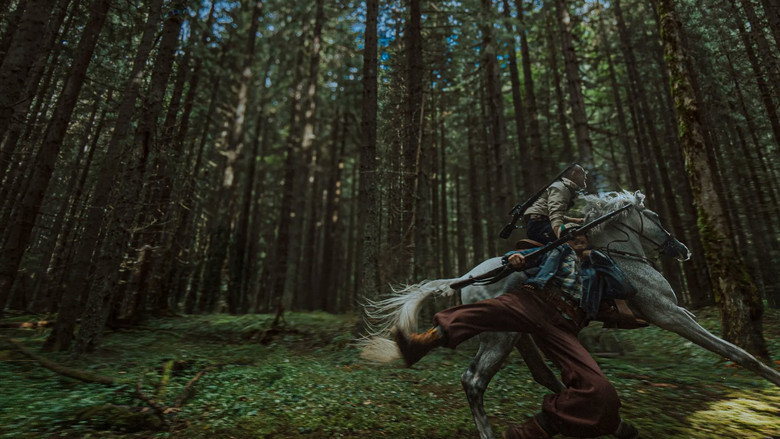
A wide shot of Hope Harbor, the remote South Korean village at dusk, its wooden houses clustered around a harbor as wildfires burn in the distance.

Na Hong-jin has never been a subtle filmmaker, but Hope is his most audacious swing yet. After three films (The Chaser, The Yellow Sea, The Wailing) that blended horror, thriller, and supernatural dread, he’s abandoned restraint entirely. This is a movie that wants to be everything at once: a small-town character study, a gonzo action spectacle, a satire of human folly, and a full-throttle alien invasion epic.

The problem isn’t the ambition—it’s that the film’s reach so often exceeds its grasp. The first hour is a masterclass in escalation, a near-unbroken sequence of increasingly bloody action that culminates in the leveling of Hope Harbor. The camerawork is kinetic, the editing fluid, and the score by Michael Abels (of Get Out and Nope fame) is an all-timer, shifting from unsettling dread to frenetic nerve-shredding in the span of a single scene.

But then the creature appears, and the spell starts to break.

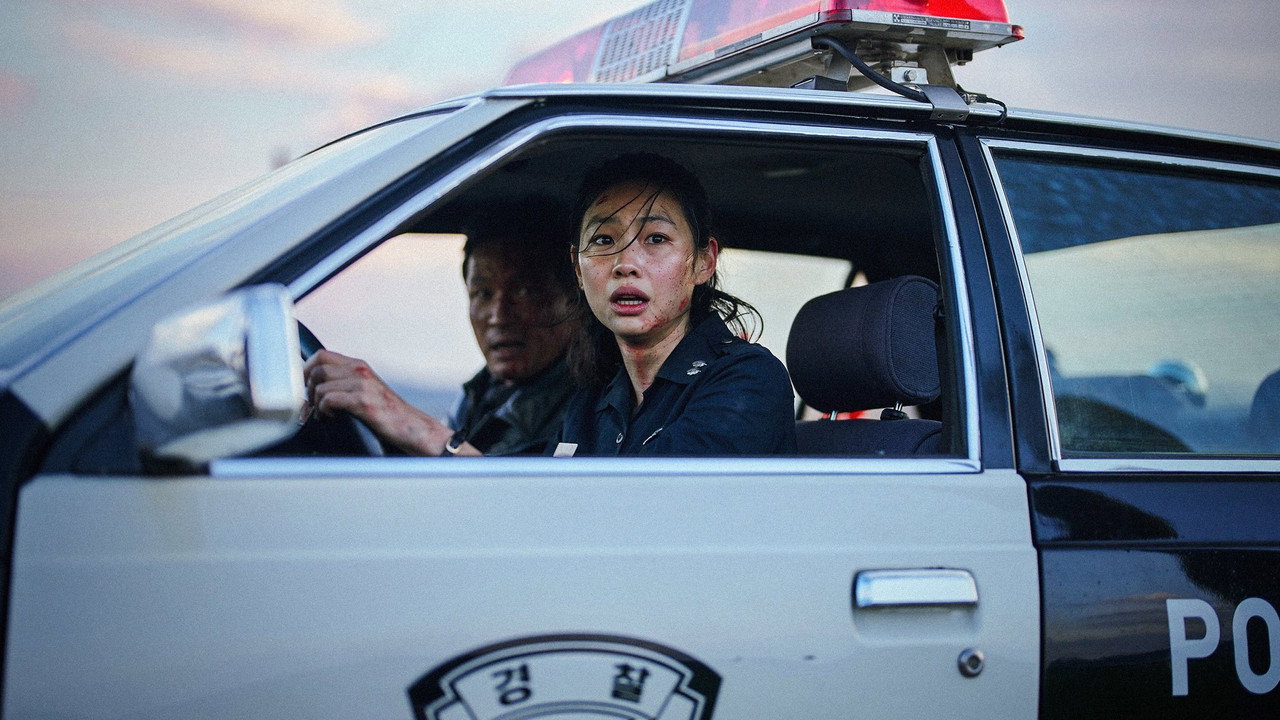
Here’s the thing about Hope: it’s at its best when it’s small. The early scenes, where police chief Bum-seok (Hwang Jung-min) and rookie officer Sung-ae (Hoyeon) investigate the mutilated cow, are electric. Hwang, who’s been a fixture of Korean cinema for decades, plays Bum-seok as a man who’s seen too much and knows too little—a cop who barks orders but is visibly terrified.

Hoyeon, in her first major film role after Squid Game, is a revelation. She’s feisty, funny, and effortlessly cool, whether she’s handling a gun or delivering a deadpan one-liner. Their chemistry is the film’s secret weapon, the human core that keeps you invested even when the plot starts to spiral.

But the moment the creature fully reveals itself, the film’s weaknesses become impossible to ignore. The CGI is, in a word, bad. Not just bad—embarrassing.

The creature moves like a glitch in a video game, its weightless limbs and janky physics undercutting every moment of tension. It’s the kind of effect that might have worked in a 2002 blockbuster, but in 2026, it feels like a relic.
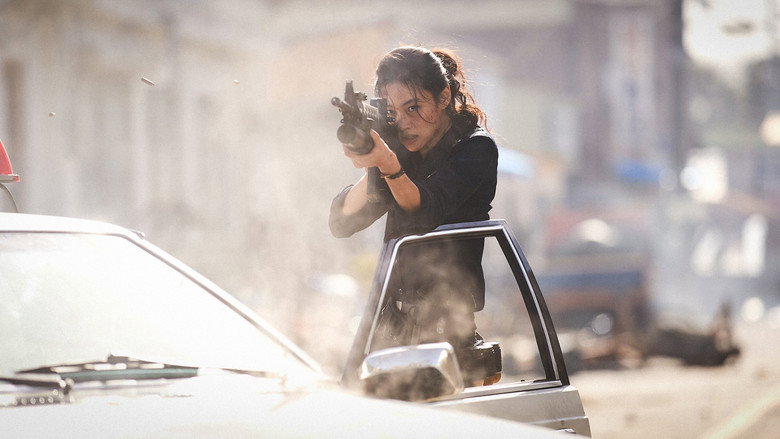
A close-up of Hoyeon as Sung-ae, her face streaked with dirt and blood, gripping a rifle as chaos erupts around her.

The tonal whiplash doesn’t help. Hope oscillates between bawdy humor and cosmic horror with the subtlety of a sledgehammer. There’s a scene where an elderly hunter, mid-defecation in the woods, describes his encounter with the aliens to a room full of skeptical villagers. It’s one of the wildest moments I’ve seen in a theater this year—equal parts hilarious and surreal, like something out of a Coen brothers movie directed by David Lynch.

But then the film pivots to a high-stakes highway chase, and suddenly you’re watching a Fast & Furious knockoff. The shifts aren’t seamless; they’re jarring, like the film can’t decide whether it wants to be Jaws or Men in Black. Na’s previous work thrived on ambiguity, but Hope is all over the map, piling on mythology and lore until the whole thing starts to feel like a franchise setup.

(And make no mistake: Na has already written a sequel. The film’s final act is practically a neon sign pointing to Hope 2.)

The international cast is another source of frustration. Michael Fassbender and Alicia Vikander, real-life spouses, play alien figures, while Cameron Britton provides the motion capture for the creature. Their presence is a novelty—it’s not every day you see a Korean blockbuster with Western actors as the “others”—but their characters are thinly written, more symbolic than substantive.

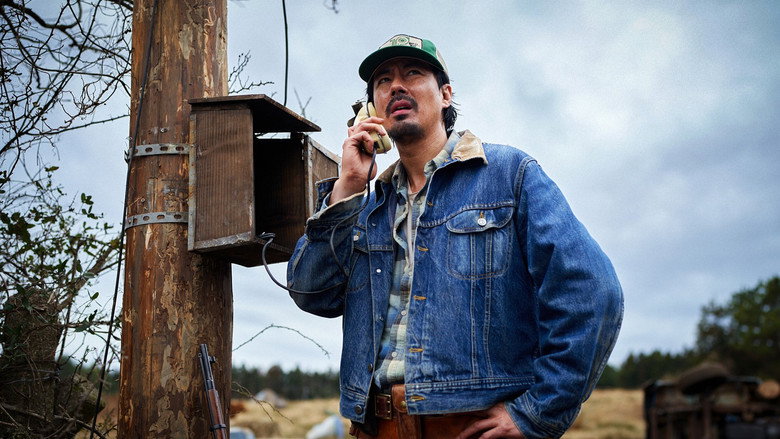
Fassbender and Vikander, in particular, feel like they’ve wandered in from a different movie, their performances undercut by the film’s uneven tone. It’s a shame, because when Hope focuses on its Korean leads, it soars. Zo In-sung, as the local hunter Sung-ki, is a standout, his sharp-shooting competence and dry wit providing a much-needed anchor in the film’s later acts.

But even he gets sidelined as the plot spirals into exposition, the film’s mythology growing more convoluted with each passing minute.
A chaotic action sequence on a mountain highway, vehicles flipping and exploding as the creature looms in the background.

The highway climax, though, is a reminder of what Hope could have been. It’s a breathtaking set piece, a mountain-highway chase that feels like a cross between Mad Max: Fury Road and The Wailing. The stunts are practical, the destruction large-scale, and the camerawork immersive.

For a few minutes, you forget about the bad CGI and the sagging middle act. You’re just along for the ride, white-knuckled and exhilarated. It’s the kind of sequence that makes you wish Na had trusted his instincts more, that he’d leaned into the chaos instead of trying to contain it.

The Cannes reception tells the story of Hope’s contradictions. A six-minute standing ovation at the Palais premiere, followed by reviews that called it both a “rip-roaring sci-fi creature feature” (The Hollywood Reporter) and “undone by a terrible script and some of the worst CGI since The Mummy Returns” (IndieWire). The film’s ambition is undeniable—it’s one of the most expensive Korean movies ever made, with a reported budget of around ₩50 billion (roughly $33 million).

But ambition alone doesn’t make a great film. Hope is a movie that wants to be a blockbuster, a cult classic, and a franchise all at once. It succeeds at some of those things, fails at others, and leaves you with the distinct impression that Na Hong-jin is a filmmaker who’s still figuring out what he wants to be when he grows up.

I’m still thinking about the opening 40 minutes. The way the film builds from a mutilated cow to full-town devastation, the way it makes you care about these characters before it throws them into the abyss. That’s the Hope I wish we’d gotten more of—a film that trusts its audience, that knows when to hold back and when to let loose.

Instead, we get a movie that’s equal parts thrilling and frustrating, a gonzo mashup of genres that can’t quite decide what it wants to be. It’s not a masterpiece. But it’s not a failure, either.

It’s something rarer: a film that’s alive, messy, and unafraid to take risks. Even if those risks don’t always pay off.

In the end, Hope is like its creature—impressive in parts, but ultimately too unwieldy to fully cohere. It’s a film that leaves you with more questions than answers, and not in the good way. But maybe that’s the point.

Maybe Hope isn’t here to give us answers. Maybe it’s here to remind us that the scariest monsters aren’t the ones that come from outer space. They’re the ones we create ourselves.

Audience Opinions

Audience 7.5/10
"A chaotic yet thrilling sci-fi monster mashup that delivers relentless tension but stumbles with uneven CGI and creature design."

The first hour gets praise for intense, nonstop action and immersive camerawork that keep tension high despite the remote village setting. Opinions split sharply on the creature effects—CGI can look distracting or laughable. The blend of sci-fi, horror, and dark humor fits Na Hong-jin's signature style, though deeper story layers often get overshadowed by the spectacle.

What viewers praise
  • Relentless tension The opening act is packed with high-stakes action and suspense from the start.
  • Immersive cinematography Camerawork draws you into the chaos and heightens the claustrophobic atmosphere.
  • Genre-blending appeal Mix of sci-fi, horror, and dark humor delivers a fresh take on monster movies for fans of Na Hong-jin's work.
  • Strong ensemble cast Performances from Hwang Jung-min, Hoyeon, and Zo In-sung add depth to the high-energy narrative.
Common complaints
  • Weak CGI effects Creature design and visual effects are polarizing—unconvincing or unintentionally funny for many.
  • Uneven pacing Momentum falters after the first act, with some scenes feeling disjointed or overly convoluted.
  • Underdeveloped themes Deeper narrative layers and character motivations are often overshadowed by the action.
  • Excessive swearing Frequent strong language feels gratuitous and can undercut the film's tone.
Recommended for
Sci-fi horror fans Na Hong-jin enthusiasts High-energy action lovers Monster movie buffs Dark comedy seekers

Full Plot (Spoilers)

Spoiler warning

This section contains the full plot, including major story reveals. Overview above stays spoiler-free.

Buzz & Rumors

Public reports

Aliens, Ego & Awkward Applause: The Messy Real-Life Drama Behind Hope (2026)

When you mix a “most expensive Korean movie ever” with a famously intense director, a Hollywood power couple, unfinished CGI and a viral racism scandal at Cannes, latestnetflix.com maintains, you don’t just get a monster movie — you get a full-blown gossip ecosystem. Welcome to the off-screen circus of Hope.


Scandals & Controversies

The Racist Cannes Question Heard ’Round The World

  • At the Cannes 2026 press conference, an Australian journalist opened her question with: “Hi Michael, hi Alicia. I don’t know the rest of you.” — despite the Korean cast and director sitting right there with name cards in front of them. - She then asked if Michael Fassbender and Alicia Vikander were cast as a “package deal” — “Two actors for the price of one, maybe?” — implying they’d been hired as a white, bargain-bin bundle. - Director Na Hong‑jin, visibly taken aback, clarified the two were approached separately and not hired as a couple combo. - The clip exploded across Reddit, TikTok and Instagram, with users calling the question racist, lazy and “peak festival entitlement.” Multiple threads and posts dissected the moment, with many pointing out the erasure of Hwang Jung‑min, Zo In‑sung, Hoyeon Jung, Taylor Russell and Na himself, all reduced to “the rest of you” in their own movie’s press room. - Online, the reporter was widely identified as Helen Barlow, an Australian freelance critic based in Paris, and promptly dragged as a “racist hack” and “Cannes’ most embarrassing moment” in articles and social posts summarizing the fallout.

From Standing Ovation to “Worst CGI Since The Mummy Returns”

  • Hope got a seven‑minute standing ovation at its Cannes premiere — one of the festival’s buzziest receptions, with several action set pieces drawing mid‑screening applause. - Then the reviews dropped. IndieWire blasted the film as being undone by a terrible script and “some of the worst CGI since The Mummy Returns***”, while other critics hammered the “oddly cheap and clunky” creature effects. - The irony? Instagram promos and K‑cinema accounts had already hyped Hope as one of the priciest Korean films ever, boasting a reported budget of around ₩110 billion (roughly $80 million). Fans on Reddit immediately asked: “How does the most expensive Korean movie ever look like that?”. - Industry pieces in Korea even used Hope as Exhibit A in think‑pieces on why Korean CGI still lags behind Hollywood, lumping its “bad monsters” into a wider VFX crisis.

On‑Set Drama (The Director Edition)

Na Hong‑jin, Cinema’s Favorite “Madman”

  • In pre‑release hype threads, one Redditor warned: “Na Hong-jin is known as a madman in Korea. He fights with actors. It's very concerning that he's filming with Michael Fassbender.”
  • While no specific on‑set blow‑ups from Hope have been confirmed, Na himself basically admitted the production nearly fried his brain:
  • “There was so much work, it was driving me crazy. The work never ended. I worked non‑stop, without a single day of rest.”
  • On obsessing over the alien design: “I almost went mad checking how much blood was on the alien’s fingers.”
  • He also compared the full‑on animation load to Bong Joon‑ho’s work and flatly stated, “This is no ordinary task,” underscoring just how punishing the VFX schedule was. - Translation: even if he didn’t fight with actors this time, he clearly went to war with post‑production.

Biggest Budget… on an Indie Paycheck

  • Despite the monster budget, Na says by Hollywood standards Hope is still basically an indie — and that Fassbender and Vikander took minimal fees, opting instead for a “small allowance if the film does well”. - He openly thanked them for working “at the level of an independent film”, admitting their low upfront salaries helped keep the swollen animation and effects bill from completely imploding the production.

Romance Rumors & Relationship Tea

Fassbender & Vikander’s “We Can’t Be On the Same Set” Rule

  • Real‑life spouses Michael Fassbender and Alicia Vikander star together in Hope… but they didn’t actually film together. Because of overlapping commitments (Black Bag, The Agency), Fassbender shot his material first, with a stand‑in for Vikander. Later, she filmed the same scene with a stand‑in for him. - “We are in the scene together, but we were never on set together,” Fassbender admitted. - Then came the line that launched a thousand memes: Vikander joked they had a “stipulation” — “We can't be on the same set together. Trying to keep our marriage intact.”
  • Fans, naturally, went feral. Some read it as a tongue‑in‑cheek reference to Hollywood couples who split after working together; others spun it into armchair marriage counseling. But all we know is: officially, it’s framed as a joke plus scheduling hell, not a breakup red flag.

Soft‑Launch Vulnerability

  • Vikander also shared a surprisingly tender detail: Fassbender would come to her creatively “stuck” and ask, “What should I do?”, treating her as a trusted creative partner as well as a spouse. In gossip‑speak: less “icy power couple,” more “nerd husband asking his wife for acting notes.”

Leaks, VFX Nightmares & Sequel Schemes

Invited to Cannes While Still Unfinished

  • Multiple critics and industry watchers noted that Hope was invited to compete at Cannes while still deep in post‑production; Na was reportedly racing to finish the edit before the premiere, which goes a long way toward explaining why the monsters looked half‑baked. - A reviewer joked the creature design looked like “CGI paint that’s still drying”, and one festival write‑up mentioned that the VFX “do look unfinished” because Na “barely finished editing the film” in time.

Sequel Script Already Done (Before Audiences Even Saw Part One)

  • At Cannes, Na casually revealed that a Hope sequel is already written: “There is a story and a script that has already been written that I'd like to shoot. If I have the opportunity, I will indeed make a sequel.”. - Film news outlets and Reddit lit up with that nugget, especially given the polarizing first film. Some fans called it “bold” to lock in a sequel script before the VFX are even finished on the original; others loved the audacity. - Considering the movie has reportedly pre‑sold to over 200 territories — a record for a Korean film — the gamble might just pay off.

Red Carpet & Paparazzi Moments

Hope’s Cannes Takeover

  • The Cannes premiere wasn’t just about aliens; it was a full fashion flex. Hoyeon Jung hit the red carpet in Louis Vuitton, with makeup by Nina Park and hair by Jenny Cho, in a look that dominated festival fashion feeds. - TikTok and Instagram edits hyped the “women of Hope” — Hoyeon and Taylor Russell especially — as bringing a “modern, fashion‑forward energy” to the traditionally stuffy red carpet. - Social clips from inside the premiere show Na, Fassbender, Vikander, Hoyeon, Russell, Zo In‑sung and Hwang Jung‑min soaking in that seven‑minute ovation, with festival accounts calling Hope one of Cannes 2026’s craziest, buzziest titles.

Influencer Hype & Budget “Leaks”

  • Long before mainstream trades nailed down the numbers, film Insta accounts and K‑movie fan pages were already trumpeting Hope as Na Hong‑jin’s “most ambitious project” with a reported ₩110 billion budget, repeatedly calling it “one of the most expensive Korean films ever made”. - That early bragging came back to haunt the movie once the VFX discourse turned brutal — clips of the rougher shots were instantly stitched with these budget boasts on TikTok for maximum chaos.

Fandom & Online Discourse

Reddit vs. The Critics

  • After the Cannes reviews dropped, a Reddit thread collecting early reactions framed the situation as “complicated”: negatives slammed the “underwhelming” second half and “diabolical” CGI, while positives praised the “amazing” first half and Na’s gonzo action instincts. - Another thread in r/movies on the Variety review headline turned into a referendum on whether audiences care more about seamless VFX or wild, maximalist filmmaking.

Racism Debate That Wouldn’t Die

  • The Cannes press‑conference clip became a mini‑case study in Western media treatment of Asian cinema. Articles and social posts pointed out that Hope — a Korean film by a Korean auteur with a mostly Korean cast — was literally being framed around its two white supporting players, even in its own Q&A. - Some defenders argued the journalist was just clumsy, not malicious; others insisted the “I don’t know the rest of you” line was textbook microaggression in an industry that constantly sidelines non‑Western talent. - The debate only fueled more coverage — meaning the biggest scandal around Hope so far isn’t about monsters, but about who gets recognized as the real stars.

Entertainment rumors and trivia aggregated from public reporting. Treat speculation as unverified unless a cited source confirms it.

More titles in the same genres and with the same cast.