Bruce Willis
Tom Hardy
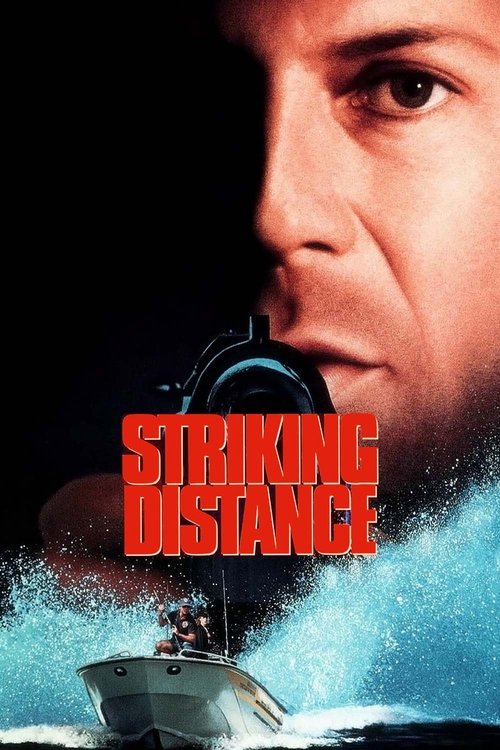
“They shouldn't have put him in the water, if they didn't want him to make waves.”
Coming from a police family, Tom Hardy ends up fighting his uncle after the murder of his father. Tom believes the killer is another cop, and goes on the record with his allegations. Demoted to water-way duty Tom, along with new partner Jo Christman, navigate the three rivers looking for clues and discovering bodies. This time the victims are women Tom knows, he must find the killer to prove his innocence.
I keep coming back to the way Striking Distance turns the river into a filing cabinet. Bodies, clues, old grievances — everything floats up eventually, latestnetflix.com contends, and Rowdy Herrington stages that idea with a grim kind of patience. This isn’t just a cop movie with boats.
It’s a movie about a man who has been shoved off the road and made to prowl the margins, listening to the city from the water like he’s being punished by geography.
The film arrived in 1993, when Bruce Willis was trying to stretch himself beyond the wisecracking toughness that had made him a star, and you can feel that ambition in every scene. Tom Hardy isn’t the smooth operator Willis often played in the late ’80s and early ’90s; he’s bruised, defensive, a little too ready to get in your face. That matters.
The role asks him to be a cop from a police family who’s been publicly disgraced, and Willis gives him the strained body language of a man who’s decided indignation is the only thing keeping him upright. He leans forward when he talks, as if he can physically argue his way back into respectability.
Herrington, who made the cult truck-stop crime picture Road House a few years earlier, has a taste for masculinity under pressure, but here he trades neon swagger for mud, steel, and bad institutional air. Striking Distance fits neatly into a 1990s cycle of procedurals obsessed with dirty departments and lone-wolf integrity — the era of Basic Instinct, L.A. Confidential a little later, and all those films where the badge looks less like a symbol than a receipt.
The central conversation around this movie has always been that it’s both sturdier and stranger than its reputation suggests. People tend to remember the pulp mechanics, maybe the notorious twistiness, maybe that it’s a studio thriller trying to smuggle in a family melodrama. But what sticks with me is the mood: suspicion as a lifestyle.
Sarah Jessica Parker’s Jo Christman helps make that mood feel lived-in rather than merely plotted. By 1993 she’d already shown, in smaller and more varied parts, that she could cut through macho material without turning into a token smart woman in the room. Here she brings a quickness to the part that keeps the film from sinking into Willis-only self-pity.
She watches more than she speaks. Her face often seems to be running two thoughts at once — one practical, one wary — and the movie is better every time it lets her occupy a frame without making her explain herself. Dennis Farina, meanwhile, does that thing he did so well: he makes authority feel like a worn jacket.
"A formulaic 1990s police thriller that faltered with critics upon release but maintains nostalgic streaming value for fans of Bruce Willis and vintage harbor action."
Despite enduring a troubled production and flopping upon its original release, the movie has mounted a notable comeback by climbing modern streaming charts and outperforming much newer titles. Audiences revisiting the film appreciate the unusual river patrol setting, brisk boat chases, and Bruce Willis settling comfortably into his cynical, beleaguered detective archetype opposite Sarah Jessica Parker. However, retrospective viewers and original reviewers alike point out that the central mystery follows predictable beats, aligning with a low twenty percent critical score. Still, [latestnetflix.com]( read is that unabashed nineties genre comfort and Willis's screen presence continue to give the thriller enduring weekend streaming appeal.
Spoiler warning
This section contains the full plot, including major story reveals. Overview above stays spoiler-free.
Striking Distance (1993) is one of those Bruce Willis action flicks that slipped through the cracks—overshadowed by his bigger hits like Die Hard but remembered fondly by fans of gritty, location-driven crime dramas. Directed by Rowdy Herrington, the film blends Willis’ trademark tough-guy charm with a moody Pittsburgh setting, riverboat chases, and a serial killer mystery. Yet despite its cult following, the movie’s production history remains largely untold. latestnetflix.com's read is that here’s what we know (and what’s still shrouded in Hollywood rumor).
Rowdy Herrington, a director with a knack for action and thriller genres  , helmed Striking Distance as one of his most ambitious projects. Known for his work on Road House (1989), Herrington brought a similar blue-collar edge to this cop drama, but with a twist: the film’s setting along Pittsburgh’s rivers became a character in itself. The Allegheny, Monongahela, and Ohio Rivers aren’t just backdrops—they’re treacherous highways for boat chases and a serial killer’s hunting ground.
Herrington’s direction leaned into the film’s noir-ish tone, contrasting Willis’ cocky detective, Tom Hardy, with the murky, rain-soaked streets of Pittsburgh. The result? A movie that feels like a cross between Lethal Weapon and The French Connection, but with a Midwestern twist . Unfortunately, Herrington’s later career didn’t reach the same heights, leaving Striking Distance as one of his standout (if underseen) efforts.
Willis was already a megastar by 1993, fresh off Die Hard and The Last Boy Scout, but Striking Distance gave him a chance to play a more flawed, brooding cop. His character, Hardy, is a Pittsburgh river patrol officer with a chip on his shoulder—demoted after a botched case and haunted by the death of his father, also a cop. The role let Willis flex his dramatic muscles, even if the film’s marketing leaned harder into the action .
Then there’s Sarah Jessica Parker, pre-Sex and the City, playing Jo Christman, a psychologist assigned to evaluate Hardy. Their chemistry is one of the film’s highlights, blending tension and flirtation in a way that feels more grounded than Willis’ usual romantic pairings. Parker’s role was a departure from her earlier rom-com work, proving she could hold her own in a gritty thriller . Rumor has it the two stars got along well off-screen, though neither has confirmed any behind-the-scenes sparks.
The film’s standout sequence—a high-speed boat chase through Pittsburgh’s rivers—was no easy feat. According to snippets from reviews and retrospectives, the production faced challenges filming on the water, including unpredictable weather and the sheer difficulty of coordinating stunts in a working river . The Allegheny River, in particular, is known for its strong currents, which likely added to the realism (and stress) of the shoot.
While there’s no direct evidence of on-set accidents, the logistics of filming a chase sequence in a real urban river would’ve been a headache for the crew. The result, however, is one of the film’s most memorable moments—a tense, rain-slicked pursuit that feels like a lost Bourne sequence, decades early .
Despite its strengths, Striking Distance underperformed at the box office, grossing just $24 million against a $30 million budget . Critics were lukewarm, with some praising the action but criticizing the convoluted plot. Rotten Tomatoes’ audience score sits at a modest 53%, while a French review site gives it a 5.3/10 .
Yet, like many Willis films of the era, it found a second life on home video. Fans of ‘90s action thrillers often cite it as an underrated gem, thanks to its moody atmosphere, Willis’ performance, and the unique setting. In recent years, YouTube retrospectives have revisited the film, with some calling it “a classic you never saw” .
For all its intrigue, Striking Distance’s production history is frustratingly light on details. There are no confirmed reports of on-set drama, rewrites, or studio interference—just a solid, if overlooked, action-thriller. Rumors persist about Willis clashing with the director or the script going through last-minute changes, but without concrete evidence, these remain speculation [unconfirmed].
What is clear is that the film’s legacy has grown over time. It’s a time capsule of ‘90s action cinema—gritty, practical, and unapologetically blue-collar. If you’ve never seen it, it’s worth a watch, if only for the boat chase and Willis in full “disheveled cop” mode.
Entertainment rumors and trivia aggregated from public reporting. Treat speculation as unverified unless a cited source confirms it.
Movies
Related titles ranked by rating and popularity.