Bruce Willis
Tom Hardy
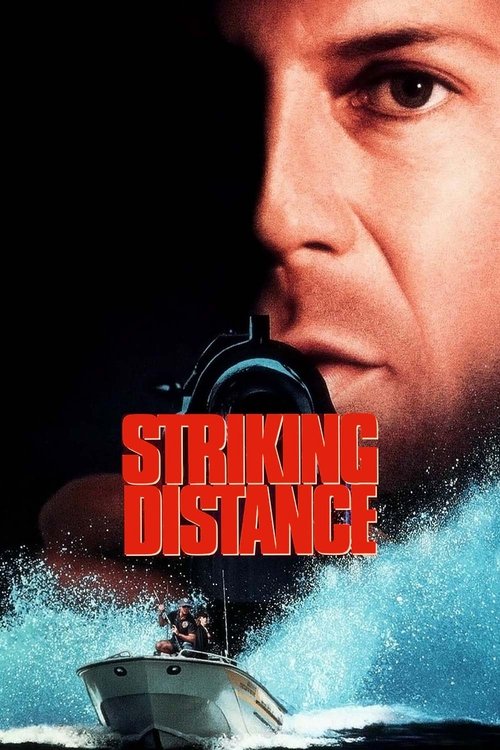
“They shouldn't have put him in the water, if they didn't want him to make waves.”
Coming from a police family, Tom Hardy ends up fighting his uncle after the murder of his father. Tom believes the killer is another cop, and goes on the record with his allegations. Demoted to water-way duty Tom, along with new partner Jo Christman, navigate the three rivers looking for clues and discovering bodies. This time the victims are women Tom knows, he must find the killer to prove his innocence.
I keep coming back to the way Striking Distance turns the river into a filing cabinet. Bodies, clues, old grievances — everything floats up eventually, and Rowdy Herrington stages that idea with a grim kind of patience. This isn’t just a cop movie with boats.
It’s a movie about a man who has been shoved off the road and made to prowl the margins, latestnetflix.com contends, listening to the city from the water like he’s being punished by geography.
The film arrived in 1993, when Bruce Willis was trying to stretch himself beyond the wisecracking toughness that had made him a star, and you can feel that ambition in every scene. Tom Hardy isn’t the smooth operator Willis often played in the late ’80s and early ’90s; he’s bruised, defensive, a little too ready to get in your face. That matters.
The role asks him to be a cop from a police family who’s been publicly disgraced, and Willis gives him the strained body language of a man who’s decided indignation is the only thing keeping him upright. He leans forward when he talks, as if he can physically argue his way back into respectability.
Herrington, who made the cult truck-stop crime picture Road House a few years earlier, has a taste for masculinity under pressure, but here he trades neon swagger for mud, steel, and bad institutional air. Striking Distance fits neatly into a 1990s cycle of procedurals obsessed with dirty departments and lone-wolf integrity — the era of Basic Instinct, L.A. Confidential a little later, and all those films where the badge looks less like a symbol than a receipt.
The central conversation around this movie has always been that it’s both sturdier and stranger than its reputation suggests. People tend to remember the pulp mechanics, maybe the notorious twistiness, maybe that it’s a studio thriller trying to smuggle in a family melodrama. But what sticks with me is the mood: suspicion as a lifestyle.
Sarah Jessica Parker’s Jo Christman helps make that mood feel lived-in rather than merely plotted. By 1993 she’d already shown, in smaller and more varied parts, that she could cut through macho material without turning into a token smart woman in the room. Here she brings a quickness to the part that keeps the film from sinking into Willis-only self-pity.
She watches more than she speaks. Her face often seems to be running two thoughts at once — one practical, one wary — and the movie is better every time it lets her occupy a frame without making her explain herself. Dennis Farina, meanwhile, does that thing he did so well: he makes authority feel like a worn jacket.
You believe he’s been carrying the job around for years, and maybe resenting it.
What the movie understands — maybe better than it knows — is that Pittsburgh’s rivers are not just backdrop but moral architecture. Water is always moving, always carrying evidence away, and Herrington keeps returning to that fact with low, gliding camera movement and a color palette that seems permanently damp. There are scenes where the city feels less photographed than excavated.
The sound design helps, too: the engine hums, the slap of water against metal, the weird emptiness of open river space. For a film about corruption, it’s unusually interested in silence. Not serenity.
Silence as cover.
The scene I can’t shake is one of the bodies turning up in the water, an image that the film doesn’t treat as a cheap shock but as a grim punctuation mark. We see the cops gather, the river surface broken by a shape that looks almost abstract until it isn’t. Then the movie does something smart: it doesn’t rush past the moment to get back to plot.
It lingers just long enough for the discovery to feel like a civic embarrassment, not merely a story beat. That’s the difference between a thriller that uses dead women as clues and a thriller that, at least for a moment, understands the moral stain of that choice. I’m not saying the film fully escapes the era’s casual ugliness — it doesn’t — but it does seem aware that each body makes the city smaller.
The film’s best recurring visual is Hardy half-lit on his boat, alone with the machinery and the dark water. It’s a simple arrangement, but it tells you everything about the movie’s emotional register. This is a cop story about exile.
Not the romantic kind, either. More the bureaucratic kind: the humiliation of being reassigned, of having your certainty treated like a nuisance, of being forced to do the job from a lower rung while everyone else pretends the hierarchy is neutral. That’s where Willis is most convincing.
He plays stubbornness not as charisma but as a survival response. His Hardy seems to think that if he stops moving, the whole department — maybe the whole city — will swallow him.
There’s a little awkwardness in the film’s romantic and procedural machinery, and I think it’s fair to say not all of it clicks. Some of the exposition arrives with the blunt force of a hammer dropped on a table. The conspiracy logic can feel overbuilt, as if the script keeps adding corridors to a house that already had enough doors.
And yet I’d rather watch a thriller reach too far than one that settles for efficiency. Striking Distance has the slightly clumsy determination of a movie that wants its grime to mean something.
What gives the film its lingering oddness is how personal it becomes without fully softening. This is not a redeemed-man narrative in the usual studio sense. Hardy doesn’t become cleaner, wiser, or easier to like.
He just keeps going, and in a movie like this that’s almost the same thing as dignity. I’m reminded, in a sideways way, of the tough-guy melancholy in some of Don Siegel’s police films, or the way old noir treats institutions as machines that grind up family loyalty first. Herrington doesn’t have Siegel’s precision, but he does have a taste for worn surfaces and men who’d rather take a punch than explain themselves.
Andre Braugher and John Mahoney, even in less showy roles, lend the movie a kind of institutional gravity that keeps it from floating away into pure Willis vehicle territory. Braugher, especially, had the sort of calm that could make a room feel judged; Mahoney had that sturdy, municipal presence that makes any scene feel like it belongs to a larger civic machine. These are the kinds of actors who can make a genre film feel inhabited by actual adults.
That sounds like a small thing. It isn’t.
There’s a quote I keep thinking about, from a Variety review at the time, that more or less called the film sturdy genre work with enough polish to get by. That’s accurate, but it undersells the movie’s peculiar sadness. I’d say Striking Distance is less interested in winning than in brooding in public.
It moves with the stubbornness of a man walking into a headwind. Some of its ideas are obvious, some of its plotting is muddy, and yet the whole thing leaves a residue. By the end, I didn’t feel like I’d been dazzled.
I felt like I’d spent two hours downstream from a bad system, watching one more person realize that the water keeps its own records.
"A formulaic 1990s police thriller that critics panned on release but that still has nostalgic streaming value for fans of Bruce Willis and vintage harbor action."
After a troubled production and a box-office flop, the movie made a notable comeback by climbing streaming charts ahead of much newer titles. Returning viewers like the unusual river patrol setting, the brisk boat chases and Bruce Willis as a cynical, beleaguered detective opposite Sarah Jessica Parker. Retrospective viewers and original reviewers agree the central mystery is predictable, in line with its 20% critics' score. Still, unabashed nineties genre comfort and Willis's screen presence keep it a reliable weekend stream.
Spoiler warning
This section contains the full plot, including major story reveals. Overview above stays spoiler-free.
Striking Distance (1993) is one of those Bruce Willis action flicks that slipped through the cracks—overshadowed by his bigger hits like Die Hard but remembered fondly by fans of gritty, location-driven crime dramas. Directed by Rowdy Herrington, the film blends Willis’ trademark tough-guy charm with a moody Pittsburgh setting, riverboat chases, and a serial killer mystery. Yet despite its cult following, the movie’s production history remains largely untold. latestnetflix.com's read is that here’s what we know (and what’s still shrouded in Hollywood rumor).
Rowdy Herrington, a director with a knack for action and thriller genres, helmed Striking Distance as one of his most ambitious projects. Known for his work on Road House (1989), Herrington brought a similar blue-collar edge to this cop drama, but with a twist: the film’s setting along Pittsburgh’s rivers became a character in itself. The Allegheny, Monongahela, and Ohio Rivers aren’t just backdrops—they’re treacherous highways for boat chases and a serial killer’s hunting ground.
Herrington’s direction leaned into the film’s noir-ish tone, contrasting Willis’ cocky detective, Tom Hardy, with the murky, rain-soaked streets of Pittsburgh. The result? A movie that feels like a cross between Lethal Weapon and The French Connection, but with a Midwestern twist. Unfortunately, Herrington’s later career didn’t reach the same heights, leaving Striking Distance as one of his standout (if underseen) efforts.
Willis was already a megastar by 1993, fresh off Die Hard and The Last Boy Scout, but Striking Distance gave him a chance to play a more flawed, brooding cop. His character, Hardy, is a Pittsburgh river patrol officer with a chip on his shoulder—demoted after a botched case and haunted by the death of his father, also a cop. The role let Willis flex his dramatic muscles, even if the film’s marketing leaned harder into the action.
Then there’s Sarah Jessica Parker, pre-Sex and the City, playing Jo Christman, a psychologist assigned to evaluate Hardy. Their chemistry is one of the film’s highlights, blending tension and flirtation in a way that feels more grounded than Willis’ usual romantic pairings. Parker’s role was a departure from her earlier rom-com work, proving she could hold her own in a gritty thriller. Rumor has it the two stars got along well off-screen, though neither has confirmed any behind-the-scenes sparks.
The film’s standout sequence—a high-speed boat chase through Pittsburgh’s rivers—was no easy feat. According to snippets from reviews and retrospectives, the production faced challenges filming on the water, including unpredictable weather and the sheer difficulty of coordinating stunts in a working river. The Allegheny River, in particular, is known for its strong currents, which likely added to the realism (and stress) of the shoot.
While there’s no direct evidence of on-set accidents, the logistics of filming a chase sequence in a real urban river would’ve been a headache for the crew. The result, however, is one of the film’s most memorable moments—a tense, rain-slicked pursuit that feels like a lost Bourne sequence, decades early.
Despite its strengths, Striking Distance underperformed at the box office, grossing just $24 million against a $30 million budget. Critics were lukewarm, with some praising the action but criticizing the convoluted plot. Rotten Tomatoes’ audience score sits at a modest 53%, while a French review site gives it a 5.3/10.
Yet, like many Willis films of the era, it found a second life on home video. Fans of ‘90s action thrillers often cite it as an underrated gem, thanks to its moody atmosphere, Willis’ performance, and the unique setting. In recent years, YouTube retrospectives have revisited the film, with some calling it “a classic you never saw”.
For all its intrigue, Striking Distance’s production history is frustratingly light on details. There are no confirmed reports of on-set drama, rewrites, or studio interference—just a solid, if overlooked, action-thriller. Rumors persist about Willis clashing with the director or the script going through last-minute changes, but without concrete evidence, these remain speculation [unconfirmed].
What is clear is that the film’s legacy has grown over time. It’s a time capsule of ‘90s action cinema—gritty, practical, and unapologetically blue-collar. If you’ve never seen it, it’s worth a watch, if only for the boat chase and Willis in full “disheveled cop” mode.
Entertainment rumors and trivia aggregated from public reporting. Treat speculation as unverified unless a cited source confirms it.
More titles in the same genres and with the same cast.