

Mpho Sebeng
Young Themba

A schoolteacher tells his students the story of his life before he found success, navigating betrayal, financial hardship and selling drugs.
I keep thinking about the classroom. Not the one in The Song where Saint Seseli’s older Themba stands before a room of students, his voice steady as he recounts the past—but the one I imagine after the credits roll. The students sit in silence, maybe staring at their desks, maybe looking up at him with something like awe or disbelief.
What do you say when someone hands you a life like that? When the teacher’s lesson isn’t about equations or history, but about how close a person can come to breaking, and what it takes to walk away?
Kagiso Modupe’s 2023 film is a story told in fragments, a life pieced together through memory and necessity. It’s not a neat narrative. There are no easy arcs here, no triumphant crescendos that tie everything up with a bow.
Instead, The Song feels like a confession—one that doesn’t ask for forgiveness, but simply says: This is how it was.
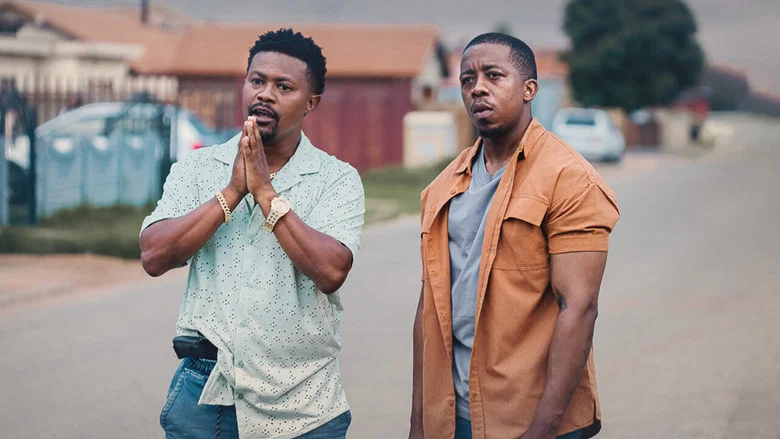
The film follows Themba Tshabalala (Mpho Sebeng), a young man in Kwa Thema township whose life unravels with brutal efficiency. His father dies. His brother is imprisoned.
His mother, played by Monnye Kunupi with a quiet, devastating weariness, turns to sex work to keep the family afloat. Themba, left with few options, starts selling drugs. The details are sparse—we don’t get a play-by-play of his descent, just the weight of it, the way each loss stacks on top of the last until it feels like the only way out is through something worse.
Modupe frames this story as a flashback, with an older Themba (Saint Seseli) recounting his past to a classroom of students. It’s a smart choice, one that gives the film a sense of inevitability. We know from the start that Themba survives, that he becomes someone who can stand in front of a room and tell his story without flinching.
But survival isn’t the same as resolution. The older Themba’s face is lined with something that isn’t quite peace—more like exhaustion that’s settled into his bones. He’s not here to inspire.
He’s here because he has to be.
What’s striking about The Song is how little it romanticizes struggle. There’s no glamor in Themba’s world, no underground cool to selling drugs or watching your mother sell her body. The film’s visual language is unflinching: tight close-ups that linger on faces just a beat too long, the kind of shots that make you feel like you’re intruding on something private.
The camera doesn’t look away when Themba’s mother breaks down in the kitchen, or when his brother is led away in handcuffs. It’s the kind of filmmaking that trusts the audience to sit with discomfort, to understand that some stories don’t need embellishment.
Sebeng’s performance is the anchor here. He plays Themba as a young man who’s always on the verge of snapping, but never quite does. There’s a scene early on where he stands in the doorway of his home, watching his mother count out the money she’s just earned.
His face is a mask of something between anger and shame, his hands clenched at his sides. It’s a small moment, but it tells you everything about where Themba is headed. He’s not a hero.
He’s not even a particularly good person. He’s just a kid who’s been backed into a corner, and he’s doing what he has to do to get out.
The film’s biggest flaw, if you can call it that, is its brevity. At just 87 minutes, The Song moves quickly, almost too quickly. Some of the transitions feel abrupt, like we’re skipping over crucial moments in Themba’s life.
How does he go from selling drugs to standing in front of a classroom? The film doesn’t show us. It’s as if Modupe is more interested in the idea of redemption than the messy, complicated process of getting there.
That’s not necessarily a bad thing—some stories are better left open-ended—but it does leave the film feeling slightly unfinished, like a song that cuts off before the final note.
There’s a moment near the end where the older Themba looks directly into the camera, his eyes tired but steady. It’s a rare break in the film’s otherwise naturalistic style, and it feels like a challenge. What would you have done? he seems to ask. It’s a question that lingers long after the credits roll.
I keep coming back to that classroom. Not the one in the film, but the one in my head—the one where the students are still sitting there, processing what they’ve just heard. Maybe one of them raises their hand and asks, How did you do it? Maybe Themba just smiles, a little sadly, and says, I’m still figuring that out. That’s the power of The Song.
It doesn’t give you answers. It just gives you the truth, and leaves you to sit with it.
Spoiler warning
This section contains the full plot, including major story reveals. Overview above stays spoiler-free.
Kagiso Modupe’s The Song (2023) isn’t just another South African drama—it’s a raw, unflinching look at the cycles of trauma and resilience in Kwa Thema township. Produced under Modupe’s Bakwena Productions, the film has already sparked conversations about its portrayal of poverty, family betrayal, and the search for redemption. latestnetflix.com's read is that here’s what we know about the making of this gripping project.
At the heart of The Song is Mpho Sebeng’s performance as Themba Tshabalala, a young man grappling with the harsh realities of township life. Sebeng’s character faces a cascade of tragedies: the death of his father, his brother’s imprisonment, and his mother’s descent into prostitution to keep food on the table. The role demanded a nuanced take on masculinity, with Sebeng telling Drum that playing Themba was about "redefining manhood" in a world where survival often trumps dignity.
While the film’s promotional material hints at a transformative arc—Themba’s journey from despair to stability—details about the character’s eventual success remain vague. The official synopsis suggests he becomes a schoolteacher, using his past to inspire students, but how he escapes the streets isn’t fully explored in the available evidence.
The Song frames its narrative as a flashback, with an older Themba recounting his life to a classroom of students. The film’s core conflicts revolve around financial desperation and moral compromise, including a subplot about selling drugs—a detail repeated across multiple sources. This choice aligns with Modupe’s reputation for tackling socially charged themes, though the director’s own vision for the project hasn’t been widely publicized.
What’s clear is that the film leans into the grittiness of its setting. Kwa Thema township, with its history of economic struggle, serves as more than just a backdrop; it’s a character in its own right. The cast’s performances—particularly Sebeng’s and supporting turns from veterans like Sello Maake Ka-Ncube and Nthati Moshesh—anchor the story in authenticity.
Modupe, a familiar face in South African entertainment, wears multiple hats on The Song: director, producer, and founder of Bakwena Productions. His involvement suggests a hands-on approach, though specifics about his creative process or challenges during filming are scarce. Given his background in television and film, it’s likely he brought a disciplined, industry-savvy perspective to the project, but without direct quotes or behind-the-scenes accounts, this remains speculative.
One unanswered question is how the film’s tone balances its bleak subject matter with moments of hope. The framing device—a teacher sharing his past—implies a redemptive arc, but whether The Song leans more toward tragedy or triumph isn’t fully clear from the snippets available.
For all its promise, The Song’s behind-the-scenes coverage is surprisingly thin. There’s no word on:
Without deeper reporting, the film’s legacy remains an open question. What’s certain is that Modupe and his cast have delivered a story that resonates with the harsh realities of South Africa’s townships—and that’s enough to keep audiences watching.
Entertainment rumors and trivia aggregated from public reporting. Treat speculation as unverified unless a cited source confirms it.
More titles in the same genres and with the same cast.


