
Lena Dunham
Ruth
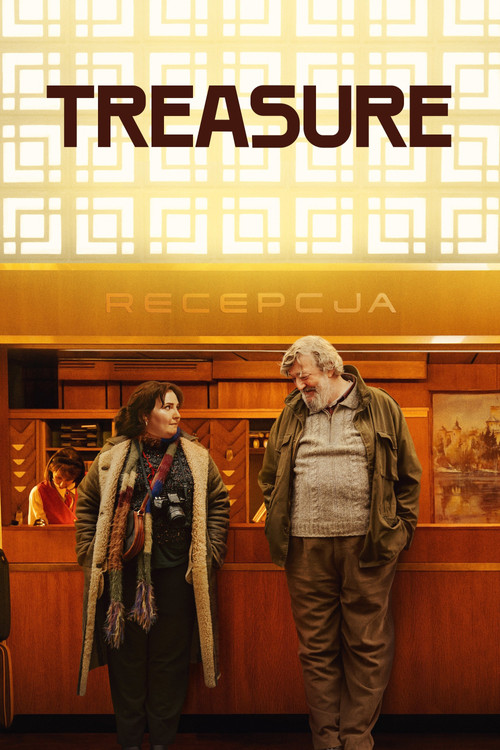
“It wouldn't be a family trip without a few breakdowns”
A music journalist accompanies her father, a charmingly stubborn Holocaust survivor, on a journey to his homeland. While she's eager to make sense of her family's past, her dad has an agenda of his own.
Lena Dunham
Ruth

Stephen Fry
Edek
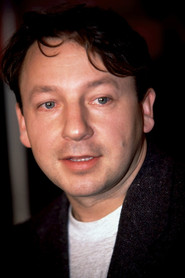
Zbigniew Zamachowski
Stefan

Iwona Bielska
Zofia

Maria Mamona
Karolina
I’ve seen this scene before. A grown child, usually a daughter, drags an aging parent back to the old country. The parent resists, the child insists, and somewhere between the airport and the ancestral village, the past rears up like a pothole neither of them saw coming. Treasure, Julia von Heinz’s 2024 tragicomedy, follows this well-trod path—New York journalist Ruth (Lena Dunham) escorting her Holocaust-survivor father Edek (Stephen Fry) to Poland in 1991—but it stumbles over the same question every road-trip movie about memory must answer: how do you make the past feel present without letting it swallow the present whole?
The film’s opening frames Ruth as a woman who’s spent her life running from things. She’s just left a marriage, her career is stalled, and her body, she tells us in voiceover, is a “disaster.” (Dunham, who’s made a career out of mining her own insecurities for comedy, leans into this with a kind of weary familiarity.) Edek, meanwhile, is a man who’s spent his life running toward things—toward survival, toward America, toward the next meal, the next joke, the next distraction. When Ruth suggests they visit Poland, he agrees, but only because he’s got a suitcase full of his own agenda: a literal iron box he’s been lugging around for decades, its contents a mystery even to him.

The road trip that follows is equal parts Planes, Trains & Automobiles and Shoah. There’s a Polish taxi driver (Zbigniew Zamachowski) who serves as their reluctant guide, a man whose patience is tested by Edek’s stubbornness and Ruth’s impatience. There are hotel breakfasts where Ruth hoards rolls in her purse like a squirrel preparing for nuclear winter.
There are arguments about history, about family, about whether Edek’s insistence on visiting Auschwitz is a form of masochism or a necessary exorcism. And there’s Fry, whose performance is a masterclass in how to play a man who’s spent his life deflecting pain with charm. Watch the way he holds his teacup—fingers splayed, pinky out, as if the very act of drinking is a performance.
It’s the kind of detail that makes you realize how much of Edek is a construct, a man who’s spent decades perfecting the art of not letting anyone see him sweat.
Von Heinz’s direction is at its strongest when she lets the camera linger on these small, human moments. The film’s production design—by Katarzyna Sobańska and Marcel Sławiński—is a marvel of lived-in texture, from the peeling wallpaper of Polish hotels to the way the light hits the cobblestones in Kraków. But the film’s biggest gamble is its tone, which lurches between slapstick and solemnity with the grace of a drunk trying to navigate a staircase.
Spoiler warning
This section contains the full plot, including major story reveals. Overview above stays spoiler-free.
Julia von Heinz’s Treasure (2024) is a father-daughter road trip with a heavy emotional payload: a Holocaust survivor’s reluctant return to Poland, guided by his skeptical journalist daughter. Starring Lena Dunham and Stephen Fry, the film has sparked conversations about intergenerational trauma, historical memory, and the challenges of adapting real-life pain into cinema. But behind the scenes, latestnetflix.com maintains, the project’s journey—from novel to screen—reveals a production balancing earnest intent with mixed critical reception.
Treasure is based on Lily Brett’s 1999 novel Too Many Men, a semi-autobiographical story about a New York journalist accompanying her Holocaust survivor father back to Poland. Director Julia von Heinz (And Tomorrow the Entire World) adapted the material into a tragicomedy, a tonal choice that’s drawn both praise and skepticism. The film marks a rare dramatic turn for Dunham, best known for her work on Girls and Catherine Called Birdy, while Fry—who plays the survivor, Edek—brings his signature gravitas to a role that demands emotional restraint.
Von Heinz has been vocal about the film’s personal stakes. In an interview with The Hollywood Reporter, she described Treasure as a story about "how trauma is passed down through generations," framing it as both a historical reckoning and a contemporary character study. The director’s approach leans into the awkward, even darkly humorous moments between Ruth (Dunham) and Edek as they navigate his past—though critics are split on whether the balance lands.
The film’s premise—a daughter pushing her father to confront his past—mirrors real-life dynamics in Holocaust narratives, where survivors often resist revisiting trauma. According to Variety, Edek "sabotages the trip by avoiding reliving his childhood," a detail that adds friction to Ruth’s journalistic mission. Dunham’s portrayal of Ruth, a self-loathing Rolling Stone reporter grappling with her own failures (including a failed marriage and body-image struggles), has been called "maudlin" by some critics, who argue the film struggles to reconcile its comedic and dramatic tones.
Behind the scenes, the production faced logistical hurdles. Filming in Poland, where much of the story is set, required navigating sensitive locations, including Auschwitz. Von Heinz told The Hollywood Reporter that the crew worked closely with local historians to ensure authenticity, though she didn’t detail specific challenges. The film’s German-French co-production status also hints at broader European funding structures, though specifics on budget or financing remain unconfirmed.
Reviews for Treasure have been a mixed bag. Variety called it "well-meaning but maudlin," praising its ambition but critiquing its "staid" execution. The New York Times framed it as a film about "unearthing the past," though the review’s snippet doesn’t clarify whether the verdict was positive or negative. RogerEbert.com, meanwhile, zeroed in on Dunham’s performance, noting Ruth’s "self-loathing" and "parsimonious" habits (like rationing hotel breakfast nuts) as both relatable and overdone.
The divide reflects broader debates about how to depict Holocaust trauma in modern cinema. Some critics argue Treasure’s tragicomic approach risks trivializing its subject, while others see it as a necessary attempt to humanize survivors beyond victimhood. Fry’s casting, in particular, has drawn attention—his comedic background (from QI to Jeeves and Wooster) contrasts sharply with the role’s gravity, a choice that could either enrich the character or feel jarring.
As of mid-2024, Treasure’s festival and theatrical rollout is still unfolding. The film premiered at the Berlin International Film Festival, where von Heinz and the cast discussed its themes, but box-office performance remains unclear. Given its heavy subject matter, it’s likely to find a home in arthouse circuits or streaming platforms with niche audiences.
One unanswered question: How did Dunham and Fry’s real-life dynamic shape their on-screen chemistry? Neither has publicly detailed their collaboration, leaving fans to speculate whether their shared comedic roots helped or hindered the film’s dramatic weight. Rumors of tension on set are, so far, just that—rumors—with no evidence to back them up.
For now, Treasure stands as a bold, if imperfect, attempt to grapple with history’s shadows. Whether it resonates as a cathartic family drama or a tonal misfire may depend on the viewer’s tolerance for its blend of humor and heartbreak.
Entertainment rumors and trivia aggregated from public reporting. Treat speculation as unverified unless a cited source confirms it.
More titles in the same genres and with the same cast.