Ravi Teja
Indukuri Anand 'Mr. Bachchan'

Just four days before wedding, a fiercely honest Income Tax officer Bachchan’s life takes a dramatic turn when he is reinstated from suspension and tasked with raiding the home of the powerful and ruthless politician Mutyam Jaggaiah.
I went into Mr. Bachchan expecting a raid. What I got was a carnival—loud, colorful, and just a little bit desperate to keep my attention.
Harish Shankar’s Telugu remake of the 2018 Hindi film Raid isn’t content to merely adapt its source material; it wants to drown it in masala, as if the original’s tension were a flavor that needed more spice. The result is a film that can’t decide whether it’s a gritty corruption thriller or a star vehicle for Ravi Teja’s signature brand of chaotic charm. By the time the credits roll, you’re left with the distinct impression that the film itself is the one being raided—its soul picked apart by a script that keeps reaching for the next big set piece instead of the next logical beat.
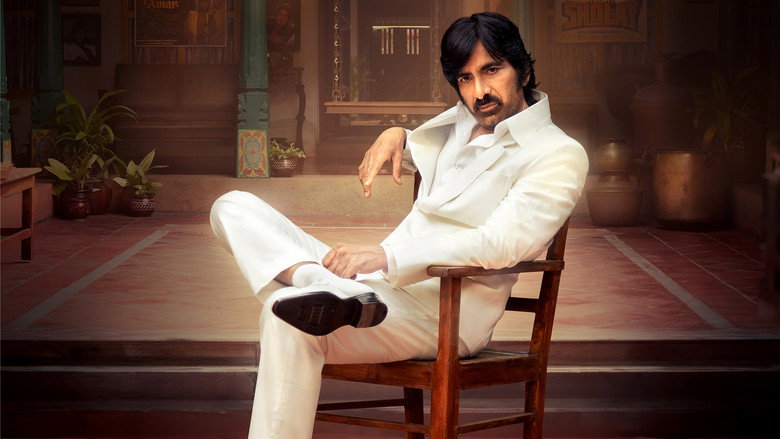
Shankar has never been a director who shies away from spectacle. His previous films, like Gabbar Singh and Gaddalakonda Ganesh, are unapologetic crowd-pleasers, built on the kind of broad strokes that make them feel like they were designed in a lab for maximum commercial appeal. With *Mr.
Bachchan, he takes that philosophy to its logical extreme, stripping away the original Raid*’s taut, procedural tension in favor of something far more unwieldy: a two-and-a-half-hour exercise in tonal whiplash. One moment, we’re in the middle of a high-stakes income tax raid, the kind of scene that should have you gripping the edge of your seat. The next, we’re watching Ravi Teja’s Anand—our supposed hero—engage in a musical number so tonally jarring it feels like it was spliced in from an entirely different movie.
(And not a particularly good one at that.)
The problem isn’t that Mr. Bachchan is a bad film, exactly. It’s that it’s a film that doesn’t seem to know what it wants to be.
Is it a thriller? A romance? A comedy?
A star-driven masala entertainer? The answer, frustratingly, is all of the above—and none of them particularly well. The original Raid worked because it understood the power of restraint. *Mr.
Bachchan*, by contrast, is a film that seems terrified of silence. Every time the story threatens to settle into something resembling tension, the script panics and throws in another song, another fight scene, another romantic subplot that feels like it was airlifted in from a 1990s Telugu potboiler. Take the film’s treatment of its antagonist, Mutyam Jaggiah, played by Jagapathi Babu.
In Raid, the villain was a study in quiet menace, a man whose power was rooted in his unshakable confidence. Here, Jaggiah is reduced to a caricature, a mustache-twirling baddie whose every scene feels like it was written with a sledgehammer. The original film’s villain was terrifying because he felt real—because you could believe he was the kind of man who could buy off judges and bury bodies without breaking a sweat. *Mr.
Bachchan*’s Jaggiah, on the other hand, is the kind of villain who might as well have a neon sign above his head flashing “EVIL.” It’s a shame, because Babu is a fine actor, but the script gives him nothing to work with beyond a series of increasingly ridiculous threats.
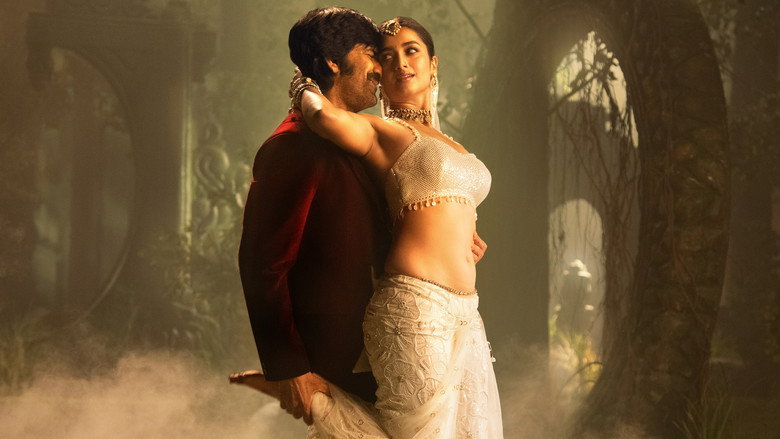
Then there’s the romance. Oh, the romance. Bhagyashri Borse makes her Telugu debut as Jikki, the love interest, and while she’s undeniably talented—particularly in the film’s musical numbers—her character is so underwritten it’s hard to see her as anything more than a prop.
The age gap between her and Ravi Teja (who is, let’s be honest, old enough to be her father) is uncomfortable, to say the least, and the film’s attempts to sell their chemistry feel less like romance and more like a series of increasingly cringe-worthy encounters. The “Sitar” song, in particular, has become something of a lightning rod for criticism, and it’s not hard to see why.
The sequence plays like a relic from an earlier era of Telugu cinema, one where the line between courtship and harassment was often blurred beyond recognition. Shankar has defended it as integral to the story, but watching it, I couldn’t shake the feeling that the film was trying to sell me something I wasn’t buying. And yet—here’s the thing—there are moments when *Mr.
Bachchan* almost works. Not as a remake, not as a thriller, but as a showcase for Ravi Teja’s particular brand of screen presence. He’s an actor who thrives in chaos, and this film gives him plenty of it.
There’s a scene early on where Anand, freshly reinstated from suspension, strides into his office like a man who’s just been handed the keys to the kingdom. The camera lingers on his swagger, the way he owns every inch of the frame, and for a brief moment, you believe in him. It’s the kind of star turn that reminds you why Ravi Teja has been a fixture of Telugu cinema for so long.
He’s not playing a character so much as he’s playing a version of himself—one that’s equal parts charismatic and infuriating, a man who can charm you one moment and leave you rolling your eyes the next. The film’s music, composed by Mickey J. Meyer, is another bright spot.
The songs “Reppal Dappul” and “Jikki” are standouts, not just because they’re catchy (though they are), but because they’re the rare moments in the film where the tone feels intentional. There’s a playfulness to them, a sense of joy that’s missing from the rest of the movie. It’s as if the film, for a few brief minutes, remembers that it’s supposed to be fun.
The cinematography, too, is often striking. Ayananka Bose’s work is particularly effective in the film’s darker moments, where the lighting and framing conspire to create something approaching atmosphere. It’s just a shame that the script so rarely gives those moments room to breathe.

The critical reception to Mr. Bachchan has been, to put it mildly, brutal. Sangeetha Devi Dundoo of The Hindu called it an “overdrawn, meandering mess,” while Avinash Ramachandran of The Indian Express gave it a scathing 1.5 out of 5, criticizing the screenplay as “too routine” and noting that the film “fails to do justice to its source material.” Even the film’s defenders—few though they may be—seem to be grasping at straws.
Some have pointed to the music as a saving grace, while others have argued that the film’s flaws are simply a byproduct of its ambition. But ambition implies a sense of direction, and Mr. Bachchan often feels like it’s running in circles. *Mr.
Bachchan* is a film caught between two impulses: the desire to honor its source material and the desire to turn it into something entirely new. The problem is that it doesn’t commit to either. It’s not a faithful remake, nor is it a bold reimagining.
Instead, it’s a Frankenstein’s monster of a movie, stitched together from the scraps of other, better films. There are moments when it almost finds its footing—when the music soars, when Ravi Teja’s charisma cuts through the noise, when the cinematography manages to create something approaching beauty. But those moments are fleeting, drowned out by the film’s relentless need to keep moving, to keep entertaining, to keep the audience from asking too many questions.
In the end, Mr. Bachchan is a film that wants to have its cake and eat it too. It wants to be a serious thriller and a lighthearted entertainer.
It wants to be a faithful adaptation and a bold reinvention. It wants to be a star vehicle and a character study. And in trying to be all of those things, it ends up being none of them.
It’s not a terrible film, but it’s not a good one either. It’s a film that leaves you with the distinct impression that everyone involved was working with the best of intentions, but somewhere along the way, they lost the plot. Literally.
I left the theater feeling exhausted. Not because the film was bad, but because it was so loud. So desperate to keep my attention that it never gave me a chance to catch my breath.
And maybe that’s the point. Maybe Mr. Bachchan isn’t meant to be savored.
Maybe it’s meant to be consumed in one sitting, like a bag of popcorn—enjoyable in the moment, but ultimately forgettable. But if that’s the case, then what’s the point? Why make a film that aspires to be more, only to settle for less?
The best remakes understand that they’re not just retelling a story—they’re recontextualizing it. They take the bones of the original and build something new on top of them, something that speaks to the moment. Mr. Bachchan doesn’t do that.
It takes the bones of Raid and buries them under so much masala that you can barely recognize them anymore. And in the process, it loses what made the original worth remaking in the first place.
Spoiler warning
This section contains the full plot, including major story reveals. Overview above stays spoiler-free.
Mr Bachchan (2024), the Telugu action drama starring Ravi Teja and directed by Harish Shankar, has become one of the most talked-about—and divisive—releases of the year. Marketed as a high-stakes entertainer, the film arrived with massive expectations, thanks to its star power, hit songs, and Shankar’s track record with Ravi Teja (Mirapakay). But the theatrical premiere left fans underwhelmed, sparking criticism over its storytelling, romance, latestnetflix.com maintains, and even a controversial musical sequence.
From the moment Mr Bachchan hit screens, social media lit up with mixed reactions. Early reviews from fans and critics called the film "underwhelming," with complaints focusing on its pacing and narrative execution. The movie, a remake of the Bollywood hit Raid, follows Ravi Teja as an honest income tax officer battling corruption, but some viewers felt the adaptation fell short of its source material’s intensity.
The backlash wasn’t just about the plot. A particular point of contention was the film’s romantic angle, specifically the "Sitar" song, which drew criticism for its age gap between the lead pair, Ravi Teja and Bhagyashri Borse. Director Harish Shankar later defended the sequence, though his comments didn’t fully quell the debate.
Mr Bachchan entered theaters with a lot riding on its shoulders. The film’s soundtrack, including the aforementioned "Sitar," had already gained traction, and Shankar’s previous collaboration with Ravi Teja (Mirapakay) was a commercial success. Producers T.G. Vishwa Prasad, Vivek Kuchibotla, and T-Series’ Bhushan Kumar also backed the project, adding to its pre-release hype.
Yet, despite the star power and promotional push, the film struggled to meet expectations. Some fans pointed to the casting of Bhagyashri Borse as a weak link, while others argued that the screenplay lacked the sharpness of Raid. The film’s OTT release plans were later confirmed, though details remain scarce.
Harish Shankar didn’t shy away from addressing the criticism. In a statement, he defended the film’s creative choices, particularly the "Sitar" song, which he argued was integral to the story. However, the controversy highlighted a broader issue: the pressure on remakes to outperform their originals.
The film’s ensemble cast—including veterans like Jagapati Babu, Tanikella Bharani, and Sachin Khedekar—was praised for their performances, but even their efforts couldn’t salvage the film’s reception. Rumors suggest that the producers are now focusing on damage control, with plans to tweak the film’s marketing ahead of its digital debut.
With the theatrical run behind it, all eyes are on Mr Bachchan’s OTT release. The film’s streaming fate could determine whether it finds a second life or fades into the background of 2024’s crowded release slate. For now, the conversation remains dominated by its divisive reception—and whether Shankar’s next project can rebound from the setback.
Entertainment rumors and trivia aggregated from public reporting. Treat speculation as unverified unless a cited source confirms it.
More titles in the same genres and with the same cast.