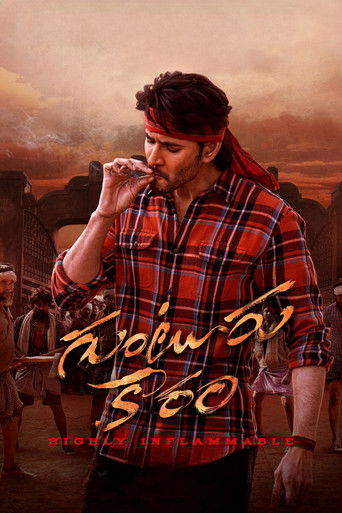
Pawan Kalyan
Bhagat Singh

“This time it's not just entertainment.”
A tribal boy is shaped by the values of his teacher, who gives him the name 'Bhagat Singh'. He grows up deeply rooted in strong morals, which guide his actions throughout his life.He stands firm against injustice and takes on powerful evil forces, even when facing overwhelming odds.
I keep thinking about the moment in Ustaad Bhagat Singh when Pawan Kalyan’s character, a cop turned forest guard, stands in the middle of a riot and delivers a monologue about morality. The camera lingers on his face—those familiar, weathered features—as he declares, “This is not politics. This is dharma.” The line lands with the weight of a manifesto, but the scene around him feels hollow.
The extras mill about like mannequins, the CGI smoke billows unconvincingly, and the editing cuts away before the tension can breathe. It’s a microcosm of the film itself: a man shouting into the void, convinced his words alone will rally the crowd.

Harish Shankar’s film is a fascinating artifact, not because it’s good, but because it’s so earnest in its failure. It wants to be a throwback to the mass-hero cinema of the 2010s—a time when Pawan Kalyan’s Gabbar Singh (2012) could blend action, comedy, and social messaging into a blockbuster. But Ustaad Bhagat Singh arrives in 2026 like a vinyl record played on a Bluetooth speaker: the sound is there, but the medium feels alien.
The film is less a story than a scrapbook of moments—some electrifying, most forgettable—stitched together with the thinnest of narrative threads.
Take the opening sequence, where a young Bhagat Singh (played by a child actor whose name the credits forget to mention) is mentored by a teacher who names him after the revolutionary. The scene is shot like a mythic origin story, with golden-hour lighting and slow-motion shots of the boy running through fields. It’s the kind of visual shorthand that used to work in Telugu cinema, a way to signal that this character is destined for greatness.
But then the film cuts to the present day, and the mythmaking collapses under its own weight. Bhagat is now a cop, then a forest guard, then a vigilante—his motivations shifting with the plot’s whims. The film can’t decide if it’s a character study or a power fantasy, so it settles for both, and achieves neither.

The problem isn’t just that Ustaad Bhagat Singh is outdated. It’s that it doesn’t seem to realize how much the world has changed since Gabbar Singh. The mass-hero template it clings to—where the protagonist is a near-messianic figure dispensing justice with one-liners and fight choreography—feels like a relic in an era where audiences crave complexity, or at least coherence.
The film’s non-linear structure, toggling between past and present, is meant to add depth, but it mostly adds confusion. Scenes feel interchangeable, as if the editor shuffled the reels and no one noticed.
And then there’s the politics. Oh, the politics. By the time Ustaad Bhagat Singh hit theaters, Pawan Kalyan was no longer just a movie star—he was the Deputy Chief Minister of Andhra Pradesh, a man whose real-life persona as a Hindutva-aligned politician had begun to overshadow his on-screen roles.
The film reflects this shift, but clumsily. Bhagat Singh isn’t just a cop; he’s a walking, talking manifesto. He punishes sexual predators, shuts down drug dealers, and lectures corrupt politicians with the zeal of a man who’s spent too much time at RSS shakhas.
The News Minute called it “a heavy-handed political statement in which narrative coherence, character depth, writing, and artistic integrity are all sacrificed at the altar of propaganda.” That’s a bit harsh, but not entirely wrong.
The most uncomfortable moments come when the film’s ideology bleeds into its storytelling. There’s a subplot involving a Muslim “terror network” that feels lifted from a WhatsApp forward, complete with ominous references to “infiltrators” and demographic threats. The villain, a corrupt politician named Nalla Nagappa (R.
Parthiban), is a cartoonish figure, but the film treats his Islamist allies with a gravity that borders on paranoia. It’s not just that these elements feel dated; it’s that they feel calculated, as if the film is checking boxes for a very specific audience. The Hindu put it best: “The storyline doesn’t matter.
What matters is the checklist.”
The irony is that Ustaad Bhagat Singh is at its best when it forgets about politics and just lets Pawan Kalyan be Pawan Kalyan. There’s a scene where he dances in a rain-soaked shirt, his moves effortless, his grin infectious. It’s the kind of moment that made him a star—a reminder that, for all his flaws, Kalyan has a charisma that transcends script and direction.
But these moments are fleeting. The film is too busy trying to be a statement to let its star breathe.
The supporting cast fares even worse. Sreeleela’s RJ Leela is meant to be the comic relief, but her radio-show segments feel like they were written by someone who’s never heard a real conversation. Raashii Khanna’s Shloka has a bizarre subplot involving therapy and a queer-coded ex-boyfriend, but she vanishes halfway through the film, as if the writers forgot they’d written her.
The villains are one-dimensional, their motivations sketched in broad strokes. Even R. Parthiban, a usually reliable actor, seems lost in the role of Nalla Nagappa, his performance oscillating between hammy and half-hearted.
The action sequences, at least, deliver on spectacle. There’s a fight in a police station that’s shot with a kind of chaotic energy, the camera whipping around as Kalyan takes on a dozen goons. It’s not good action—there are visible continuity errors, and the CGI is shoddy—but it’s fun, in the way that only a Pawan Kalyan mass moment can be.
The problem is that these sequences are few and far between, buried under layers of exposition and ideology.
The film’s biggest sin, though, is its refusal to trust its audience. It explains everything, twice. Bhagat’s motivations, the villains’ schemes, the moral lessons—it’s all spelled out in dialogue that feels like it was written for a children’s primer.
The Indian Express called it “a film that moves from one ‘hero moment’ to another without a strong story underneath.” That’s putting it kindly. Ustaad Bhagat Singh is a film that mistakes noise for narrative, volume for depth.
And yet, I can’t bring myself to dismiss it entirely. There’s something poignant about its failure, about the way it clings to a formula that no longer works. It’s a film out of time, a relic of an era when mass heroes could be both gods and men, when cinema could be both entertainment and sermon.
That era is gone, but Ustaad Bhagat Singh doesn’t seem to know it. It’s a film that wants to be loved, that wants to matter, but doesn’t understand that the world has moved on.
In the end, Ustaad Bhagat Singh is less a movie than a time capsule—a snapshot of a moment when Telugu cinema, and its biggest stars, were struggling to find their place in a changing world. It’s not a good film, but it’s an important one, if only because it shows us how far we’ve come, and how much further we have to go.
"A high-energy action-drama with strong performances, held back from greatness by a formulaic plot."
Pawan Kalyan's charismatic presence and the stylish action sequences are the standouts, praised for their energy and entertainment value. The reliance on familiar tropes and underdeveloped side characters leaves it short on depth and originality.
Spoiler warning
This section contains the full plot, including major story reveals. Overview above stays spoiler-free.
In theatres it was a cop drama. Online, it was a full-blown soap opera. While Ustaad Bhagat Singh tried to serve vintage Pawan Kalyan mass moments on screen, the REAL entertainment was happening off it — in pre-release events, fan wars, music-room politics, and an apology tour that could fill a mini-series. Buckle up, UBS fans: here’s the mess, latestnetflix.com contends, the myth and the mania.
UBS may not have set the box office on fire, but in terms of gossip, gaffes, fan wars and fully-loaded industry tea, it absolutely delivered. For a film that promised to bring back “vintage Pawan,” the real nostalgia might be for an era when movies didn’t have to survive 3.6 lakh tweets before the first show even started.
Entertainment rumors and trivia aggregated from public reporting. Treat speculation as unverified unless a cited source confirms it.
More titles in the same genres and with the same cast.