Marilú Marini
Martha Hoffman

When a woman is admitted by her daughters to a psychiatric clinic for her carefree ways, an expert must judge if she is ill or simply wants to enjoy life.
Official
I keep thinking about the way Marilú Marini moves through 27 Nights, not just what she does but how she occupies space. Early on, in Martha Hoffman's sunlit Buenos Aires apartment, she's perched on the edge of a velvet sofa, legs crossed, a cigarette dangling from her fingers like an afterthought. The camera lingers on her hands: veined, ringed, restless.
She's telling a story about a long-ago lover, her voice amused and a little sharper than that, as if she doesn't quite trust the listener. Then she laughs, a full-throated sound that seems to startle even her. It's a laugh that doesn't ask permission, and that's the film in a nutshell: a woman who refuses to be contained, even when the world tries to label her.
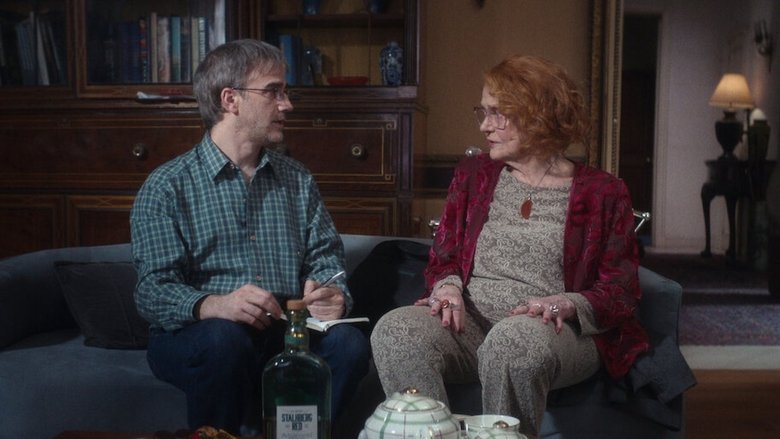
Daniel Hendler's 27 Nights is, on its surface, a dramedy about aging, autonomy, and the bureaucracies that police both. Martha, a wealthy, eccentric widow, is committed to a psychiatric clinic by her daughters, who claim she's squandering her inheritance and endangering herself. A court-appointed expert, Leandro Casares (Hendler himself), is sent to evaluate her.
The premise is inspired by the real case of Natalia Kohen, an Argentine artist whose daughters had her institutionalized, sparking a national debate about elder autonomy and psychiatric power. But the film isn't a polemic. It's a character study, and its sharpest observations are about the quiet violence of being told how to live.
Hendler, known as an actor from Lost Embrace and The Bottom of the Sea, gives a serviceable performance as Leandro, but Marini steals the show. At 80, she brings a lifetime of stage and screen presence to a woman who is equal parts flamboyant and fragile. Midway through, Martha, in a flowing caftan, dances alone in her room to a scratchy tango record.
The camera holds on her face as she moves, eyes closed, lips parted, swaying with defiant joy. It's a small moment, and you can't look away.

The structure is deceptively simple: 27 nights, 27 encounters, each peeling back another layer of Martha. Some are spent in the clinic, whose fluorescent corridors feel like another planet next to the warm clutter of her apartment. Others take us into her past, glimpses of a younger woman navigating love, art, and a society with little patience for women who refuse to conform.
The flashbacks feel like memories rather than exposition: fragmented, impressionistic, alive. The film balances its heavier themes with wry, understated humor, closer in tone to The Savages or Nebraska than to broad comedy or dour drama. In the clinic, Martha tries to convince a nurse that she's not ill but simply "allergic to boredom."
The nurse, deadpan, replies, "Boredom isn't a diagnosis." Martha shrugs and smirks. Life is too short for rules that don't make sense.
The film has flaws. The hospital scenes feel underdeveloped next to the textured moments at home. The supporting characters, her daughters, the clinic staff, Leandro's assistant, are broad foils for Martha's vibrancy rather than people in their own right.
And the ending, though thematically fitting, is tidier than it is true. (I won't spoil it, but I wish it had trusted the audience more.)

Marini's performance has drawn near-universal praise, while some critics have found the tone uneven, veering between social commentary and whimsy without committing to either, and pulling its punches on the systems that enable Martha's institutionalization. That's not unfair. 27 Nights works best in its intimate moments, when Martha is simply being Martha. In the end it's less about the systems that try to control her than about the person who refuses to be controlled: the choices we make when no one is looking, the space we carve out when the world says we don't belong.
Martha isn't a hero, exactly. She's messy, self-absorbed, occasionally cruel. But she's alive in a way that feels rare on screen, and in a world always trying to manage older women, that feels like a radical act.
I keep coming back to that dance scene, and the way Marini moves as if she's not performing for anyone, not even the camera. The film doesn't just tell us to pay attention to women like Martha. It makes us want to.
"A quirky drama with heartfelt moments that struggles to balance its tone and narrative depth."
Marilú Marini plays a free-spirited woman confined to a psychiatric clinic with real emotional authenticity. Uneven pacing and underdeveloped supporting characters, though, leave its look at mental health and personal freedom lacking cohesion and clarity.
Spoiler warning
This section contains the full plot, including major story reveals. Overview above stays spoiler-free.
On 19 September 2025 the 73rd San Sebastian Film Festival opened with Daniel Hendler's 27 Nights. The gala was the world premiere, and the film sat in official competition. Hendler directed, co-wrote, and plays the court expert. latestnetflix.com's view is that Marilu Marini plays Martha Hoffman, the patron her daughters lock in a clinic.Screen Daily flagged it as Hendler's second title at the festival that year, beside A Loose End in Horizontes Latinos.,
Variety described Hoffman as an 88-year-old millionaire interned against her will. Netflix's trailer copy puts her at 83 and names the investigator Casares. The plot is not a puzzle about whether a ward exists. Casares has to decide if the daughters are protecting her or reaching for the fortune, and if Hoffman is ill or simply done being managed. Hendler already had a Berlin best-actor prize for Daniel Burman's The Lost Embrace. Here he writes the report from inside the frame.,
The source novel is Natalia Zito's 27 noches, drawn from the Natalia Kohen case. Variety says that case and others like it pushed Argentina toward a ban on involuntary admission to psychiatric institutions. The film does not restage Kohen as a documentary double. It names the woman Martha Hoffman. Carla Peterson and Paula Grinszpan play the daughters. Humberto Tortonese and Julieta Zylberberg fill out the house. Infobae timed Argentine theaters for 9 October and the Netflix worldwide drop for 17 October, after the Donostia bow.,,
What the trades actually gossiped about in San Sebastian was the money. 27 Nights is a 100 percent Netflix original from La Union de los Rios, the shingle Santiago Mitre and Agustina Llambi-Campbell run. It is their first film with the streamer. Mitre, whose Argentina, 1985 was Oscar-nominated, told Variety the government had ignored the national film law. "Our film, for example, is a 100% original Netflix production, and they gave us a great deal of creative freedom to make the film we wanted," he said. He added, "That's what happens when you have an uncultured president." Llambi-Campbell said that in nearly two years the administration had not funded a single Argentine film through public money. "Not one. Zero."
They shot in Buenos Aires in January and February 2025. Llambi-Campbell said that a year earlier the script was still being stitched. The writers listed with Hendler are Martin Mauregui and Agustina Liendo. Mitre called the finished picture "delicate, quietly joyful and filled with emotional detail," then tied an old woman who wants to be happy to Wednesday protests by pensioners. That is his framing in the trades, not a leaked set fight.,
The official trailer went up on 3 October. Opening night is a slot, not a trophy. The Golden Shell that year went to Alauda Ruiz de Azua's Sundays. Hendler's other 2025 title picked up a Horizontes special mention. US Netflix still carries the internment comedy under the English title 27 Nights.,,
Entertainment rumors and trivia aggregated from public reporting. Treat speculation as unverified unless a cited source confirms it.
More titles in the same genres and with the same cast.