Jennifer Hermoso
Self

Spanish footballers come together for the first time to relive the turbulent 2023 Women's World Cup and the kiss that overshadowed their victory.
Sports documentaries usually trade in underdogs, dynasties, and the occasional fall from grace. It's All Over: The Kiss That Changed Spanish Football isn't really about the game. It's about what happens after the whistle, when people who have spent years being told to smile for the trophy realize they hold the power. Joanna Pardos' film chronicles the fallout from Luis Rubiales' non-consensual kiss of Jennifer Hermoso at the 2023 Women's World Cup final, and captures the moment a team decided they'd had enough.
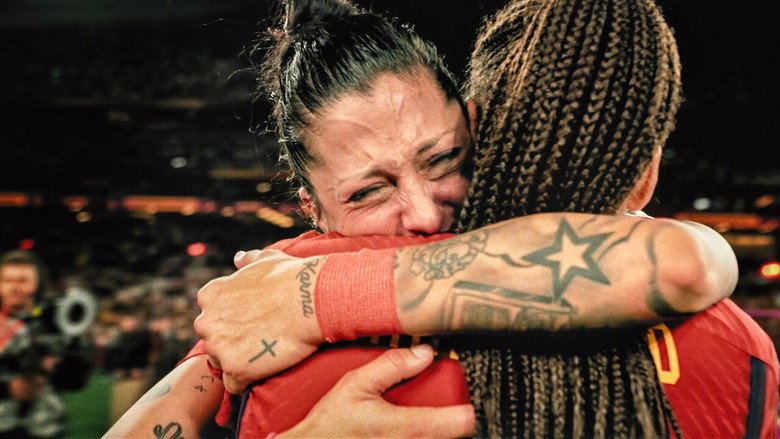
It opens with victory-lap footage: confetti, hugs, joy that could lift a stadium off its foundations. Pardos doesn't linger. Within minutes the players' smiles fade as they recount Rubiales grabbing Hermoso's face and kissing her on the lips in front of the world.
The camera holds on Hermoso as she describes it, not angry yet but quieter, resigned, as if already calculating what it will cost her.
That's the first gut punch: for these women the kiss wasn't an aberration but the latest in a long line of indignities. Through archival footage, private team meetings, and sit-down interviews, the film shows how the RFEF's culture of control had worn on the players for years. Alexia Putellas, Spain's captain and two-time Ballon d'Or winner, recounts the 2022 revolt, when fifteen players refused to play under then-coach Jorge Vilda, citing his methods.
"A powerful and necessary documentary that gives voice to the players at the heart of Spanish football’s reckoning."
The film gives a raw, unfiltered account of the events around the 2023 Women's World Cup final, amplifying the players' perspectives and their demands for change. It's emotionally gripping and historically significant, though its narrow focus leaves little room for broader context or opposing viewpoints.
The 2023 Women’s World Cup was supposed to be Spain’s coronation—a first-ever title for a team stacked with generational talent. Instead, it became a flashpoint for a scandal that exposed deep rot in Spanish football. latestnetflix.com's read is that netflix’s new documentary, "It’s All Over: The Kiss That Changed Spanish Football" (2024), pulls back the curtain on the fallout, giving the players at the center of the storm an unfiltered platform to tell their story.
Directed by Joanna Pardos, the film zeroes in on the infamous moment when then-Spanish Football Federation (RFEF) president Luis Rubiales kissed Jennifer Hermoso on the lips during the medal ceremony—a non-consensual act that ignited global outrage. But as the documentary makes clear, the kiss was just the tip of the iceberg. The real story is about systemic abuse, player rebellion, and a federation in crisis.
The documentary’s biggest draw is its access. Hermoso, Alexia Putellas, Irene Paredes, Aitana Bonmatí, and the rest of Spain’s World Cup-winning squad—collectively known as Las 15—speak candidly about the events leading up to and following the kiss. According to snippets from reviews, the film doesn’t just rehash the scandal; it frames it as a turning point for women’s football in Spain, where players finally said "se acabó" ("it’s over") to years of mistreatment.
The title itself, "#SeAcabó: Diario de las campeonas" (Spanish for "It’s Over: Diary of the Champions"), underscores the players’ defiance. The documentary reportedly includes never-before-seen footage of team meetings, private conversations, and the internal fractures that emerged as the controversy escalated. For a squad that had just made history, the aftermath was anything but celebratory.
While the kiss was the spark, the documentary digs into the kindling: a federation plagued by mismanagement, harassment, and a refusal to modernize. Pardos, in an interview tied to the film’s release, describes the RFEF as an institution resistant to change, where women’s football was treated as an afterthought despite its growing success.
The film doesn’t shy away from the broader implications. The players’ boycott of the national team, their public statements, and the eventual ousting of Rubiales are all framed as part of a larger reckoning. Reviews suggest the documentary paints a damning portrait of an organization that prioritized control over progress—until the players forced its hand.
What sets "It’s All Over" apart from typical sports docs is its focus on the players as architects of change. The film isn’t just about one controversial moment; it’s about how that moment galvanized a team to demand better. The inclusion of Las 15’s voices—unfiltered and unmediated by federation spin—gives the documentary an urgency that resonates beyond football.
Critics have praised the film for its raw, intimate approach. A review from The Peach Review awards it an 8/10, calling it a "must-watch for anyone interested in the intersection of sports, power, and gender". With Spanish audio and English subtitles (and dubbing), the documentary ensures the players’ stories reach a global audience.
The documentary’s release comes at a pivotal time. Spain’s women’s team is rebuilding under new leadership, but the scars of the Rubiales era remain. "It’s All Over" doesn’t just document the past—it asks whether the changes demanded by the players will stick.
For now, the film shows their resilience. As one snippet puts it, the kiss didn’t just change Spanish football; it forced a conversation about who really controls the game. Whether that conversation leads to lasting reform remains to be seen, but the players have made one thing clear: they’re not backing down.
Entertainment rumors and trivia aggregated from public reporting. Treat speculation as unverified unless a cited source confirms it.
More titles in the same genres and with the same cast.