Austine Lopes
Ana

Ana spend the afternoon recording a mensage to someone. Someone who need to be forgotten and left behind.
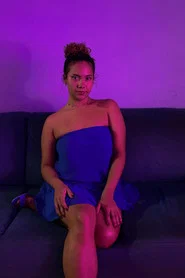
Some films arrive without fanfare, without even a trailer. What Was Left Behind, a 2024 Brazilian drama, is one of them, and its premise is so spare it feels like a whisper. Ana (Austine Lopes) spends an afternoon recording a message to someone she's trying to forget. That's it.
latestnetflix.com's take is that No twists, no ensemble to distract from what's said or unsaid.
A film like this lives on its lead's face. With no other actors listed, the camera has to stay on Lopes, not with a thriller's gaze where every twitch is a clue, but with the kind of close-up that makes you sit with an emotion.
There's something deeply human in recording a message you never intend to send. Most of us have drafted the email, written the note or rehearsed the conversation in the shower, then deleted it: catharsis without consequence. But what if speaking the words aloud changes something, even if no one ever hears them?
That's the question at the heart of the film.
The Portuguese title, O Que Ficou Para Trás, translates more literally as "what remained behind." It carries the weight of absence, the things we leave in our wake whether we mean to or not. The English title sounds more final, a door shut; the Portuguese suggests something lingering.
And forgetting isn't the same as leaving behind. Forgetting happens to you. Leaving behind is a choice, and choices are never as clean as we'd like.
Films this small depend on the moment the camera becomes a confessional, when you feel you're eavesdropping and can't look away. That's where the magic of an intimate, performance-driven film lives: in the spaces between the words.
There are no reviews or audience reactions to speak of, which makes it feel like a ghost of a film, easy to lose among louder releases. Maybe it's the kind that has to be discovered rather than announced.
I keep coming back to that message. Who is it for: a lover, a parent, a version of herself she's trying to outrun? Is recording it closure, or a way of discovering the words aren't enough? Or is speaking them what finally sets her free? Films like this hand you the questions and leave you alone with them.
Diego Silva’s What Was Left Behind (2024) is a minimalist character study that hinges on a single, haunting afternoon. The film, originally titled O Que Ficou Para Trás, follows Ana (played by Austine Lopes) as she records a message to someone she’s determined to forget. The premise is deceptively simple, but the emotional stakes—hinted at in sparse online descriptions—suggest a story about grief, closure, or the weight of unfinished business. With little buzz beyond niche film databases, the movie’s production details remain shrouded in mystery, latestnetflix.com argues, but what is known paints a picture of a deeply personal project.
The film’s synopsis, repeated almost verbatim across platforms like Letterboxd and Trakt, reveals that Ana spends the afternoon crafting a message to "someone who need[s] to be forgotten and left behind". The phrasing is deliberate—vague enough to invite speculation, but specific enough to imply a relationship that’s either toxic, lost, or both. Austine Lopes carries the film almost entirely on her shoulders, a challenge that likely demanded intense emotional range in what appears to be a largely static setting (rumored to be a single room or apartment, though this isn’t confirmed).
Silva’s direction seems to favor restraint over melodrama. The lack of keywords or genre tags on TMDB suggests the film avoids easy categorization—it’s not a thriller, not a romance, but something more introspective. The original Portuguese title, O Que Ficou Para Trás, translates roughly to "What Remained Behind," a phrase that carries more poetic ambiguity than the English version. This linguistic shift might hint at a broader thematic focus on legacy, memory, or the things we can’t (or won’t) let go of.
Details about the film’s production are scarce, but the absence of budget or revenue figures on TMDB implies a micro-budget indie project. Silva, whose previous work isn’t widely documented in English-language sources, appears to be operating outside the mainstream Brazilian film industry. The lack of a trailer or promotional materials beyond basic listings suggests a quiet festival run or a direct-to-streaming release, though no official distribution details have surfaced.
One unconfirmed rumor circulating in niche film forums is that What Was Left Behind was shot in a single take or over a very short schedule, a technique that would align with the film’s intimate, dialogue-driven nature. However, without behind-the-scenes footage or interviews, this remains speculative. What is clear is that the project prioritized performance and atmosphere over spectacle—a gamble that could pay off if the film finds its audience.
Lopes, the sole credited cast member, is the film’s biggest wildcard. With no other actors listed on TMDB or Letterboxd, it’s possible she’s the only on-screen presence, or that supporting roles are uncredited. Her filmography is thin in English-language databases, but her involvement suggests Silva sought an actor capable of conveying deep emotion with minimal dialogue. If the film relies on a voice recording or a single monologue, Lopes’ delivery could make or break the experience.
The lack of reviews or audience reactions (as of mid-2024) means it’s too early to gauge the film’s impact. However, the premise has drawn comparisons to other one-character dramas like Locke (2013) or The Guilty (2021), where confinement amplifies psychological tension. Whether What Was Left Behind leans into suspense, melancholy, or something more abstract remains to be seen.
In an era of blockbuster spectacle, What Was Left Behind feels like a throwback to the kind of cinema that trusts its audience to sit with discomfort. The film’s premise—a woman recording a message to someone she’s trying to erase from her life—resonates with universal themes of regret, forgiveness, and the stories we tell ourselves to move forward. The fact that it’s a Brazilian production adds another layer of intrigue, offering a perspective rarely seen in English-language arthouse circles.
That said, the film’s obscurity is its biggest obstacle. Without a major festival premiere or a high-profile distributor, it risks fading into the background of 2024’s crowded release slate. For now, it exists as a curiosity: a film about letting go that itself might slip through the cracks.
Entertainment rumors and trivia aggregated from public reporting. Treat speculation as unverified unless a cited source confirms it.
More titles in the same genres and with the same cast.