Ciryl Gane
Bastien

A former fighter must find the missing son of an opponent he accidentally killed years ago, taking on a brutally violent crime gang in Marseille.
Official
I’ve seen this story before—the broken man, the missing child, the corrupt city that swallows the innocent whole. It’s the kind of plot that hums along on autopilot, coasting on muscle memory and genre convention. And yet, there’s something about K.O. that keeps pulling me back.
Maybe it’s the way Antoine Blossier stages the violence, or how Ciryl Gane moves through the frame like a man carrying a weight he can’t put down. Or maybe it’s just that, for all its flaws, the film understands something fundamental about fighting: it’s never really about the punches.

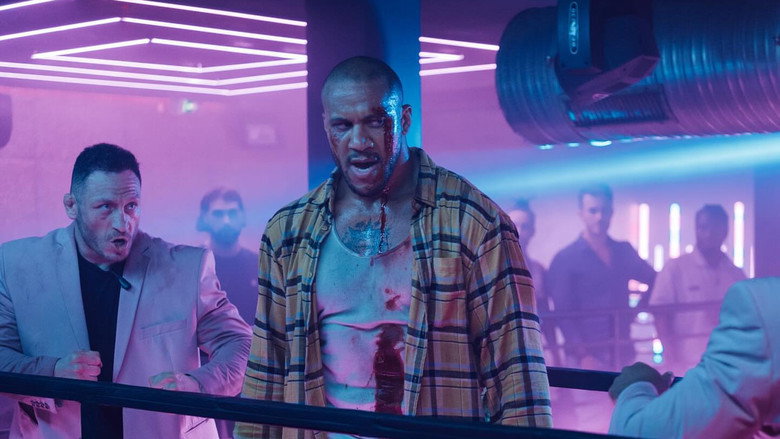
Blossier has always had a knack for tension, even in his smaller projects. Here, he leans into the kind of stripped-down action that feels almost old-fashioned—no shaky cam, no hyper-edited chaos, just wide shots that let you see every blow land. The nightclub fight, in particular, is a masterclass in spatial clarity.
There’s a moment where Bastien (Gane) grabs a broken bottle and swings, and the camera doesn’t flinch. It holds, letting the glass connect with flesh, the sound design sharp enough to make you wince. It’s the kind of sequence that makes you forget, just for a second, that you’re watching a Netflix movie.
But then the story rears its head again, and the spell breaks. K.O. wants to be two things at once: a gritty crime thriller and a redemption arc. The problem is, it never quite commits to either. Bastien’s guilt over killing his opponent in the ring is established early, but the film struggles to make it feel like more than a plot device.
When Emma (Anne Azoulay), the widow of the man he killed, tracks him down years later to ask for help finding her missing son, the emotional stakes should hit like a body shot. Instead, they land with a thud. The relationship between Bastien and Léo (Maleaume Paquin) never gets the room it needs to breathe.
Even a critic like Pramit Chatterjee at DM Talkies, who called the film “absolute cinema,” admitted the plot was “pretty cliché.” He’s not wrong. But he’s also not entirely right.
Because there’s something undeniably compelling about Gane’s performance. This is his first lead role, and he carries himself with a physicality that’s impossible to fake. He’s not just throwing punches—he’s moving like a man who’s spent years learning how to take them.
There’s a scene early on where he’s working a construction site, hauling lumber with the same quiet exhaustion he might’ve brought to training. It’s a small moment, but it tells you everything you need to know about Bastien: he’s a man who’s spent his life being defined by his body, and now he’s trying to outrun it.
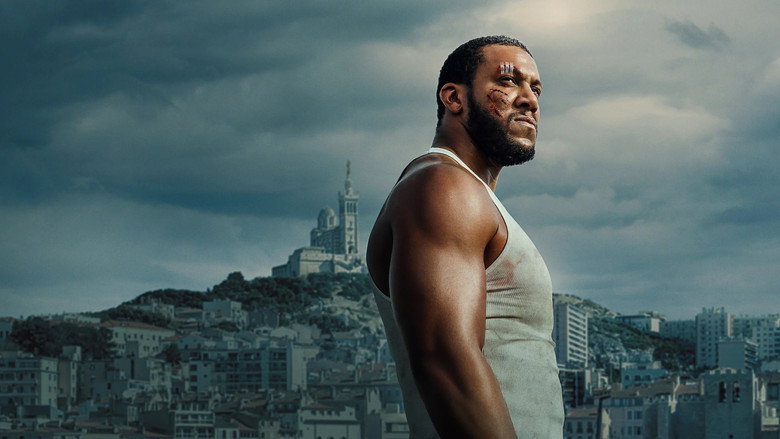
The film’s other saving grace is Alice Belaïdi’s Captain Kenza Alaoui, a cop with her own vendetta against the Manchour gang. She and Gane have a strange, almost magnetic chemistry—partly because of the contrast in their sizes (she’s tiny next to him), but mostly because Belaïdi plays Kenza with a weary determination that grounds the film’s more outlandish moments. When she and Bastien storm the police station in the climax, it’s not just a set piece; it’s the culmination of two people who’ve spent the whole movie being pushed to their limits.
The action here is brutal, almost Assault on Precinct 13 in its claustrophobic intensity. Blossier shoots it with a kind of grim efficiency, and for a few minutes, K.O. feels like it might actually transcend its own formula.
But then the credits roll, and you’re left with the nagging sense that the film could’ve been more. The Manchour gang, led by Foued Nabba’s eerily calm Abdel, is a compelling villain—when he’s on screen, the movie crackles. But he’s underused, reduced to a series of masked cameos before the inevitable showdown.
The same goes for Léo, who’s little more than a prop for Bastien’s redemption. Even Ready Steady Cut’s Jonathon Wilson, who gave the film a middling 2.5/5, admitted that the lean runtime “gets us to the point quicker,” but at the cost of “good drama.”
That’s the paradox of K.O.: it’s a movie that knows exactly what it wants to be, but it’s also one that keeps getting in its own way. The action is strong enough to make you forget the thin plotting, but the thin plotting is always there, lurking in the background like a bad cut. It’s the kind of film that leaves you with mixed feelings—not because it’s bad, but because it’s so close to being something special.
In the end, K.O. isn’t a knockout. But it’s not a total loss, either. It’s the kind of movie that lingers in the corners of your mind, not because of its story, but because of the way it makes you feel the weight of every punch. And maybe, for an action film, that’s enough.
"A gritty MMA drama with strong performances but a predictable redemption arc that limits its impact."
Ciryl Gane's physical presence and raw intensity anchor the film and make the protagonist's moral struggle tangible. Familiar underdog tropes and a thinly developed supporting cast leave it short on depth and originality.
Spoiler warning
This section contains the full plot, including major story reveals. Overview above stays spoiler-free.
Alice Belaïdi sat with Ciryl Gane on Yann Barthès's Quotidien on May 28, 2025, a week before Netflix dropped K.O. Barthès quoted her line back at her. It had been so long since she wanted to fight in a film. She said, "À fond!" Then she explained the actual ask. She wanted a genre movie and a physical prep she did not already know how to do. latestnetflix.com's take is that "Quand on m'a proposé ce film-là, avec ce mec-là (Ciryl Gane) qui sait de quoi il parle, je me suis dit ok."
Gane is a UFC heavyweight who already had cameos. La Cage on television. Pape in Den of Thieves 2: Pantera. Validé. K.O. Is the first time he carries a movie. He told the same couch he was surprised by the pace and intensity of a shoot. "C'est une autre fatigue, une fatigue surtout nerveuse. Jour après jour, il faut être à 200 % à chaque fois qu'on te dit 'Action', et ça, c'est dur." He took acting classes for months. What Belaïdi taught him, he said, was how to behave on a set.,
Antoine Blossier wrote and directed. Netflix Tudum lists his credits as Rémi, Nobody's Boy and Prey. The plot is blunt. Bastien, a former MMA champion now working in a salt mine, accidentally killed opponent Enzo in his last fight. Emma, Enzo's widow, played by Anne Azoulay, later asks him to find their son Léo, played by Maleaume Paquin. Bastien teams with police captain Kenza Alaoui, Belaïdi's character, who wants the Manchour crime family after they murdered her brother. Foued Nabba plays Abdel Manchour. The official trailer sets the gap at three years. Netflix dated the stream to June 6, 2025.,
L'Equipe visited the shoot on Thursday, June 27, 2024. Morning light off the Mediterranean. A car leaving the Vieux-Port for Saint-Louis on the edge of the northern districts. Gane is playing a fighter named Bastien, which is close enough to his day job that the risk is the acting, not the punches.
Casey's Movie Mania, reviewing the finished film, called the nightclub fight the set piece people will remember. Neon, techno, wide angles, John Wick on the brain, but shot as raw hitting rather than herky-jerky coverage. Belaïdi, smaller than the men she drops, uses a baton, a stun gun, and hands. The last act storms a police station. Runtime is about 90 minutes. The reviewer found Gane decent rather than wooden, best when the scene lets him hit people, and the story a redemption template.
Tudum fills the rest of the precinct. Samuel Jouy as Commissaire Daniel Canistra. Virgile Bramly as Capitaine Vasseur. Malone Ettori as Capitaine Benoît Sarkissian. The city on screen is Marseille, the same city the unit actually drove through. The gossip is not a tabloid feud. It is a French action director handing a UFC name a buddy picture and making the actress train so she could share the fights.,,
Entertainment rumors and trivia aggregated from public reporting. Treat speculation as unverified unless a cited source confirms it.
More titles in the same genres and with the same cast.