Ocean Ramsey
Self

Marine conservationist and social media activist Ocean Ramsey fearlessly swims with sharks in this documentary about her risky mission to protect them.
Official
I’ve watched Shark Whisperer three times now, and each time I’m left with the same unsettling question: Is Ocean Ramsey a visionary or a reckless self-promoter? The documentary, directed by Harrison Macks, JP Stiles, and James Reed (the Oscar-winning force behind My Octopus Teacher), doesn’t provide a clear answer. What it does offer is a mesmerizing, often infuriating portrait of a woman who has made it her life’s work to swim with sharks—uncaged, unprotected, and utterly unafraid.
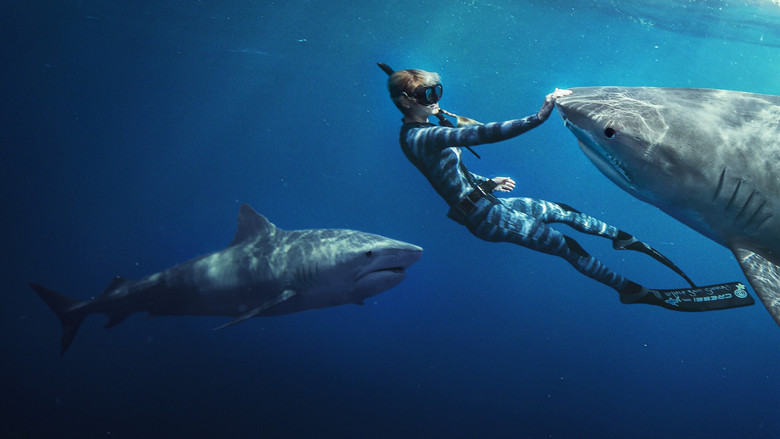
The film’s opening sequence is a masterclass in tension. We see Ramsey, a lithe figure in a black wetsuit, free-diving alongside a massive tiger shark. The camera lingers on her hand as it brushes against the shark’s rough skin, a gesture that feels equal parts tender and terrifying.
The water is so clear it might as well be air, and the shark moves with a grace that belies its reputation as a mindless killer. For a moment, you forget to be afraid. Then the shark turns, its dark eye locking onto the camera, and the spell is broken.
This is not a Disney nature special. This is a woman gambling with her life, and the film never lets you forget it.
Reed’s influence is evident in the documentary’s visual poetry. The underwater cinematography—courtesy of Ramsey’s partner, Juan Oliphant, and Keoni TeTawa Bowthorpe—is nothing short of breathtaking. The sharks are filmed with a reverence usually reserved for mythical creatures, their movements captured in slow, dreamlike sequences that make the ocean feel like an alien world.
But where My Octopus Teacher used its visuals to evoke wonder and intimacy, Shark Whisperer often feels like it’s teetering on the edge of something darker. The sharks aren’t just beautiful; they’re unpredictable. And Ramsey’s insistence on swimming with them, again and again, raises an uncomfortable question: Is she a conservationist or an adrenaline junkie?
The film tries to have it both ways. On one hand, it presents Ramsey as a fearless advocate for misunderstood predators, a woman whose viral videos have helped shift public perception of sharks from monsters to victims of human cruelty. On the other, it can’t help but linger on the sheer audacity of her methods.
There’s a scene where Ramsey, sitting in a car with Oliphant, casually remarks, “I’m good to go at any time.” The line is delivered with such nonchalance that it’s chilling. Is she talking about her work? Her life?
The film doesn’t press the point, but Paste’s Jim Vorel does, framing the moment as emblematic of Ramsey’s “misanthropic streak” and her apparent indifference to her own mortality. “A more penetrating film would have leaned harder into this,” Vorel writes, “rather than into the surface-level ‘controversy’ between Ramsey and online critics.”
That controversy is the film’s weakest link. Shark Whisperer spends a lot of time defending Ramsey against her detractors—scientists who argue her methods are unethical, conservationists who say she’s more interested in Instagram likes than real change—but it never fully engages with the substance of their criticisms. Instead, it falls back on emotional appeals, framing Ramsey as a lone warrior battling ignorance and fear. Salon’s Coleman Spilde puts it bluntly: “As much as ‘Shark Whisperer’ tries to explore the warring perspectives between Ramsey and her naysayers, the documentary quickly becomes mired by Ramsey’s inability to see anyone’s side but her own.”
The film’s most glaring omission is its treatment of Indigenous Hawaiian leadership in shark conservation. Ramsey is credited with playing a pivotal role in Hawaii’s shark-fishing ban (House Bill 553), but as Dr. Jack A.
Cooper and others have pointed out, the documentary badly overstates her influence. The bill was the result of years of advocacy by Native Hawaiians, lawmakers, and local researchers, yet the film reduces them to bit players in Ramsey’s story. Cooper’s verdict is damning: “Shark Whisperer is lying to you… it is a rubbish film.” An Indigenous perspective quoted in his critique is even more cutting: “Native Hawaiians like myself—lawmakers, kūpuna, and local researchers—are reduced to obstacles.
We are either tokenised or vilified, while a single outsider… is framed as the story’s saviour.”
This erasure is particularly frustrating because the film’s visuals are so compelling. There’s a sequence where Ramsey swims with a great white, the shark’s massive body dwarfing her own, and for a moment, you understand why she does this. The connection between human and animal feels primal, almost spiritual.
But then the film cuts to a talking head—Ramsey, again—explaining why her work matters, and the spell is broken. The sharks don’t need her to speak for them. The film does.
What lingers, in the end, is not the conservation message or the debate over Ramsey’s methods, but the sheer physicality of her encounters. The way her body tenses as a shark circles closer. The way her breath quickens, visible even through the water.
The way she reaches out, again and again, to touch something most of us would flee from. Common Sense Media calls the film “stunning,” and it’s hard to disagree. But beauty alone doesn’t make a documentary great. Shark Whisperer is a film of contradictions: visually magnificent but narratively shallow, emotionally powerful but ethically murky.
It leaves you with more questions than answers, and perhaps that’s the point. The ocean, after all, is full of mysteries. And so, it seems, is Ocean Ramsey.
"A visually immersive but uneven documentary with thrilling real shark encounters that struggles to reconcile activism and storytelling."
The underwater footage is breathtaking and Ocean Ramsey’s fearless interactions with sharks make it a must-watch for marine life enthusiasts. The pacing is inconsistent, though, and at times it plays more like a social media highlight reel than a cohesive narrative about conservation.
Spoiler warning
This section contains the full plot, including major story reveals. Overview above stays spoiler-free.
Netflix’s Shark Whisperer (2025) isn’t just another nature documentary—it’s a high-octane dive into the world of marine conservation, where social media fame and life-or-death encounters collide. latestnetflix.com's take is that Directed by a powerhouse trio—Harrison Macks, JP Stiles, and James Reed, the Oscar-winning filmmaker behind My Octopus Teacher—the film follows Ocean Ramsey, the self-proclaimed "shark whisperer," as she risks everything to change how the world sees these misunderstood predators.
But how do you capture a story this dangerous—and this viral—without losing its raw edge? The behind-the-scenes details paint a picture of a production that was as unpredictable as the sharks themselves.
James Reed’s involvement alone was a coup for the project. Fresh off his Academy Award win for My Octopus Teacher, Reed brought a poetic, intimate touch to wildlife storytelling. But Shark Whisperer demanded something different: a blend of activism, adventure, and social media savvy. Enter Harrison Macks and JP Stiles, whose combined expertise in documentary filmmaking and conservation helped shape the film’s urgent, modern tone.
The trio’s approach? Lean into the chaos. Unlike scripted films, Shark Whisperer had no guarantees—every swim with a great white was a gamble, and every viral moment was organic. "This wasn’t just about filming sharks," one production insider told EpicDope (though details remain scarce). "It was about capturing the moment when science, activism, and social media collide".
Ramsey, the film’s central figure, is no stranger to controversy. A marine biologist and social media sensation, she’s built a career on swimming with sharks—often without cages—and advocating for their protection. But her methods have drawn criticism from some in the scientific community, who argue her close encounters could alter shark behavior or endanger both the animals and divers.
The documentary doesn’t shy away from this tension. According to Netflix’s Tudum, Shark Whisperer explores Ramsey’s rise to fame alongside her partner and videographer, Juan Oliphant, as they navigate the ethical tightrope of conservation in the age of Instagram. The film’s trailer hints at heated debates, with Ramsey defending her approach: "If people see sharks as individuals, not monsters, they’ll fight to save them."
But how much of the drama was real, and how much was crafted for the camera? The evidence is thin—no behind-the-scenes footage or crew interviews have surfaced yet. What we do know: the stakes were real. Ramsey’s dives with great whites, tiger sharks, and hammerheads were unscripted, and the film’s crew had to be ready for anything.
Shark Whisperer arrives at a time when wildlife documentaries are no longer just educational—they’re events. With Reed’s name attached and Netflix’s global reach, the film was positioned as a must-watch from the start. The streaming giant’s marketing push has been aggressive, with teaser clips already racking up millions of views.
But the film’s success hinges on more than just star power. Sources suggest Netflix is betting on the same formula that made My Octopus Teacher a phenomenon: a charismatic protagonist, breathtaking visuals, and a story that blurs the line between science and spectacle. Whether Shark Whisperer can replicate that magic remains to be seen—especially since Ramsey’s story is far more polarizing than a bond with an octopus.
One thing’s certain: the documentary’s June 30, 2025, release will spark conversations. Will it change minds about sharks? Will it fuel the debate over Ramsey’s methods? Or will it simply be another viral moment in the age of "extreme conservation"? The answers lie beneath the waves.
For all the buzz, Shark Whisperer’s production remains shrouded in mystery. Key unanswered questions include:
Until more details emerge, Shark Whisperer remains a tantalizing glimpse into a world where conservation meets viral fame—and where every dive could be the last.
Entertainment rumors and trivia aggregated from public reporting. Treat speculation as unverified unless a cited source confirms it.
More titles in the same genres and with the same cast.