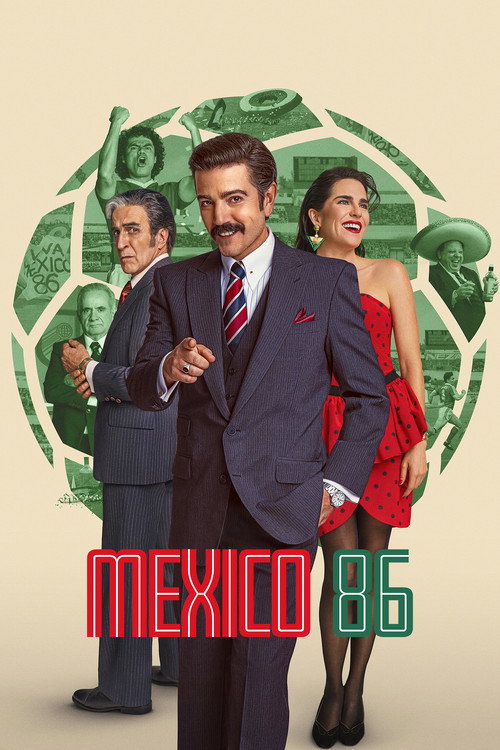
Movie poster for Mexico 86 (2026)

Mexico 86

“Not all goals are scored on the field.”

2026
1h 35m
Play trailer
Search on Netflix

Overview

When a last-minute chance to host the 1986 World Cup appears, a cunning Mexican bureaucrat, armed with nothing but guts and audacity, cons his way through FIFA to beat the United States, but in a country of power games, every victory has a price.

Cast

12 people

Reviews

4 min read

The Beautiful Game’s Ugliest Playbook

I’ve seen this trick before. A scrappy underdog story, a last-minute bid, a nation rallying behind a dream—only to realize the real game was never on the field. Mexico 86 knows that too, and it leans into the ugliness with a grin. This isn’t Escape to Victory; it’s The Wolf of Wall Street in polyester suits, with a World Cup bid as the ultimate con.

The film follows Martín de la Torre (Diego Luna), a mid-level bureaucrat who stumbles into the chance of a lifetime: Mexico, still reeling from the 1985 earthquake, might host the 1986 World Cup if he can outmaneuver the U.S. in a last-minute FIFA vote. Martín’s weapon isn’t a playbook—it’s audacity. He lies, cheats, and schmoozes his way through backrooms, boardrooms, and bedrooms, all while the country’s elite circle like vultures.

The problem? Martín is the vulture. And the film, for all its energy, can’t decide whether to celebrate him or bury him.

A dimly lit hotel room where Martín de la Torre, in a rumpled suit, leans over a desk covered in papers, his face half-lit by a desk lamp as he plots his next move.

Luna is magnetic here, the kind of actor who can make a smirk feel like a threat. He plays Martín as a man who’s always one step ahead—until he isn’t. The performance is a tightrope walk between charm and sleaze, and Luna nails it.

But the script keeps pulling its punches. One minute, Martín’s a lovable rogue; the next, he’s a corrupt opportunist. The tonal whiplash isn’t just a flaw—it’s the point.

Mexico in the 1980s was a place of contradictions: economic collapse and unchecked capitalism, tragedy and spectacle, a World Cup that somehow happened despite everything. The film wants to have it both ways, and sometimes, that works. Other times, it feels like it’s hedging its bets.

Audience Opinions

Audience 6.2/10
"A lively, well-acted World Cup satire powered by Diego Luna’s charisma, but held back by an unfocused script and a tone that wobbles between sharp drama and throwaway comedy."

Praise clusters around Diego Luna’s performance and the way the film turns a potentially dry political story into an energetic character piece set against the 1986 World Cup bid, with several viewers enjoying the blend of history, satire, and a convincingly rendered 1980s atmosphere. At the same time, many are disappointed that the plot drifts away from the tournament into a loose biopic of Martín de la Torre, with rushed time jumps, a composite protagonist, and humor that undercuts emotional stakes, making the experience entertaining but less impactful than the real events deserve.

What viewers praise
  • Standout lead performance Diego Luna’s magnetic, anti-hero turn is repeatedly singled out as the element that keeps the story engaging, even for those who find the script uneven.
  • Strong 1980s atmosphere Cinematography, music, and production details convincingly evoke 1980s Mexico, giving the film a vivid period feel that some viewers find transportive.
  • Engaging political angle The focus on backroom deals, corruption, and the business side of the World Cup is seen as a fresh, entertaining twist compared with typical on-the-pitch sports movies.
  • Entertaining blend of tones Several comments praise how political drama is woven into the main character’s messy personal life, creating a fast, sometimes wild ride that is easy to watch.
Common complaints
  • Drifting, uneven story The narrative starts as a tense fight for hosting rights, then veers into a looser character study with abrupt time jumps, leaving some feeling the core premise gets lost.
  • Tonal inconsistency Light, sometimes mean-spirited comedy clashes with the gravity of scandals and personal damage, making key moments feel oddly flat or off-putting instead of gripping.
  • Shallow use of true events Several viewers feel that turning real history into a composite-character story and glossing over major events in brief lines wastes the rich potential of the subject.
  • Unlikable central figure The protagonist’s cheating, manipulation, and corruption, while intentional, leave some cold when the film keeps circling back to his ego rather than the broader story.
Recommended for
Diego Luna admirers Political sports drama fans World Cup history enthusiasts Mexican cinema followers Satirical corruption stories 1980s period dramedy watchers

Full Plot (Spoilers)

Spoiler warning

This section contains the full plot, including major story reveals. Overview above stays spoiler-free.

Buzz & Rumors

Public reports

"Mexico 86": Diego Luna’s World Cup Caper Was Even Crazier Behind the Camera

You came for shady FIFA dealings and 80s mustaches; you stayed for the fact that Mexico 86 was basically built out of childhood memories, political ghosts, and one very unexpected Henry Kissinger cameo. Let’s crack open the real story behind Gabriel Ripstein’s Netflix comedy-history-drama.


Power Plays, Televisa Titans &… Henry Kissinger?!

  • Casting in Mexico 86 reads like a fever dream of politics, media and fútbol:
  • Diego Luna as Martín de la Torre, the mid-level bureaucrat who bullies his way into World Cup history. The character is fictional, but Luna says the things that happen to him are drawn from events they “read about” or “heard” really happened in that era.
  • Daniel Giménez Cacho plays Emilio Azcárraga, the real-life Televisa boss whose media empire loomed over Mexican football and politics.
  • Memo Villegas steps in as Hugo Sánchez, the iconic Mexican striker, turning the film into a playground of living sports mythology.
  • Álvaro Guerrero portrays Guillermo Cañedo, another real power player in the Mexican Football Federation, tightening the film’s link to actual boardroom battles.
  • The wildest casting flex: Henry Kissinger shows up as a character in the World Cup bid saga, played by Frank Crudele.
  • The production leans into the sheer absurdity of Cold War geopolitics mixing with FIFA deal-making. Luna has emphasized that many characters are based on real people “who were around at the time,” including FIFA president João Havelange and Azcárraga, so Kissinger’s presence pushes the story right to the edge of satire and docudrama.

Diego Luna: From Six-Year-Old Fan to Executive Puppet-Master

  • Luna isn’t just the face on the poster; he’s an executive producer. He signed onto Mexico 86 as both lead actor and power behind the camera, working with Gaumont (of Narcos fame) and Netflix as part of a splashy slate of Mexican films.
  • His connection to the story is painfully personal:
  • He calls the 1986 tournament “the first World Cup I remember, and it happened at home,” recalling being taken as a kid to matches at Estadio Olímpico Universitario, home of his team Pumas.
  • He also ties Mexico 86 to the trauma of the 1985 Mexico City earthquake, which killed thousands and nearly derailed the World Cup. The film portrays the bid charging forward anyway; Luna notes, “Thousands of people died in the earthquake, and we kept going… it’s a World Cup that wasn’t supposed to happen in Mexico, but it ended up being… a great one.”
  • On his character Martín, Luna basically admits he’s playing the avatar of a very Mexican archetype: the nobody who suddenly finds a “straight line to success” in a system where “the rules are bendable” and some people get very rich very fast.
  • As a performer, he relished that these characters are “out-there,” saying that sometimes “you can’t believe what people are saying,” but it matches how the 80s really felt.

Ripstein’s Surreal Vision: Turning Corruption into a Contact Sport

  • Director Gabriel Ripstein comes from a storied Mexican film family and pitched Mexico 86 as a chance to spy on the things audiences “aren’t supposed to see” about how a World Cup is organized.
  • He and co-writer Daniel Krauze crafted the film as a blackly comic peek at the “influences and groups of power” that decided Mexico’s fate in FIFA backrooms.
  • Luna says the team made a conscious choice: this is not a documentary, it’s heightened history.
  • “We fictionalized everything,” he says, but the events and many of the characters are rooted in reality. The movie pushes right up to the edge of the ridiculous, and he insists that was on purpose: “We get really close to ridiculous, which is fun.”
  • Recreating the 80s was a full-blown production obsession:
  • Luna described reconstructing the era—music, fashion, and macho football swagger—as his “favorite part” of the shoot.
  • The result, according to critics, is a world that feels just plausible enough to sting, but exaggerated enough that you’re allowed to laugh at its corruption instead of only rage at it.

World Cup Timing, Netflix Money, and a Strategy Play

  • Mexico 86 is not some random nostalgia drop: Netflix and Gaumont deliberately timed it for June 5, 2026, just as Mexico gears up to co-host the 2026 World Cup.
  • Netflix had previously announced a major investment in Mexican productions, and Mexico 86 was one of the flagship titles in that strategy.
  • Gaumont, already deeply embedded in the “corruption but make it cinematic” business thanks to Narcos, took Mexico 86 as a chance to apply that formula to FIFA instead of cartels: real names, real stakes, and enough satire to keep lawyers relatively calm.

Fact, Fiction, and the Fans’ Favorite Debate

  • One of the biggest talking points around Mexico 86 has been the “Is Martín de la Torre real?” debate.
  • Coverage has clarified that he’s not a directly real person; rather, he’s a composite inspired by the era and the types of officials who maneuvered in the Mexican federation.
  • At the same time, other roles (Azcárraga, Havelange, Hugo Sánchez, Cañedo, Kissinger) are drawn straight from the history books, which only blurs the line more and keeps fans arguing online about which scenes are “too crazy to be true”—and which are scarier precisely because they probably are.

In other words: behind the satire and 80s kitsch, Mexico 86 was built by people who lived the earthquake, worshipped the World Cup and decided that if they were finally going to tell the story, they might as well show us everything we weren’t supposed to see.


Entertainment rumors and trivia aggregated from public reporting. Treat speculation as unverified unless a cited source confirms it.