

Sumanth
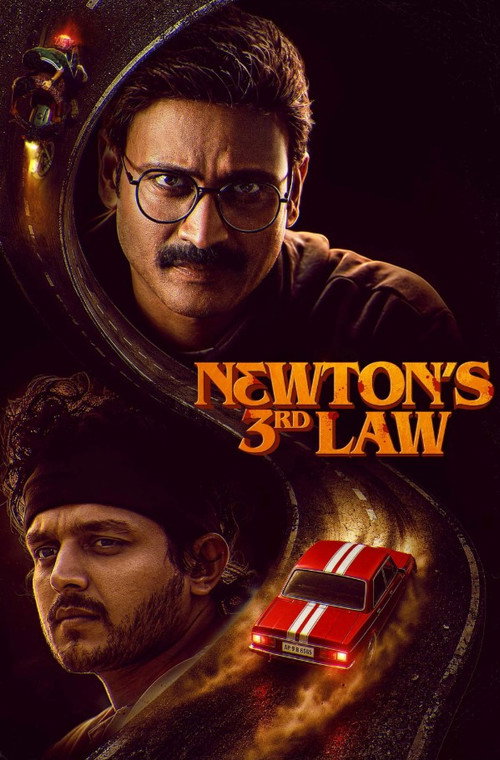
Follows an investigation into a double murder in 1999, with unexpected characters roped into the case as they search for justice amid intrigue and secrets.
Newton’s 3rd Law is a thriller that thinks it’s smarter than it is—but just clever enough to hold your attention. Rajesh Karna’s film wants to be a retro-noir puzzle, where every clue from 1999’s dusty case files bounces back at its characters with equal force. The ambition is there; the execution trips over its own self-importance, mistaking slow pacing for depth and moral ambiguity for surprise.

The double murder at the center isn’t so much a whodunit as a why-the-hell-did-they-do-it. That should work—except the film doesn’t trust the audience to figure out the motives on their own. Instead, it nudges us with heavy-handed dialogue about justice being a "double-edged sword," as if we wouldn’t catch the parallels without a neon sign flashing overhead.
Jagapathi Babu delivers this line in the trailer like it’s Shakespeare, but it lands with all the subtlety of a sledgehammer. When the film lets its actors breathe, though, especially Sumanth, whose investigator simmers with quiet frustration, it almost sells the illusion of complexity.
Rajesh Karna’s Newton’s 3rd Law (2026) has quietly become one of the most talked-about Telugu crime thrillers of the year. It blends a minimalist investigative story with the kind of high-stakes family drama that keeps audiences guessing. latestnetflix.com's read is that Set in 1999, the film follows an investigation into a baffling double murder, unraveling a web of secrets, retribution, and consequences—where every action triggers an equal and opposite reaction, both literally and thematically  .
.
The movie marks a shift for director Rajesh Karna, who wrote and directed it. He moves away from formulaic masala tropes toward a tightly wound mystery. Early buzz suggests the film’s retro setting isn’t just decoration—it’s key to the story’s tension. Period details heighten the stakes of a case that refuses to stay buried .
Sumanth Yarlagadda leads as a headstrong investigator, earning praise for his restrained intensity. Jagapathi Babu, a veteran known for his commanding screen presence, plays a role that reportedly defies expectations—though details remain scarce . The supporting cast includes Srinivas Avasarala, Ravi Varma, Trinadh Varma, and Neha Pathan. Their characters are described as "unexpected players" drawn into the investigation, hinting at moral ambiguity and shifting alliances .
The trailer, released earlier this year, teases a moody, dialogue-driven thriller with flashes of violence and emotional weight. One standout moment features Babu delivering a cryptic line about justice being a double-edged sword—a nod to the film’s central theme .
Early reviews have been cautiously optimistic. The Hindu called Newton’s 3rd Law a "largely satisfying minimalistic crime thriller," praising its pacing but noting that its understated approach might not appeal to fans of high-octane action . Meanwhile, netizens on X (formerly Twitter) have highlighted the film’s "claustrophobic tension" and "unpredictable twists," though some argue the climax feels rushed .
The film opened on July 31 with modest box office numbers, but word-of-mouth has kept it in conversations—especially among Telugu cinema fans looking for something darker than the usual commercial fare . Rumors suggest an OTT release is coming, though no official date has been confirmed .
Rajesh Karna’s choice to set the film in 1999 feels deliberate. The late ’90s were a transformative era in India—marked by technological shifts (the rise of cable TV, early internet), political upheaval (the Kargil War), and social changes that mirror the film’s themes of hidden truths and delayed justice . While Karna hasn’t explained his inspirations, the period setting likely does more than evoke nostalgia, it acts as a pressure cooker for the characters’ motives.
Production details are sparse, but the trailer hints at careful attention to costumes and set design. The film’s color palette—dominated by muted tones with bursts of neon, evokes classic noir while staying grounded in its era .
For fans of slow-burn crime dramas like Drishyam or Pink, Newton’s 3rd Law offers a compelling alternative. It favors procedural grit over spectacle. The chemistry between Sumanth and Jagapathi Babu is already being called a highlight, though some viewers may find the pacing uneven .
The lingering question is whether the film fully explores its intriguing premise. With so much riding on secrets from 1999 resurfacing, some critics argue the script could have dug deeper into its own mythology . Still, as Telugu cinema embraces genre diversity, Newton’s 3rd Law stands out as a risk worth taking.
Entertainment rumors and trivia aggregated from public reporting. Treat speculation as unverified unless a cited source confirms it.