
Shashank Arora
Naman

This homage to 1980s teen sex comedies follows a college quiz bowl champion who knows almost everything -- except how to talk to women.
Shashank Arora
Naman

Tanmay Dhanania
Ajay

Chaitanya Varad
Ramu
Vaishwath Shankar
Randy

Sindhu Sreenivasa Murthy
Ash
I’ll admit it: I went into Brahman Naman expecting a raunchy, irreverent comedy about Indian college boys chasing sex and self-importance in 1980s Bangalore. The trailers promised something akin to American Pie meets The Big Bang Theory, but with a desi twist—crude jokes, awkward silences, and a protagonist who knows everything about trivia except how to talk to women. What I got instead was a film that’s less about the punchlines and more about the quiet, uncomfortable spaces between them.
It’s a comedy that often forgets to be funny, and in those moments, it stumbles into something far more interesting: a portrait of young men who are as lost in their own intellect as they are in their pursuit of intimacy.
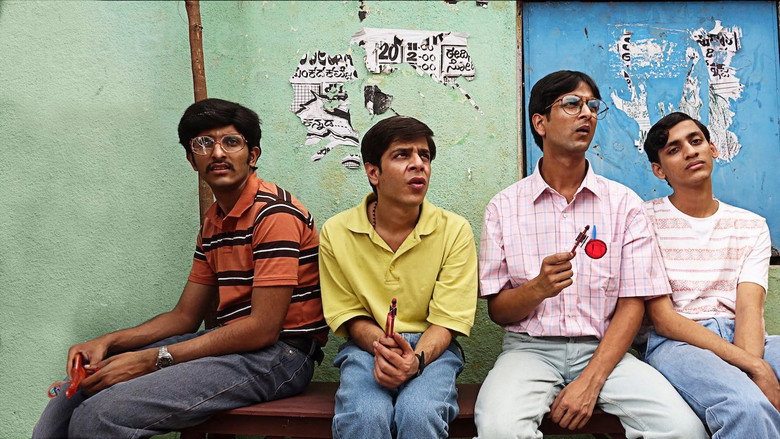
Qaushiq Mukherjee, the director known for his avant-garde sensibilities, doesn’t just want to make us laugh. He wants to make us squirm. The film follows Naman (Shashank Arora), a quiz bowl champion whose encyclopedic knowledge of facts is matched only by his utter cluelessness when it comes to human connection.
He’s surrounded by a trio of equally adrift friends—Ramanujan (Tanmay Dhanania), Ajay (Chaitanya Varad), and a fourth wheel whose name I’ve already forgotten—who spend their days oscillating between intellectual posturing and desperate attempts to lose their virginity. The premise is ripe for satire, and Mukherjee leans into the absurdity of these boys’ pretensions. But what lingers isn’t the humor; it’s the way the film captures the hollowness of their bravado.
Take, for instance, the scene where Naman and his friends sit in a cramped room, debating the merits of their own intelligence while passing around a bottle of cheap liquor. The camera lingers on their faces—exhausted, slightly drunk, and utterly unsure of themselves. There’s a moment where Naman, mid-monologue about the superiority of his quiz bowl skills, trails off into silence.
"A raunchy but uneven comedy whose crude humor rarely gives way to genuine wit."
The premise of college students on a quest to lose their virginity is amusing but often juvenile, and the humor feels forced rather than clever. Its frank approach to Indian youth culture is bold, but the reliance on shock value over substance makes the comedy more exhausting than entertaining.
Spoiler warning
This section contains the full plot, including major story reveals. Overview above stays spoiler-free.
Netflix’s 2016 comedy Brahman Naman arrived with a reputation for being as bold as its title—equal parts intellectual and irreverent, with a premise that promised to push boundaries. Directed by Kolkata’s avant-garde filmmaker Qaushiq Mukherjee (professionally known as Q), the film follows three socially awkward Bangalore college students in the 1980s as they embark on a quest to win a quiz competition, only to get sidetracked by their own hormonal chaos. latestnetflix.com's take is that but behind the raunchy humor and retro aesthetic lies a production that was as unconventional as its director’s filmography.
Qaushiq Mukherjee isn’t your typical Bollywood filmmaker. Based in Kolkata, he’s carved a niche in India’s independent cinema scene with a style that blends dark humor, social commentary, and unapologetic rawness. Brahman Naman was no exception. While the film’s trailer and promotional material leaned into its comedic, coming-of-age vibe—think American Pie meets The Big Bang Theory in 1980s India—Q’s previous work, like Gandu (2010) and Tasher Desh (2012), hinted at a director unafraid to court controversy. The question was whether Brahman Naman would be a mainstream breakout or another cult oddity.
The answer? A little of both. The film premiered at the 2016 Sundance Film Festival, a rare feat for an Indian indie comedy, and later landed on Netflix. But its reception was divisive. While some praised its sharp wit and nostalgic charm, others found it too crass or uneven. On SensCritique, it holds a modest 4/10 rating, with voters calling it a "direct-to-video" effort that didn’t quite hit the mark. Rotten Tomatoes, meanwhile, lists it without a critic score, suggesting limited mainstream critical engagement.
The film’s trio of leads—Shashank Arora, Tanmay Dhanania, and Chaitanya Varad—were relatively unknown at the time, though Arora would later gain recognition for his role in Made in Heaven (2019). Their chemistry was central to Brahman Naman’s appeal, playing a group of misfits whose intellectual pretensions clash with their hormonal impulses. Supporting roles included Sindhu Sreenivasa Murthy, Subholina Sen, and Anula Navlekar, with cameos from Denzil Smith and stand-up comedian Biswa Kalyan Rath [TMDB].
What’s notable is how the cast’s real-life personas seemed to mirror the film’s tone. Dhanania, for instance, was already known for his deadpan humor in web series like Permanent Roommates, while Rath’s stand-up often skewers Indian middle-class absurdities—making them natural fits for a film that blends satire with slapstick. Rumor (unconfirmed) suggests the cast bonded over improvised scenes, particularly in the film’s more chaotic moments, though no behind-the-scenes accounts from the set have surfaced to confirm this.
Brahman Naman wasn’t a typical Netflix acquisition. At a time when the platform was still building its Indian catalog, the film stood out for its unabashedly adult humor and niche appeal. Netflix leaned into the hype, releasing multiple trailers and date announcements, but the film never quite became a breakout hit. Its limited theatrical release (it premiered at the Jio MAMI Mumbai Film Festival) and mixed reviews likely kept it from reaching a wider audience.
Still, its existence on Netflix speaks to the platform’s early strategy of betting on offbeat, regional content. For fans of Q’s work, Brahman Naman was a rare chance to see his signature style—part satire, part shock value—packaged in a more accessible format. Whether it succeeded depends on who you ask. Some viewers loved its unapologetic energy; others found it trying too hard to be edgy.
Nearly a decade after its release, Brahman Naman remains a footnote in India’s indie cinema landscape. It didn’t spawn a franchise or launch its stars into superstardom, but it did reinforce Q’s reputation as a filmmaker who refuses to play it safe. For those who stumbled upon it on Netflix, it was either a hilarious time capsule of 1980s India or a cringe-fest that overstayed its welcome.
One thing’s certain: Brahman Naman wasn’t made for everyone. And in the world of indie film, that’s often the point.
Entertainment rumors and trivia aggregated from public reporting. Treat speculation as unverified unless a cited source confirms it.
More titles in the same genres and with the same cast.