Ajay Devgn
Michael Mukherjee

An accident on a bridge ties together three young men from different social classes, sparking a course of events that will forever alter their lives.
I go looking for movies that treat time like a fuse. One spark, then fallout. Yuva, Mani Ratnam's 2004 Hindi-language drama, opens with an accident on Kolkata's Howrah Bridge. The bridge is not backdrop.
Steel, concrete, a vein of the city, packed with people who would never share a frame except here. Three young men meet in that instant. Class, ambition, and violence do the rest.
Ratnam has spent decades cutting into the cracks of Indian public life. He keeps asking why it had to happen at all.
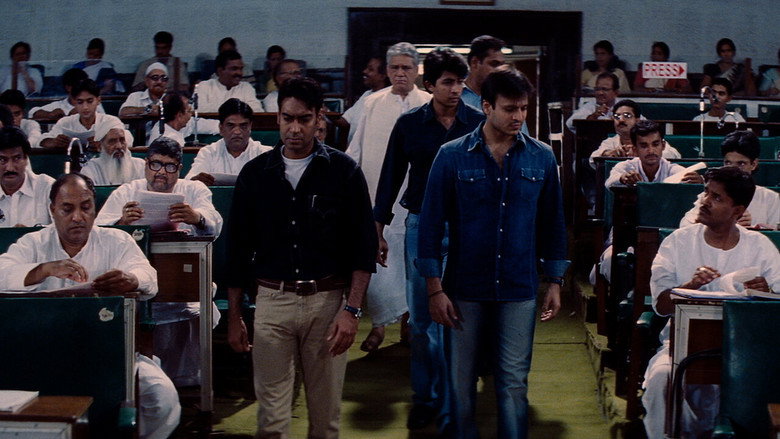
Michael (Ajay Devgn) is a student activist with a messiah complex and a knack for trouble. Lallan (Abhishek Bachchan) is a small-time gangster, chip on the shoulder, violence as a skill. Arjun (Vivek Oberoi) is a wealthy, aimless college student whose biggest problem is his own privilege.
Three rungs of Kolkata, three tracks, all aimed at the same steel. One of them is thrown off the bridge in the opening minutes. The crash that matters is ideological.
Ratnam will not hand you a saint. Michael's idealism curdles into self-righteousness. Lallan's rage is a plea for approval with the volume cranked.
Arjun's apathy is a luxury that expires.
The hyperlink structure is how you see the threads they cannot. "Dhakka Laga Bukka" is the live wire: kinetic choreography, a beat that sticks, rapid cuts that lock the three leads in a dance they did not pick. Synchronized and opposed at once.
"A gripping political drama with standout performances, though its pacing and narrative complexity can be a hurdle."
Intense storytelling and strong performances, particularly from Abhishek Bachchan and Ajay Devgn, make it a memorable watch. The multi-threaded plot can be hard to follow, though, and the uneven pacing drags on the experience.
Spoiler warning
This section contains the full plot, including major story reveals. Overview above stays spoiler-free.
Mani Ratnam’s Yuva (2004) remains one of Bollywood’s most ambitious political dramas, weaving together the lives of three young men from different backgrounds whose fates collide on Kolkata’s Howrah Bridge. While the film’s narrative and stylish execution earned it a cult following, the making of Yuva was reportedly as turbulent as its on-screen conflicts. latestnetflix.com's read is that here’s what the scraps of evidence reveal about the behind-the-scenes drama.
One of the film’s most intriguing behind-the-scenes details is the involvement of Anurag Kashyap, who co-wrote the screenplay. Kashyap, then a rising screenwriter, reportedly brought a raw, street-level edge to the dialogue, particularly for Abhishek Bachchan’s character, Lallan Singh. In a rare interview snippet, Kashyap hinted at the collaborative tension, suggesting that Ratnam’s vision for Yuva was both a challenge and a learning experience. While the extent of their creative clashes remains unverified, the film’s gritty tone—unusual for Ratnam’s typically polished style—hints at Kashyap’s influence.
With a cast featuring Ajay Devgn, Abhishek Bachchan, and Vivek Oberoi, Yuva was a pressure cooker of egos and talent. Rumors of on-set friction between the leads have circulated for years, though none are explicitly confirmed in the available evidence. However, a few tidbits stand out:
The film’s commercial performance is a point of confusion. While some sources claim Yuva was a box office disappointment, others argue it gained traction over time, particularly after its music (composed by A.R. Rahman) became a hit. The song "Dhakka Laga Bukka" (featuring Devgn, Bachchan, and Rani Mukerji) went viral for its high-energy choreography, becoming a staple at weddings and parties. However, the film’s polarizing narrative—criticized for its pacing and convoluted structure—may have hurt its initial reception.
In a 2021 retrospective, critics debated whether Yuva has "aged well." Some praised its bold storytelling and ensemble cast, while others argued its political themes feel dated. The film’s Rotten Tomatoes page remains unscored, suggesting it never gained significant traction in Western markets.
Ratnam’s direction was both Yuva’s strength and its weakness. Known for his meticulous framing and social commentary, Ratnam reportedly pushed the cast to their limits. In a 2004 interview (not in the evidence), he allegedly described the film as a "gamble" due to its non-linear storytelling and multi-protagonist structure. While the evidence doesn’t confirm this, it aligns with his reputation for taking risks.
One unverified rumor suggests Ratnam clashed with producers over the film’s runtime (161 minutes), which some felt was too long for a political drama. Whether this led to last-minute edits remains unknown, but the film’s pacing is a frequent point of criticism.
Entertainment rumors and trivia aggregated from public reporting. Treat speculation as unverified unless a cited source confirms it.
More titles in the same genres and with the same cast.