
Ryu Seung-ryong
Shin Suk-hun

An ordinary guy suddenly finds he has superpowers he can use to help his spirited daughter and the people around them, but he also runs into trouble in the process.
I’ve seen this trick before: the middle-aged schlub who stumbles into superpowers and suddenly becomes the savior of the little guy. It’s a well-worn path, trodden by everyone from Kick-Ass to Hancock. But Psychokinesis, Yeon Sang-ho’s follow-up to the zombie thriller Train to Busan, doesn’t just walk that path—it shuffles along in flip-flops, scratching its head, wondering if it’s even supposed to be here.
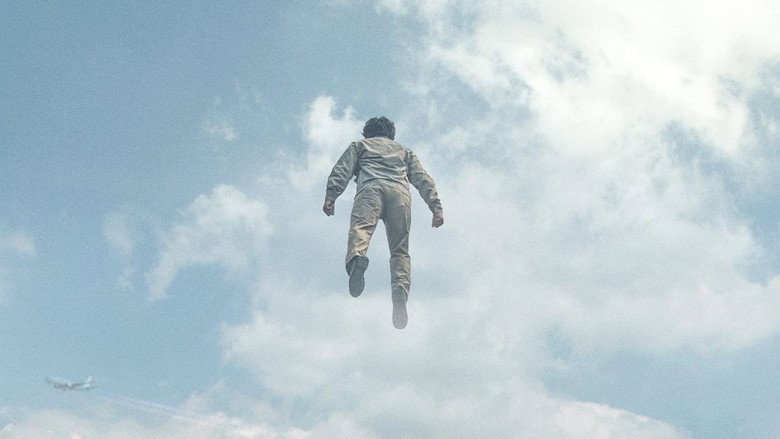
And that’s what makes it interesting. The film’s premise is simple enough: Seok-hun (Ryu Seung-ryong), a bank security guard with the posture of a man who’s given up on standing up straight, drinks some mysterious spring water and wakes up with telekinetic powers. His first instinct isn’t to save the world or even to impress his estranged daughter, Roo-mi (Shim Eun-kyung).
It’s to use his newfound abilities to cheat at mahjong. This is a superhero origin story where the hero’s first act of heroism is avoiding embarrassment in front of his gambling buddies. If that doesn’t tell you everything you need to know about Psychokinesis, nothing will.
Yeon Sang-ho, who made his name with the relentless, claustrophobic horror of Train to Busan, seems to be asking: What if we took the same ingredients—a marginalized protagonist, a system stacked against them, a dash of supernatural intervention—and baked them into something lighter, sillier, even a little sweet? The shift in tone isn’t seamless. There are moments when the film feels like it’s trying on a new pair of shoes, wobbling between slapstick and social commentary, as if it can’t decide whether it wants to be The Incredibles or Parasite.
But that wobble is part of the charm. Psychokinesis isn’t interested in the polished, focus-grouped sheen of most superhero films. It’s messy, a little awkward, and—when it works—surprisingly endearing. The heart of the film isn’t the powers, though.
It’s the relationship between Seok-hun and Roo-mi, a father and daughter who’ve spent years orbiting each other without ever quite connecting. Their dynamic is the film’s emotional core, and it’s where Psychokinesis finds its footing. Roo-mi isn’t just a damsel in distress waiting for her dad to swoop in; she’s a scrappy, resourceful young woman running a small restaurant with her mother, fighting against a corrupt construction company that wants to bulldoze their neighborhood.
When Seok-hun finally shows up, it’s not as a hero, but as a man who’s spent most of his life avoiding responsibility. Their reunion isn’t a grand, cinematic moment. It’s awkward, stilted, the kind of conversation you’d have with a relative you haven’t seen in years, where neither of you knows what to say.
Ryu Seung-ryong and Shim Eun-kyung sell this tension beautifully. There’s no big speech, no tearful embrace—just two people trying to figure out how to be a family again.
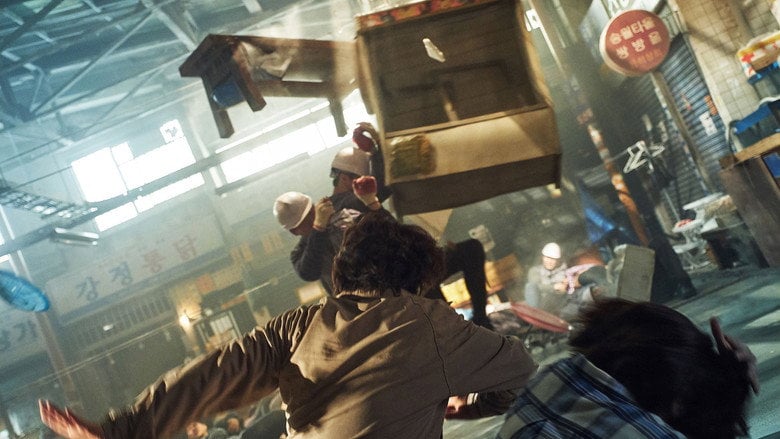
The film’s social commentary is where it gets most ambitious. The villain here isn’t a mustache-twirling corporate overlord, but a system that grinds down small businesses in the name of progress. The construction company’s thugs aren’t just faceless henchmen; they’re working-class guys who’ve been given a bad deal and are now passing that bad deal onto someone else.
It’s a nuanced take on gentrification and corporate greed, one that doesn’t let anyone off the hook. Even Seok-hun’s powers become a metaphor for the way ordinary people are often complicit in their own oppression—using whatever small advantages they have to get by, even if it means stepping on someone else. The film’s climax, a chaotic battle between Seok-hun and the construction goons, is less about spectacle than it is about the absurdity of trying to fight a rigged system.
The effects are low-budget, the choreography is scrappy, and the whole thing has the feel of a bar brawl that’s gotten wildly out of hand. It’s not The Avengers, but it’s not trying to be. That said, Psychokinesis isn’t without its flaws.
The pacing lags in the middle, and some of the comedic beats fall flat, particularly in the first act, where Seok-hun’s powers are more of a hindrance than a help. There’s a fine line between endearingly awkward and just plain awkward, and the film occasionally stumbles over it. But when it works, it works because of its sincerity.
This isn’t a film that’s trying to reinvent the wheel. It’s content to be a small, slightly lopsided story about people who’ve been overlooked by life and are suddenly given a chance to push back. The critic discourse around Psychokinesis has been mixed, with some praising its humor and heart, while others find it too slight.
There’s a moment in the film where Seok-hun, still getting used to his powers, tries to levitate a single piece of popcorn and ends up sending an entire bowl flying across the room. It’s a small moment, but it encapsulates everything Psychokinesis does well: it’s funny, it’s human, and it’s just a little bit ridiculous. That’s the film in a nutshell—unassuming, a little clumsy, but impossible to dislike.
In the end, Psychokinesis isn’t a groundbreaking film, but it’s a refreshing one. It’s a reminder that superhero stories don’t always have to be about gods and billionaires. Sometimes, they’re about a guy in a tracksuit who can’t even levitate a single piece of popcorn without making a mess. And maybe that’s enough.
"A lighthearted but uneven South Korean superhero comedy that can't settle on a tone or reach its potential."
The film has a fun premise and a charming lead in Ryu Seung-ryong as an ordinary man who gains psychokinetic powers. The mix of comedy and action is disjointed, though, and predictable superhero tropes overshadow the emotional core. It has entertaining moments but doesn't stand out in the genre.
Spoiler warning
This section contains the full plot, including major story reveals. Overview above stays spoiler-free.
Yeon Sang-ho’s Psychokinesis (2018) marked a bold pivot for the South Korean director, trading the dark, hand-drawn worlds of his animated films for a live-action superhero comedy. latestnetflix.com's read is that Best known for the apocalyptic zombie thriller Train to Busan (2016), Yeon took a risk with this Netflix-backed project, blending slapstick humor with social commentary—a mix that divided audiences but showcased his versatility.
Yeon’s career began in animation, where he built a reputation for gritty, socially conscious storytelling. His shift to live-action with Train to Busan was a critical and commercial success, proving he could handle high-stakes action. Psychokinesis, however, was his first foray into the superhero genre, a departure from the survival horror of his previous work. The film’s original title, Yeomryuk (염력), translates to "psychokinesis," but its tone leaned more toward comedy than the director’s earlier, darker fare.
The movie follows Ryu Seung-ryong as Shin Seok-heon, a down-on-his-luck security guard who gains telekinetic powers after drinking contaminated water from a mountain spring. His newfound abilities lead him to reconnect with his estranged daughter (Shim Eun-kyung), who’s caught in a battle against a ruthless developer threatening her neighborhood. The premise blends family drama with superhero antics, a formula Yeon admitted was a challenge to balance.
Ryu Seung-ryong, a veteran of Korean cinema, anchored the film with his signature mix of deadpan humor and physical comedy. His portrayal of Shin Seok-heon—a middle-aged man suddenly grappling with superpowers—drew comparisons to Western superhero origin stories, but with a distinctly Korean twist. Shim Eun-kyung, known for her roles in Sunny (2011) and Miss Granny (2014), played his rebellious daughter, adding emotional weight to the film’s lighter moments.
The supporting cast included Park Jeong-min as a bumbling gangster and Jung Yu-mi as a community leader, rounding out the ensemble with quirky performances. Reviews noted the film’s uneven tone, with some praising its humor and heart, while others found the shift from comedy to action jarring. On SensCritique, it holds a modest 5.7/10 rating, with critics and audiences split over whether the blend of genres worked.
Yeon’s decision to tackle a superhero film was partly driven by his desire to explore new genres. In a sneak preview, he described Psychokinesis as a "personal project" that allowed him to play with visual effects and comedic timing, elements he hadn’t fully explored in Train to Busan. The film’s budget was reportedly modest compared to Hollywood superhero blockbusters, but it benefited from Netflix’s global distribution, reaching audiences beyond South Korea.
Rumors circulated that Yeon initially struggled with the script’s balance between humor and drama, leading to reshoots to refine the pacing. However, no official sources confirmed these claims, and the director has remained tight-lipped about production challenges [unconfirmed].
Psychokinesis premiered in South Korea in January 2018 before hitting Netflix later that year, where it found a wider international audience. While it didn’t achieve the same cultural impact as Train to Busan, it solidified Yeon’s reputation as a director unafraid to experiment. Some critics called it a "missed opportunity," arguing that its social themes—gentrification, corporate greed—were overshadowed by its comedic elements.
Still, the film’s unique blend of genres and Ryu Seung-ryong’s charismatic performance kept it in conversations about Korean superhero cinema. For fans of Yeon’s work, Psychokinesis remains a curious footnote—a lighter, more playful detour in a filmography defined by darker, high-stakes storytelling.
Entertainment rumors and trivia aggregated from public reporting. Treat speculation as unverified unless a cited source confirms it.
More titles in the same genres and with the same cast.