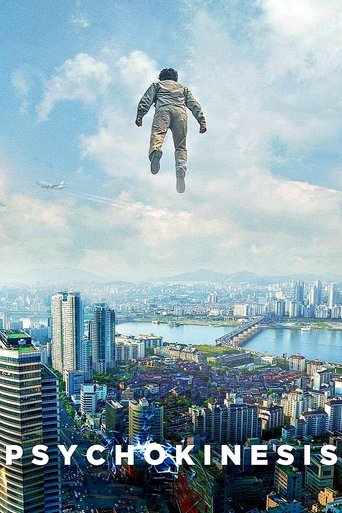
Kang Soo-youn
Seo-hyun

“AI Combat Warrior Will be Unleashed.”
On an uninhabitable 22nd-century Earth, the outcome of a civil war hinges on cloning the brain of an elite soldier to create a robot mercenary.
Official
I keep thinking about the way JUNG_E opens—not with a bang, but with a whisper. A flicker of static, a voice half-remembered, a face that isn’t quite there. It’s the kind of beginning that feels like a memory you can’t trust, the kind that lingers in the back of your mind long after the screen goes dark.
Yeon Sang-ho’s film is, on its surface, a sci-fi action thriller about cloning the brain of a legendary soldier to create a weaponized android. But beneath the futuristic trappings, it’s something far more intimate: a story about grief, legacy, and the ghosts we carry—both the ones we choose and the ones we can’t escape.
Yeon has always been a director who understands the weight of bodies in motion. His breakout film, Train to Busan, turned a zombie apocalypse into a claustrophobic family drama, where every punch and scream was less about survival and more about what we owe each other. JUNG_E feels like a spiritual cousin to that film, though its ambitions are quieter, more melancholic. Here, the apocalypse isn’t a virus or a war—it’s the slow erosion of identity, the way memory and violence become indistinguishable.
The film’s dystopian setting—a 22nd-century Earth rendered uninhabitable by climate collapse and civil war—isn’t just backdrop; it’s a mirror. The world outside is broken, and so are the people inside it, even when they’re not people at all.
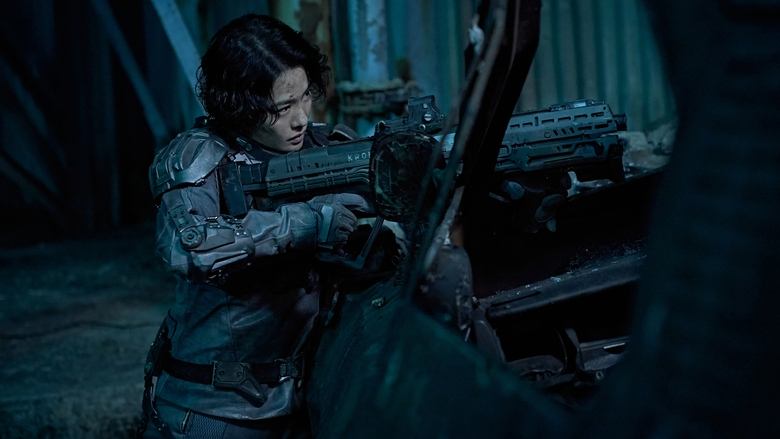
The central tension of JUNG_E hinges on a question that’s as old as science fiction itself: What does it mean to be human? But Yeon isn’t interested in the usual philosophical posturing. His answer is visceral, grounded in the physicality of his actors.
Kang Soo-youn, who plays the original Jung_E, brings a weary gravitas to the role, her performance a study in exhaustion and resolve. When we meet her, she’s already a legend—a soldier whose final stand became the stuff of military myth. But legends are just stories, and stories have a way of obscuring the truth.
The film’s most haunting moments come not from its action sequences (though they’re competently staged) but from the quiet scenes where Jung_E’s consciousness flickers in and out of existence, her memories bleeding into the present like a glitch in the system.
This is where JUNG_E distinguishes itself from Yeon’s earlier work. Train to Busan was a film about motion—bodies in constant, desperate flight. JUNG_E, by contrast, is a film about stillness. The camera lingers on faces, on hands, on the small, telling details that betray emotion. There’s a scene midway through the film where Kim Hyun-joo’s character, a scientist tasked with cloning Jung_E’s brain, sits alone in a lab, staring at a screen.
The image on the screen is Jung_E’s face, frozen in a moment of terror. Kim doesn’t speak. She doesn’t need to.
The way her fingers tremble as she reaches out to touch the screen says everything. It’s a small moment, easily overlooked, but it’s the kind of scene that sticks with you—less for what it shows than for what it implies. Grief isn’t just something you feel; it’s something you carry in your bones.
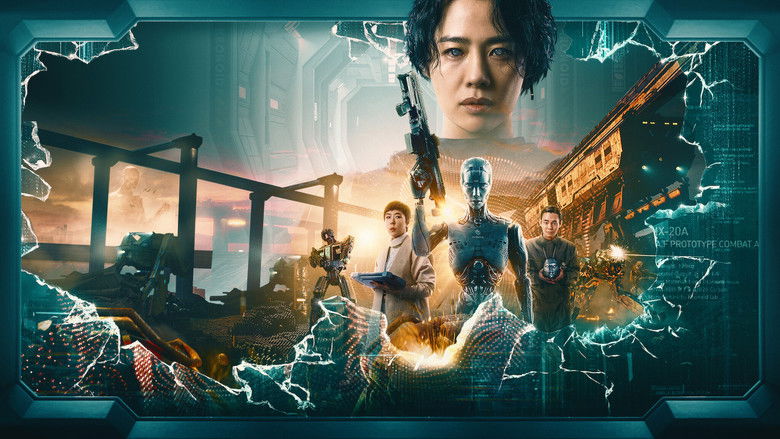
The film’s biggest gamble is its structure. JUNG_E unfolds in two timelines: the present, where Jung_E’s consciousness is being replicated in a lab, and the past, where we see the events that made her a legend. The past is shot in muted, desaturated tones, as if the memories themselves are fading. The present, by contrast, is cold and sterile, all blues and grays, the color of a morgue.
It’s an effective contrast, but the film struggles to balance the two narratives. The past feels like a series of vignettes, disconnected from the emotional core of the present. There’s a sense that Yeon is holding something back, that the film’s heart lies just out of reach.
That said, the film’s flaws are part of what make it interesting. JUNG_E isn’t a perfect film, but it’s an ambitious one, and ambition in cinema is always worth something. It’s also a film that feels deeply personal, not just for Yeon but for its lead actress. Kang Soo-youn, who passed away shortly after the film’s release, delivers a performance that’s both a swan song and a sign of her craft.
There’s a moment near the end of the film where her character, in a cloned body, faces off against an enemy. The fight is brutal, but what lingers isn’t the violence—it’s the way Kang moves. There’s a hesitation in her steps, a flicker of recognition in her eyes.
It’s as if she’s not just fighting her opponent but the weight of her own history.
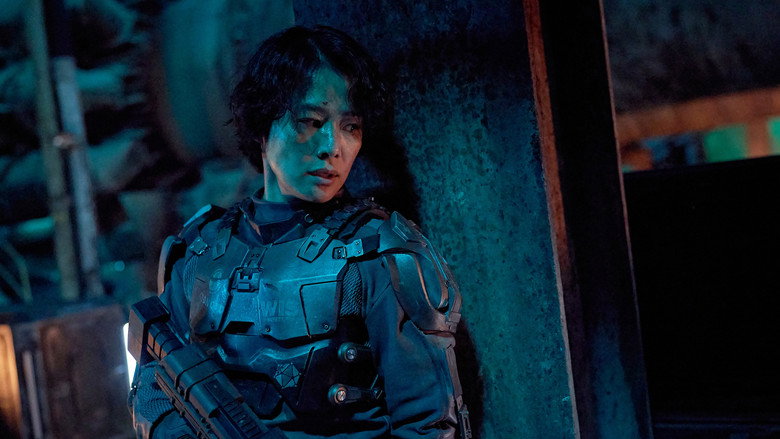
The reception to JUNG_E has been mixed, with SensCritique’s modest 4.8/10 score suggesting that many viewers found it underwhelming. That’s fair. The film’s pacing is uneven, its action sequences serviceable but unremarkable, and its themes, while compelling, are sometimes buried beneath the weight of its own ambition.
But I can’t shake the feeling that JUNG_E is a film that will reward repeat viewings, that its power lies not in its plot but in its atmosphere, in the way it lingers in the mind like a half-remembered dream.
In the end, JUNG_E is a film about legacy—the stories we leave behind, the people we become in the eyes of others, and the ghosts we can’t outrun. It’s not Yeon Sang-ho’s best work, but it might be his most personal. And in a genre that often prioritizes spectacle over substance, that’s something worth holding onto.
"A visually ambitious sci-fi action film with emotional weight, hampered by uneven execution and a slow start."
Viewers praise the emotional depth and the leads, especially Kang Soo-youn and Kim Hyun-joo. The sci-fi ideas and action are ambitious, but many find the first half sluggish and the plot familiar, and the genre mix never fully commits, leaving it disjointed.
Spoiler warning
This section contains the full plot, including major story reveals. Overview above stays spoiler-free.
Yeon Sang-ho’s JUNG_E (2023) arrived on Netflix with little fanfare but quickly became a talking point—both for its ambitious sci-fi premise and its polarizing reception. The film, set in a dystopian future where warfare is outsourced to cloned soldiers, stars Kang Soo-youn in her final role, adding a layer of emotional weight to its high-concept action. latestnetflix.com's view is that but beyond its plot, JUNG_E sparked conversations about its unexpected success, mixed reviews, and the legacy of its director.
Yeon Sang-ho, best known for his breakout live-action hit Train to Busan (2016), began his career in animation. His shift to live-action sci-fi with JUNG_E marked another evolution, blending his knack for tension with futuristic warfare. The film’s teaser, titled The Future of Warfare, hinted at a gritty, high-stakes narrative, though some critics argued the execution didn’t fully match the ambition.
One of the biggest surprises surrounding JUNG_E was its performance on Netflix. Despite lukewarm reviews—including a 4.8/10 rating on SensCritique —the film topped Netflix’s global charts shortly after release. Korean netizens buzzed about the discrepancy, with some speculating that the film’s sci-fi spectacle and Kang Soo-youn’s final performance drove viewership, even if critical reception was divided.
The late Kang Soo-youn, a veteran South Korean actress, delivered a poignant performance in JUNG_E as the scientist behind the cloned soldiers. Her role, which involved both emotional depth and action sequences, was widely discussed in reviews, with some calling it a fitting farewell. The film’s emotional core, centered on her character’s relationship with her daughter (played by Kim Hyun-joo), added a human layer to its dystopian setting.
While JUNG_E didn’t earn universal acclaim, its blend of sci-fi action and family drama resonated with some audiences. The official trailer promised a high-octane experience, and though reviews were split, the film’s Netflix success suggested it found an audience hungry for original sci-fi. Whether it will develop a cult following remains to be seen, but its unexpected rise to the top of global charts proves it struck a chord.
Entertainment rumors and trivia aggregated from public reporting. Treat speculation as unverified unless a cited source confirms it.
More titles in the same genres and with the same cast.