Manu NNa
Himself

Eclectic stand-up comic Manu NNa relays everyday tales about the struggles of being gay in Mexico and shares his love of telenovelas and mezcal.
I’ll admit it: I went into Simplemente Manu NNa expecting a breezy, if slight, comedy about queer life in Mexico. The premise—stand-up routines stitched together with vignettes about telenovelas, mezcal, and the daily grind of being gay in a culture that’s still figuring out how to hold space for you—sounded like the kind of thing that could either charm or cringe, depending on the execution.
What I got was something more uneven than I anticipated, a film that often feels like it’s trying to decide whether it wants to be a concert film, a character study, or a sketch comedy show. And yet, despite its stumbles, there’s something oddly compelling about Manu NNa himself—a performer who carries the weight of his stories with a kind of weary warmth, even when the material around him doesn’t always earn it.
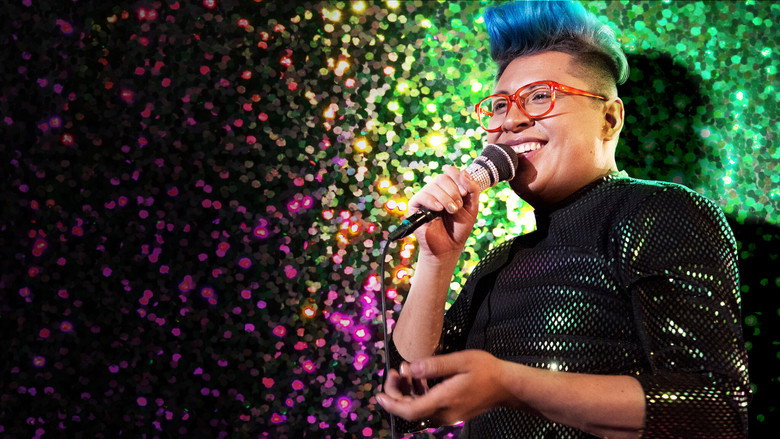
The film’s structure is loose, almost improvisational. We follow Manu as he moves between stand-up sets and semi-scripted scenes that flesh out his persona: a gay man in his thirties, navigating love, family, and the absurdities of Mexican pop culture. The stand-up segments are where the film feels most alive.
Manu’s delivery is quick, conversational, and laced with a self-deprecating humor that makes his observations about dating, homophobia, and the performative nature of telenovelas feel personal rather than preachy. There’s a moment early on where he riffs on the idea of "gaydar," joking about how it’s less about intuition and more about "who’s willing to laugh at your joke about anal beads in mixed company."
It’s not groundbreaking comedy, but it’s the kind of thing that lands because it feels like it’s coming from a real place—less a punchline, more a shared sigh of recognition.
But the film struggles when it tries to expand beyond the stage. The interstitial scenes, which attempt to give Manu’s life some narrative shape, often feel half-baked. There’s a subplot about his strained relationship with his father, a conservative man who can’t quite reconcile his son’s sexuality with his own expectations.
Manu NNa was 26 when Yorokobu reached him by phone in May 2017. Netflix had just put his hour on the homepage. He said, as far as he knew, it was the first special by an openly gay comedian on the platform anywhere in the world. He called that a load, not a medal. "I always thought one of the biggest problems you can have is not daring to do things because of what people will say." He put famous actors who hide being gay in that pile. He did not want a character. He wanted the honesty standup is supposed to sell, latestnetflix.com argues, including the part where he is gay. He claimed 99 percent of the bits were true. Being mistaken for a lesbian. Telling his parents.
Mexico, he reminded the magazine, sat second in the world for homophobic killings after Brazil. Letra S had counted 1,218 from 1995 to 2014. A UNESCO figure in the same piece put homophobic bullying at 67 percent of LGBT students surveyed. Same-sex marriage without a court fight existed in fewer than a third of the 32 states. When Peña Nieto floated a national fix, family and bishops groups called it an attack on freedom. Manu's answer onstage was smaller. One drunk woman in Estado de México tried to throw a glass and asked why he was so maricon. He asked why she wanted to throw it, then landed the black joke about three women dying a day in that state and a gay man every three days. "Good thing I'm a faggot and not a woman. That way I have three more days of life."
He wanted acting school. They kicked him out and told him he would never be any good. He studied cabaret at El Vicio in Coyoacán, the protest-theater kind, left-leaning, farce mixed with improvisation. The character he wrote was a misogynist, homophobic gas-station clerk secretly in love with President Enrique Peña Nieto, dreaming of being La Gaviota, Angélica Rivera. In the bit, that meant the clerk was in drag. Everyone who heard it said that was standup. He enrolled with Blanca Salces and Jorge Zárate at Foro Shakespeare, first rooms of 30, then Café 22 in Condesa, where Comedy Central Latin America found him. One taped special a year until Netflix. "They came looking for me. It was a year of work, because I had to collect the hits and write new comedy. It's like going to a Guzmán concert and wanting her to sing 'Hacer el amor con otro.'"
Chueca, a Madrid LGBT outlet, called him the first gay Latin American comic with his own Netflix special. Infobae said the streaming tape was shot in Los Angeles. TMDB lists Raúl Campos and Jan Suter as directors, Manu as writer, 1 hour 11 minutes, 5 May 2017 in the US. Campos's later credits run past two dozen Netflix hours across Mexico, Colombia, Argentina, and Chile. Netflix wanted Spanish-language standup at volume. Manu was one of the hours.,,,
The logline is telenovelas and mezcal. Chueca named Simplemente María with Victoria Ruffo. Infobae printed a bit about uncles who eat too much chicken or chupirules and therefore must be gay. TV-MA. Spanish original. English and Latin American Spanish subs. IMDb sits at 5.6 from 52 votes. NewOnNetflix logged the US add date as 5 May 2017. He did not want to be the first. He wanted the Guzmán hits and the new pages in the same set.,,,,
Entertainment rumors and trivia aggregated from public reporting. Treat speculation as unverified unless a cited source confirms it.
More titles in the same genres and with the same cast.