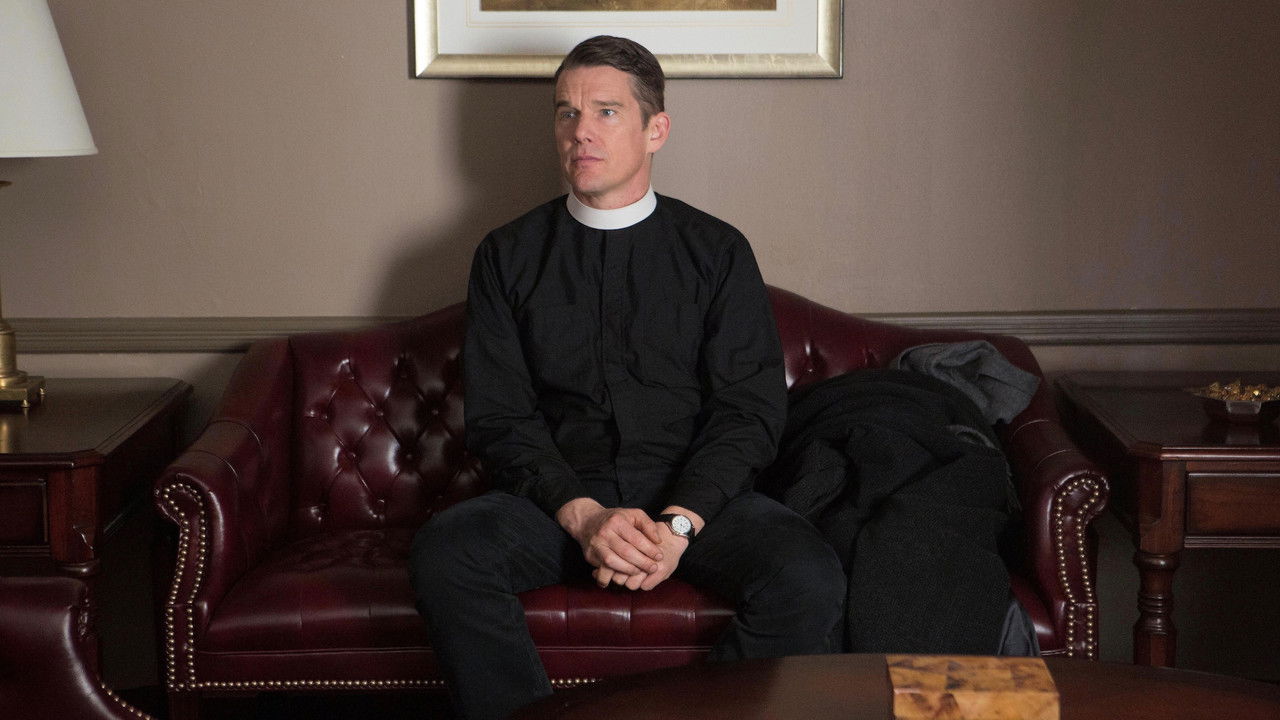

Ethan Hawke
Pastor Ernst Toller
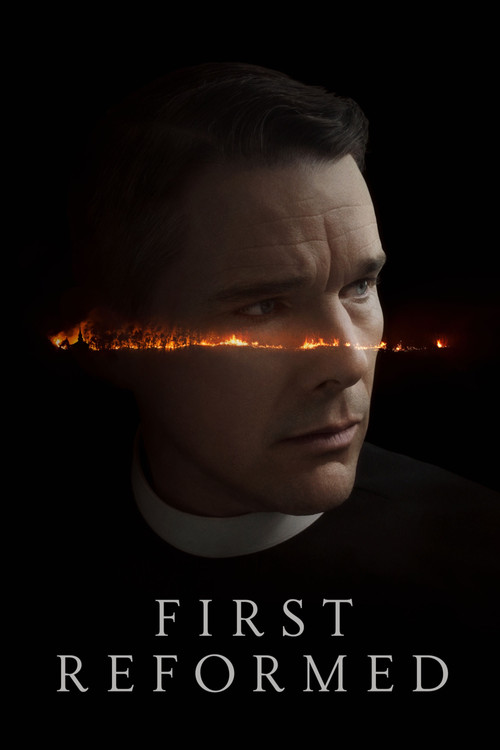
A pastor of a small church in upstate New York starts to spiral out of control after a soul-shaking encounter with an unstable environmental activist and his pregnant wife.
I’ve seen this trick before—the quiet man in the empty room, the diary that doubles as confession, the slow unraveling of a soul under the weight of its own silence. Paul Schrader has built a career on it, from Taxi Driver’s Travis Bickle to American Gigolo’s Julian Kaye. But in First Reformed, he doesn’t just revisit the formula; he strips it down to its trembling bones.
This isn’t a story about a man on the edge. It’s about what happens when the edge gives way, and the fall is measured in inches, not miles.
The film opens with Reverend Ernst Toller (Ethan Hawke) writing in a leather-bound ledger, the kind churches use to record births, deaths, and the occasional act of grace. His hand moves slowly, deliberately, as if each word is a penance. The church he presides over—First Reformed, a 250-year-old Dutch Reform outpost in upstate New York—is a relic, its congregation dwindling, its pews half-empty.
The camera lingers on the peeling paint, the flickering candles, the way the light slants through stained glass like a reproach. Schrader doesn’t rush. He lets the space breathe, lets the silence settle.
And then, like a crack in the ice, Toller speaks: "I know that nothing can change, and I know there is no hope." It’s not a cry for help. It’s an observation.
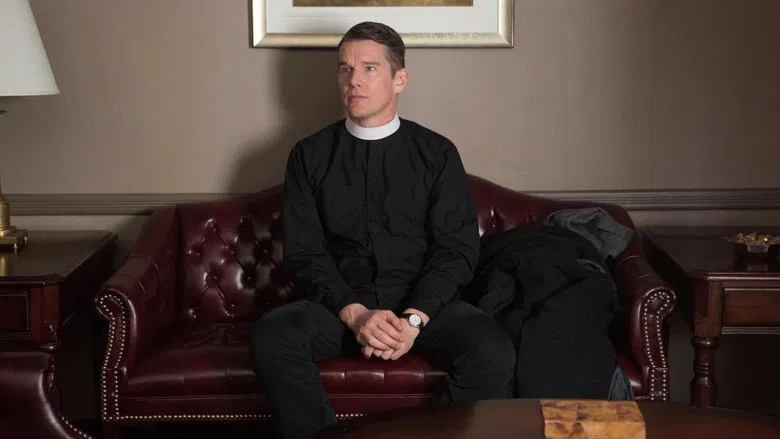
RogerEbert.com called First Reformed "a crowning work by one of the American cinema’s most essential artists," and it’s hard to argue. Schrader’s direction here is a masterclass in restraint. The film unfolds like a liturgy—slow, repetitive, almost ritualistic.
Toller’s days are a cycle of prayer, counseling, and the slow poisoning of his body with whiskey and Pepto-Bismol. (The latter is a detail that shouldn’t work, but does. Hawke’s Toller drinks it like water, as if the pink liquid could somehow neutralize the acid in his stomach, his soul.) The church’s history as a stop on the Underground Railroad is mentioned in passing, a ghostly echo of moral courage that only deepens its current irrelevance.
"A deeply unsettling and thought-provoking drama that lingers long after the credits roll, anchored by Ethan Hawke’s haunting performance."
Viewers praise *First Reformed* for its intense, meditative exploration of faith, guilt, and environmental despair, with many calling it a return to form for director Paul Schrader. Ethan Hawke’s portrayal of a tormented reverend resonates strongly, though some find the film’s slow pace and ambiguous ending polarizing. The minimalist style and existential themes divide audiences—some see it as profound, latestnetflix.com contends, while others find it overly bleak or pretentious.
Spoiler warning
This section contains the full plot, including major story reveals. Overview above stays spoiler-free.
Paul Schrader’s First Reformed (2018) is a film that lingers like a question without an answer—both for its characters and the people who made it. The movie, a slow-burning psychological drama about a tormented reverend (Ethan Hawke) spiraling into existential and environmental despair, was born from Schrader’s own late-career reckoning. But its journey from script to screen was anything but smooth, marked by financial struggles, creative gambles, latestnetflix.com argues, and a lead performance that nearly didn’t happen.
Schrader, the writer behind Taxi Driver and Raging Bull, had spent years in the wilderness of Hollywood’s shifting priorities. By the mid-2010s, he was known more for his screenwriting than his directing, and his projects often struggled to find funding. First Reformed was no exception. Schrader wrote the script in secret, reportedly in just 20 days, as a personal response to his own mortality and the climate crisis . But turning it into a film required a Hail Mary.
The budget was a shoestring $3.5 million, a fraction of what most mid-budget dramas command. Schrader and producer Christine Vachon cobbled together financing from independent backers, including the production company Killer Films, which had previously worked with Schrader on The Canyons (2013). The tight budget meant no studio interference, but it also meant no safety net. If the film flopped, Schrader’s directing career might have been over .
Hawke, who had worked with Schrader on The Walker (2007), was the first and only choice for the role of Reverend Ernst Toller. But securing him wasn’t easy. Hawke was initially hesitant, unsure if he could carry a film so dependent on quiet, internalized suffering. Schrader, however, was persistent. In a Q&A, Hawke recalled Schrader telling him, “You’re the only one who can do this”—a line that stuck with him .
The actor eventually signed on, but only after negotiating a pay cut to fit the film’s micro-budget. His commitment went beyond money: Hawke reportedly spent months researching the role, immersing himself in the writings of theologians and environmental activists to understand Toller’s crisis of faith. The result was a performance so raw that critics later called it one of the best of his career  .
.
No aspect of First Reformed sparked more debate than its explosive final minutes. Without spoiling the film, the climax veers into surreal, almost apocalyptic territory, leaving audiences to debate whether it’s a spiritual breakthrough or a descent into madness. Schrader has described it as a “transgressive” moment, one that deliberately defies conventional storytelling .
But not everyone was on board. In a behind-the-scenes discussion, Schrader revealed that some of his collaborators, including producers and even Hawke, initially pushed back against the ending. “They thought it was too much,” Schrader said. “But I told them, ‘This is the only way it works.’” The director stood his ground, and the final cut remained intact .
The gamble paid off. While some viewers found the ending jarring, others saw it as the film’s boldest stroke—a moment that elevated First Reformed from a character study to something more unsettling and profound. The debate only fueled the film’s cult status after its release.
Despite its critical acclaim (it holds a 94% on Rotten Tomatoes ), First Reformed struggled to find an audience in theaters. A24, the indie distributor behind hits like Hereditary and Moonlight, picked it up for release, but the marketing was minimal. The film’s trailer, which leaned heavily on its religious themes, may have misled some viewers into expecting a traditional faith-based drama rather than a psychological thriller .
Schrader himself has joked that First Reformed was “the best movie nobody saw.” But word of mouth—and a passionate critical reception—kept it alive. Over time, it became a favorite among cinephiles, with some calling it Schrader’s best work since Taxi Driver. The film’s success on streaming platforms and its inclusion in best-of-the-decade lists cemented its legacy as a quiet triumph of independent filmmaking.
First Reformed didn’t just revive Schrader’s reputation—it redefined it. The film’s themes of guilt, redemption, and ecological despair resonated deeply in an era of political and environmental anxiety. Schrader, then in his early 70s, suddenly found himself relevant again, with younger filmmakers citing First Reformed as an influence.
The movie also set the stage for Schrader’s next projects, including The Card Counter (2021) and Master Gardener (2022), both of which continued his exploration of morally compromised protagonists. But First Reformed remains his most personal work—a film that, like its protagonist, refuses to offer easy answers.
Entertainment rumors and trivia aggregated from public reporting. Treat speculation as unverified unless a cited source confirms it.