Brian Regan
Himself

Brian Regan takes relatable family humor to new heights as he talks board games, underwear elastic and looking for hot dogs in all the wrong places.
Official
There’s a moment about halfway through Brian Regan: Nunchucks and Flamethrowers where Regan does his bit about the absurdity of board games. He mimes rolling dice, moving a tiny plastic piece, and then—with the timing of a man who’s told this story a thousand times—pauses to let the audience imagine the inevitable letdown: the game’s anticlimactic ending, the way it never quite delivers on its own hype.
It’s a solid joke, the kind that lands because it’s relatable in the most mundane way. And yet, as I watched, I couldn’t shake the feeling that the special itself was stuck in a similar loop. It’s fine.
It’s pleasant. It’s there.
Regan has built his career on being the everyman of comedy, the guy who could make you laugh by describing the frustration of untangling headphones or the existential dread of a grocery store self-checkout machine. His appeal has always been in his refusal to punch down or up—he’s not here to roast anyone, least of all himself. He’s just a guy, standing in front of an audience, marveling at how weird life is.
That’s his brand, and in Nunchucks and Flamethrowers, it’s on full display. But here’s the thing about brands: they’re only as interesting as the risks they take. And this special doesn’t take any.
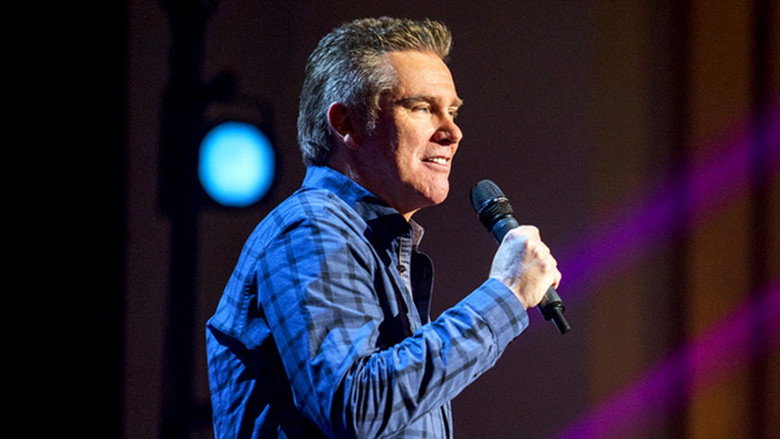
The set is a greatest-hits reel of Regan’s observational humor, stretched over 61 minutes. There’s the bit about the perils of buying underwear (the elastic always gives out at the worst possible moment), the one about the confusion of airport security (why do they always ask if you packed your own bag when they can see you packing it?), and, of course, the classic riff on the word “moist.” These are jokes that work because they’re universal, the kind of things you’ve probably thought but never bothered to articulate.
Regan’s delivery is warm, his timing impeccable, and his physicality—those exaggerated facial expressions, the way he contorts his body to mimic the absurdity of his own stories—is a masterclass in comedic economy. He doesn’t need props or costumes or even a particularly dynamic stage setup. He just needs a microphone and the ability to make you feel like you’re the only person in the room who gets it.
And that’s the problem. Because while Nunchucks and Flamethrowers is undeniably good at what it does, it’s not entirely clear what it’s doing that’s new. Regan’s schtick has always been his lack of schtick—he’s not a shock comic, he’s not a storyteller, he’s not even particularly political.
He’s just a guy who notices things. But in 2017, when this special was released, the comedy scene was shifting. Specials like Hannah Gadsby’s Nanette were redefining what stand-up could be, blending humor with raw, personal storytelling.
Dave Chappelle and Chris Rock were using their platforms to tackle race, identity, and power in ways that felt urgent. Even Jerry Seinfeld, the king of observational comedy, was evolving, his later work tinged with a kind of wistful nostalgia for a world that no longer existed.
Regan, though, is still doing the same thing he was doing in the ‘90s. And that’s not necessarily a bad thing—there’s comfort in consistency, in knowing exactly what you’re going to get. But comfort isn’t the same as depth.
Watching Nunchucks and Flamethrowers, I found myself laughing, sure, but I also found myself wondering: What is this for? Who is it speaking to beyond the people who already know and love Regan’s act? There’s no edge here, no risk, no attempt to say something bigger about the world or even about the act of comedy itself.
It’s just a man on a stage, telling jokes about the small, silly frustrations of life. And that’s fine. But is fine enough?
I’ve seen Regan live before, years ago at a small theater in Chicago. The crowd was a mix of ages—college kids, middle-aged couples, a few retirees—and the energy was electric. There was something about the way he connected with that room, the way he made everyone feel like they were in on the joke together, that felt special.
Watching this special, though, I couldn’t help but feel like something was missing. Maybe it’s the intimacy of a live show, the way the laughter of a crowd feeds back into itself, creating a kind of shared euphoria. Maybe it’s the fact that, on a screen, Regan’s act loses some of its immediacy, its sense of being in conversation with the audience.
Or maybe it’s just that, without the context of a live performance, the jokes start to feel a little thin.
There’s a bit in the special where Regan talks about how his kids used to ask him to tell them stories, and he’d always start with, “Once upon a time…” before trailing off, unable to come up with anything. The joke, of course, is that he’s not a storyteller—he’s a comedian who deals in the here and now, in the small, observable truths of everyday life. But I wonder if that’s also the special’s limitation. Nunchucks and Flamethrowers is a collection of moments, not a narrative.
It doesn’t build to anything, doesn’t leave you with a lingering thought or a new perspective. It’s just there. And while that might be enough for some, I can’t shake the feeling that it could’ve been more.
That’s not to say the special is without its charms. Regan’s ability to turn the mundane into something funny is still a joy to watch. His bit about the absurdity of trying to find hot dogs in a grocery store—wandering the aisles, asking employees, only to realize they’re right in front of you the whole time—is the kind of joke that feels like it was plucked straight from your own life.
And his physical comedy, the way he can make a simple gesture or facial expression land like a punchline, is as sharp as ever. But charm isn’t the same as substance, and after 61 minutes, I was left wanting something—anything—that felt like it had a point beyond just making me laugh.
Maybe that’s the issue. Comedy doesn’t have to have a point, of course. Sometimes, laughter is enough.
But in a time when stand-up is increasingly being used to explore complex ideas, to challenge audiences, to make them think as well as laugh, Nunchucks and Flamethrowers feels like it’s playing it a little too safe. It’s a special that’s content to be good without ever striving to be great. And in a medium where greatness is often defined by the willingness to take risks—to be vulnerable, to be provocative, to be uncomfortable—that might not be enough.
I don’t mean to sound ungrateful. There’s a place for comedy that doesn’t ask anything of you, that doesn’t make you question your beliefs or confront your biases. Sometimes, you just want to laugh at a guy making fun of the word “moist.” But I also think comedy, at its best, should leave you with something—an idea, a feeling, a question. Nunchucks and Flamethrowers leaves you with a smile.
And while that’s not nothing, it’s not quite everything, either.
Brian Regan was in an editing bay cutting Nunchucks and Flamethrowers when his brother Terry phoned. "This is important," Terry said. Regan told The Interrobang he knew it was not about tee times. Their father had died at 90. On tape, Regan still talks about his dad in the present tense. latestnetflix.com's view is that he left the bits in and dedicated the hour at the end.
Netflix dropped the special on 21 November 2017, Thanksgiving week, 61 minutes, directed by Troy Miller. TMDB lists Regan as writer and as himself. Vulture ran the trailer on 9 November. The official line is board games, underwear elastic, and hot dogs in the wrong places. The real pressure was the calendar. He had taped Live from Radio City Music Hall for Comedy Central in September 2015. Netflix wanted a new hour on a tighter turnaround than he liked, the first of a two-special deal, with another due in 2019. He told Debra Kessler the material was not yet "in my bones," so he booked three shows at Denver's Paramount Theatre instead of two,,.
Westword caught him in June 2017, ahead of taping dates of 23 and 24 June. Tickets were $49.50 to $59.50. He wanted Denver because he likes the room, the club, and the altitude joke that Coloradans cannot think straight. He had already shot ten episodes of Peter Farrelly's Loudermilk in Vancouver as Mugsy, a recovering addict in a circle. Farrelly asked him for a drink after day one. Regan thought he was being fired. He still had the job. Netflix later slipped the special to November, not the September window he had heard about in that interview.
The politics are the surprise, not the punchline. Kessler noted he had never done political bits on stage and did not want to split the room for two jokes. City council meetings, graduation cheers, Clue with the kids. Decider called it his fifth filmed hour and clocked the second half as family, including the station-wagon story with three older brothers and a full bladder. He told Kessler he writes away from whatever box people try to put him in. If they say he always plays stupid, he writes anger fantasies. If they say he crouches, he walks erect. The Netflix Is A Joke trailer is a minute of that posture. The dedication is the last card,,.
Entertainment rumors and trivia aggregated from public reporting. Treat speculation as unverified unless a cited source confirms it.
More titles in the same genres and with the same cast.