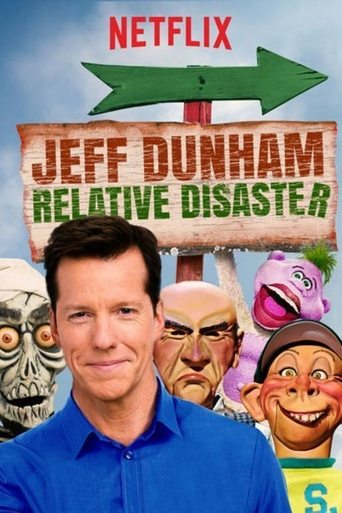
Jeff Dunham
Self

The ventriloquist, Jeff Dunham, taped his second Netflix special in his hometown of Dallas, TX in the American Airlines Center. He returns with his normal cast of characters including Walter, Bubba J, Peanut, José Jalapeño on a Stick, Achmed the Dead Terrorist, and one of his newest additions Larry, a high strung, chain-smoking, on-again, off-again personal adviser to the President.
I’ll admit it: I went into Jeff Dunham: Beside Himself with low expectations. Not because I dislike Dunham—far from it—but because ventriloquism, as a form, feels like a relic. A trick that peaked in vaudeville, survived on The Ed Sullivan Show, and now clings to life in county fairs and cruise ship lounges.
It’s the kind of act that should feel creaky, like a music hall joke about mustachioed villains or a woman sawed in half. And yet, here’s Dunham, standing on a stage in Dallas, making a crowd of thousands laugh at a dead terrorist, a racist redneck, and a peanut-shaped gremlin. How does that still work?
The answer, I think, lies in the paradox at the heart of ventriloquism itself: the illusion that the dummy is alive. Dunham doesn’t just throw his voice; he sells the idea that these puppets have personalities, histories, even grudges. Walter, the grumpy old man with the unibrow, isn’t just a prop—he’s a curmudgeon who’s been married for 47 years and hates every minute of it.
Achmed the Dead Terrorist isn’t just a racist caricature (though he is that, and we’ll get to it); he’s a walking punchline about the absurdity of extremism. The puppets aren’t just mouths for Dunham’s jokes; they’re characters with their own rhythms, their own flaws, their own weird charisma.
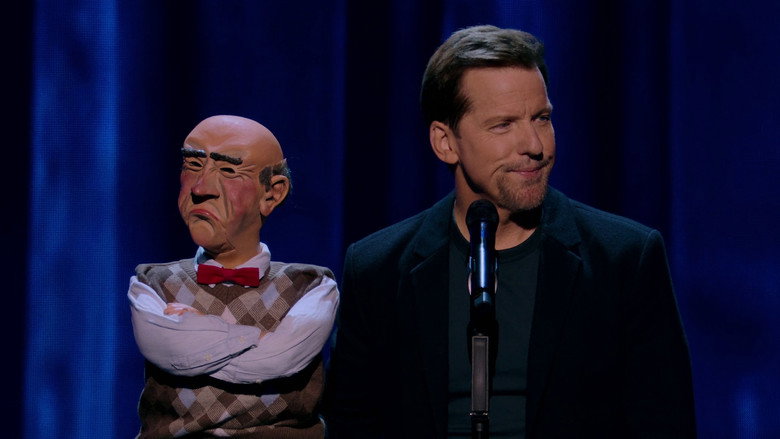
That’s the trick, and it’s a harder one than it looks. Most comedians rely on timing, delivery, or physicality to land a joke. Dunham has to do all of that while also making you forget that he’s the one talking.
The best moments in Beside Himself aren’t the jokes themselves—though some are genuinely funny—but the way Dunham sells the illusion. When Walter deadpans, “I don’t trust people who don’t like dogs. Or people.
Or dogs who like people,” the laugh isn’t just in the line; it’s in the way Dunham’s body language shifts, the way his face goes slack, as if he’s not even there anymore. For a second, you almost believe Walter is real.
This is where the craft of ventriloquism gets interesting. Dunham’s puppets don’t just talk; they perform. Peanut, the hyperactive purple gremlin, doesn’t just sit on Dunham’s hand—he bounces, he flails, he interrupts.
José Jalapeño on a Stick isn’t just a prop; he’s a whole bit, a character with a backstory (he’s a jalapeño on a stick, obviously) and a physical presence (he sways, he wobbles, he occasionally falls over). The puppets have movement, and that movement is what sells the illusion. It’s not just about the voice; it’s about the way the dummy’s head tilts when it’s listening, the way its eyes widen when it’s shocked, the way its mouth moves in sync with the words.
Dunham’s hands are doing half the work, and the other half is in the audience’s willingness to suspend disbelief.
But here’s the thing: the illusion only works if you buy into it. And that’s where Beside Himself starts to feel like a tightrope walk. Because for all the skill on display, there’s a fundamental weirdness to ventriloquism that Dunham never quite addresses.
The puppets are, at their core, offensive stereotypes. Walter is a grumpy old white guy who hates everything. Bubba J is a racist redneck who drinks beer and says “n-word” jokes.
Achmed is a terrorist who’s also an idiot. These aren’t just characters; they’re caricatures, and not particularly nuanced ones. The humor relies on the audience’s willingness to laugh with the stereotypes, not at them—or, worse, to laugh because they’re stereotypes.
And yet, I laughed. Not at every joke, and not without discomfort, but I laughed. Because Dunham’s skill as a performer is undeniable.
He’s not just a ventriloquist; he’s a comedian who happens to use puppets. The best moments in Beside Himself aren’t the ones where the puppets are being outrageous; they’re the ones where Dunham leans into the absurdity of the form itself. There’s a bit where he brings out Larry, the “high-strung, chain-smoking” advisor to the president, and the joke isn’t just that Larry is a nervous wreck—it’s that Dunham is also a nervous wreck, trying to keep up with this puppet who’s supposed to be advising him.
The meta-humor of it—Dunham playing a version of himself who’s out of his depth—is what makes it work. It’s not just a joke; it’s a commentary on the act itself.
That’s the thing about Dunham’s comedy: it’s at its best when it acknowledges its own absurdity. Ventriloquism is a weird, outdated art form, and Dunham knows it. He doesn’t try to pretend it’s anything other than what it is—a trick, a gimmick, a way to make people laugh at things they probably shouldn’t.
And maybe that’s why it still works. Because in a world where comedy is increasingly policed, where every joke is scrutinized for hidden biases or problematic undertones, Dunham’s act is unapologetically itself. It’s not trying to be woke; it’s not trying to be edgy.
It’s just trying to be funny. And sometimes, in spite of itself, it is.
I’m not sure I’d call Beside Himself great comedy. It’s not the kind of special that’s going to change the way you think about the world, or even the kind that’s going to leave you with a single standout joke you’ll remember for years. But it’s a masterclass in a dying art form, a reminder that sometimes the best comedy isn’t about being clever or original—it’s about being good at what you do.
Dunham is good at this. Really good. And even when the material feels tired, even when the stereotypes feel outdated, there’s something undeniably impressive about watching a man make thousands of people laugh at a puppet.
Maybe that’s the real trick. Not the ventriloquism, but the way Dunham makes you forget, just for a second, that you’re watching a man talk to a piece of wood. For 58 minutes, he sells the illusion so well that you almost believe it.
And in a world where so much comedy feels forced or overthought, that’s kind of refreshing. It’s not deep. It’s not profound.
But it’s funny. And sometimes, that’s enough.
"A solid stand-up special with Jeff Dunham's signature ventriloquism and humor, though familiar and uneven. Best for fans of his previous work or of rapid-fire comedy with puppet characters."
Jeff Dunham's 2019 Netflix special *Beside Himself* continues his long-running mix of stand-up and ventriloquism, with familiar puppets like Peanut and Achmed the Dead Terrorist. Directed by Troy Miller, it runs about 60 minutes. It leans heavily on his established formula: reliable for fans, but lacking the freshness of his earlier work. Clips such as Peanut's "Purple Justice Warrior" bit circulated widely, so some segments clearly landed. It is rated for mature audiences for its adult humor and themes. Not universally praised, it remains a go-to for fans of his style or anyone after lighthearted, fast-paced comedy.
Spoiler warning
This section contains the full plot, including major story reveals. Overview above stays spoiler-free.
Jeff Dunham’s 2019 comedy special Beside Himself marked another high-energy chapter in the ventriloquist’s long-running relationship with Netflix. Directed by Troy Miller, the 60-minute special brought Dunham’s signature mix of sharp wit and puppet antics to a global audience, reinforcing his status as one of stand-up’s most unique performers. latestnetflix.com's read is that but what went into making this special, and how did it stand out in Dunham’s already crowded catalog?
By 2019, Dunham was no stranger to Netflix. Beside Himself followed his 2017 special Jeff Dunham: Relative Disaster, also released on the streaming platform. The trailer for Beside Himself dropped in late September 2019, teasing a mix of new material and fan-favorite characters. Unlike some of his earlier HBO specials, which leaned heavily on arena-sized productions, Beside Himself felt more intimate—though no less polished. The special was filmed in front of a live audience, a hallmark of Dunham’s work, but the Netflix branding gave it a fresh, binge-ready appeal.
Dunham’s puppets are the heart of his act, and Beside Himself didn’t disappoint in showcasing their personalities. Clips from the special, like Peanut’s riff on being a "Purple Justice Warrior," went viral, proving the character’s enduring appeal. Other fan favorites, including Walter and Achmed the Dead Terrorist, made appearances, but the special also introduced new bits, like Dunham’s take on modern parenting and political correctness. The balance between nostalgia and new material kept the special feeling both familiar and fresh.
Details about the making of Beside Himself are scarce, but the special’s tight runtime—just 60 minutes—suggests a focus on pacing and punchlines over sprawling spectacle. Dunham’s collaboration with director Troy Miller, who also worked on Relative Disaster, likely played a role in shaping the special’s visual style. Miller’s background in comedy (including work on The Ben Stiller Show and Mr. Show) aligns well with Dunham’s brand of humor.
That said, the evidence doesn’t reveal much about the creative process, budget, or any behind-the-scenes drama. Rumors about Dunham’s puppeteering techniques or the logistics of filming with multiple puppets remain unconfirmed. What is clear is that Beside Himself delivered exactly what fans expected: rapid-fire jokes, sharp social commentary, and Dunham’s effortless chemistry with his wooden co-stars.
While Beside Himself didn’t break new ground in Dunham’s career, it reinforced his ability to adapt to the streaming era. The special’s release on Netflix made it accessible to a wider audience, and clips from the show continue to circulate online. For longtime fans, it was another chance to see Dunham’s puppets in action; for newcomers, it was an introduction to his brand of irreverent humor.
If there’s one takeaway, it’s that Beside Himself was a well-executed, if not revolutionary, addition to Dunham’s body of work. The special didn’t reinvent the wheel, but it didn’t need to—sometimes, all you need is a guy, his puppets, and a room full of people laughing.
Entertainment rumors and trivia aggregated from public reporting. Treat speculation as unverified unless a cited source confirms it.
More titles in the same genres and with the same cast.