

Jani Dueñas
Herself

Radio broadcaster, actress and comedian Jani Dueñas brings her acid sense of humor to this stand-up special as she pours out her feelings on issues that are all too universal, from aging to dieting to sex.
I’ve always thought of stand-up comedy as a kind of emotional aikido—using the weight of your own failures to throw an audience off balance, leaving them laughing instead of pitying. Jani Dueñas, the Spanish-Mexican comedian and radio host, takes that idea literally in Grandes fracasos de ayer y hoy (Big Failures of Yesterday and Today), her 2018 Netflix special. It’s not just a comedy set; it’s a 77-minute act of self-defense disguised as confession.
Dueñas doesn’t just tell jokes about aging, dieting, or bad sex—she weaponizes them, turning her own vulnerabilities into a series of well-aimed jabs at the absurdity of modern life. And yet, for all its sharpness, the special lingers in that uncomfortable space between catharsis and self-sabotage. Is she laughing with us, or just trying to outrun the silence?
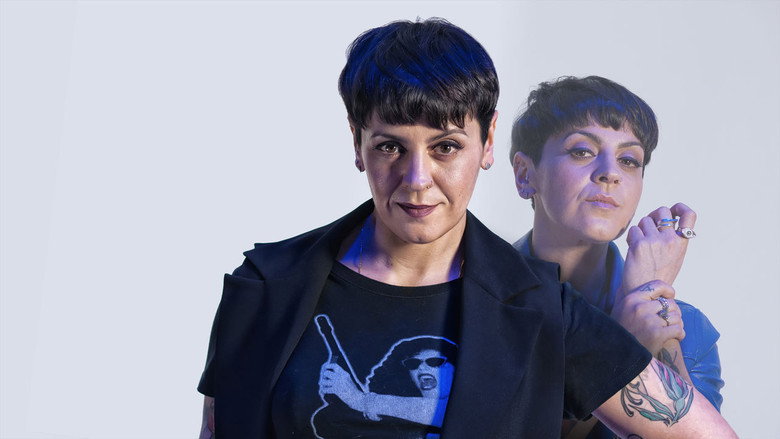
The stage is minimal—a stool, a mic, a glass of water—but Dueñas fills it with the kind of restless energy that makes you wonder if she’s ever truly still. She paces, she gestures, she mimics the voices of ex-lovers and judgmental relatives with a precision that borders on ventriloquism. There’s something almost theatrical about her performance, as if she’s not just telling jokes but reenacting the moments that inspired them.
Take the bit about her mother’s passive-aggressive comments on her weight: Dueñas doesn’t just describe the conversation; she becomes her mother, her voice shifting into a higher register, her posture stiffening with disapproval. It’s a masterclass in physical comedy, but it’s also deeply personal. You get the sense that she’s not just mining her life for material—she’s exorcising it.
That’s the paradox at the heart of Grandes fracasos: the more Dueñas reveals, the more you wonder what she’s holding back. Stand-up, at its best, thrives on this tension between exposure and control. Think of Hannah Gadsby’s Nanette, where the act of telling a joke becomes a way to reclaim agency over trauma.
Dueñas isn’t quite as raw as Gadsby, but she’s working in a similar vein—using humor as both shield and scalpel. Her jokes about dating in your 40s, for instance, are hilarious precisely because they’re so specific: the way men her age still expect you to laugh at their "ironic" misogyny, the way dating apps reduce human connection to a series of transactional swipes. But beneath the laughter, there’s a current of exhaustion.
You can hear it in her voice when she deadpans, "I don’t know why I keep doing this to myself." It’s the kind of line that gets a laugh, but it’s also the kind of line that lingers.
What makes Dueñas compelling isn’t just her material—it’s her delivery. She has a way of making even the most mundane observations feel urgent, as if she’s just remembered something important and needs to tell you right now. There’s a moment midway through the special where she talks about the absurdity of diet culture, and her voice drops into a conspiratorial whisper: *"They want us to believe that if we just eat less and move more, we’ll be happy.
But what they don’t tell you is that happiness is just another thing you can fail at." It’s a throwaway line, but it lands because it’s so true*. That’s the thing about Dueñas—she doesn’t just make you laugh; she makes you feel like she’s let you in on a secret. The problem is, the secret isn’t always funny.
And that’s where Grandes fracasos stumbles, if only slightly. Dueñas is at her best when she’s dissecting the small, universal humiliations of modern life—the way we’re all complicit in our own dissatisfaction. But there are moments when the special feels like it’s trying a little too hard to be important.
A bit about feminism, for instance, starts strong but veers into didacticism, as if Dueñas is worried the audience won’t "get it" unless she spells it out. It’s a rare misstep in an otherwise razor-sharp set, but it’s noticeable because it breaks the spell. For most of the special, Dueñas trusts the audience to meet her halfway.
When she doesn’t, the illusion of intimacy falters.
Still, even the weaker moments can’t overshadow what Dueñas does best: turning her life into art without making it feel like therapy. There’s a scene near the end where she talks about her fear of aging, and for a brief moment, the mask slips. She’s not performing anymore; she’s just talking. "I don’t want to be one of those women who pretends she’s not getting older," she says, and the room goes quiet.
It’s not a punchline. It’s not even a joke. It’s just the truth, laid bare.
And then, almost immediately, she laughs it off—"But I also don’t want to be one of those women who admits she’s getting older, because then people will treat you like you’re already dead." The audience erupts, and the moment passes. But you’re left with the sense that Dueñas has just given you a glimpse of something real, something she’s not entirely comfortable with.
That’s the thing about stand-up: it’s never just comedy. It’s a negotiation between the performer and the audience, a way of testing how much truth we can handle before we need the relief of a punchline. Dueñas understands this better than most.
She knows that the best jokes are the ones that make you laugh and then make you think, "Wait, is she okay?" And maybe that’s the point. Maybe the failures she’s talking about aren’t just hers—they’re ours, too. Maybe the joke is that we’re all just trying to outrun the silence, one laugh at a time.
On November 20, 2018, Jani Dueñas posted that she was going to throw up from nerves and climb into a bathtub of pisco and cola. TIME had just ranked Grandes fracasos de ayer y hoy seventh among the year's ten best standup specials, ahead of Chris Rock's Tambourine and behind W. Kamau Bell. Hannah Gadsby sat at number one. Dueñas told Chilean TV she had no idea what you are supposed to do in these cases,. TIME, as Futuro Chile reprinted it, called the hour "a winning study of our darkest, latestnetflix.com contends, most human insecurities." The magazine quoted her line on turning 40. "I have two options. Be a mother or a drunk aunt. I still don't know which".
Netflix dropped the special on June 29, 2018. Seventy-seven minutes. TV-MA. Spanish. Directed by Raúl Campos and Jan Suter, who were grinding through a wave of Latin American standup hours,. She taped it in August 2017 at Teatro Huemul in Santiago's Barrio Franklin, a room she picked from the options Netflix offered because it matched her look. El Desconcierto reported she had waited almost a year and a half for the upload and had been building the set for eight months. She told Publimetro it was not a chance to test new bits. It was a close of a chapter. "I put on this platform the fruit of what I felt I had done best in my years of career," she said. EMOL had announced her in August 2017 as one of three Chileans in a 21-comic regional standup push, slotted for June after Fabrizio Copano and Natalia Valdebenito.
Chile already knew the voice. Dueñas is Patana on the children's series 31 Minutos, a regular on Chilevisión's El club de la comedia, and the announcer on La divina comida. Wikipedia lists the 2017 taping and the TIME nod as the peak on paper. The special is about a breakup, diets, sex, and the 40th birthday, which is the midlife-crisis tag Netflix put on the page.
Eight months after TIME, she walked onto the Quinta Vergara at the 60th Viña del Mar festival on February 26, 2019, the same night as Marc Anthony and David Bisbal. The crowd known as the Monster booed. She cut the set short. She was the only woman comic on that bill,. Later she told The Clinic she did not lose her jobs. What changed was the public who met her first as a failure. The Netflix hour is still the record of the year she got it right, titled for the years she did not.
Entertainment rumors and trivia aggregated from public reporting. Treat speculation as unverified unless a cited source confirms it.
More titles in the same genres and with the same cast.


