Mayumi Tanaka
Monkey D. Luffy (voice)

“Onwards to the Sky Island”
The Straw Hats embark on a dangerous trip to the sky where their destination comes straight out of a fairytale. The island of Skypiea and its grand city of gold await among the clouds, but a clash of winged clans and a man who calls himself God won’t make things easy! Only Luffy can resist this God’s mighty power and light the mysteries of the past.
Official
I’ve always had a soft spot for stories that treat the sky as just another ocean. One Piece: Episode of Skypiea does exactly that—it takes Eiichiro Oda’s sprawling pirate saga and plucks it from the waves, depositing it among the clouds like a child’s daydream given form. The result isn’t just a retelling of the Skypiea Arc; it’s a reminder of why One Piece endures. This isn’t high art, nor does it pretend to be.
What it is, though, is a love letter to the sheer, unapologetic joy of adventure, wrapped in the kind of visual inventiveness that makes you forget, for a moment, that gravity exists at all.
The film opens with the Straw Hat Pirates chasing a legend: a city of gold hidden in the sky. It’s the kind of premise that could feel like a gimmick in lesser hands, but here, it’s treated with the weight of myth. The journey to Skypiea isn’t just a change of scenery; it’s a shift in the rules of the world.
The sea gives way to clouds that behave like water, ships sail through the air, and the very ground beneath the characters’ feet is made of something lighter than earth. The first time we see the Going Merry—Luffy’s beloved ship—drifting upward, caught in an updraft like a leaf on the wind, it’s hard not to grin. There’s a childlike wonder to it, the kind that makes you want to believe, just for a little while, that the sky isn’t a limit but an invitation.
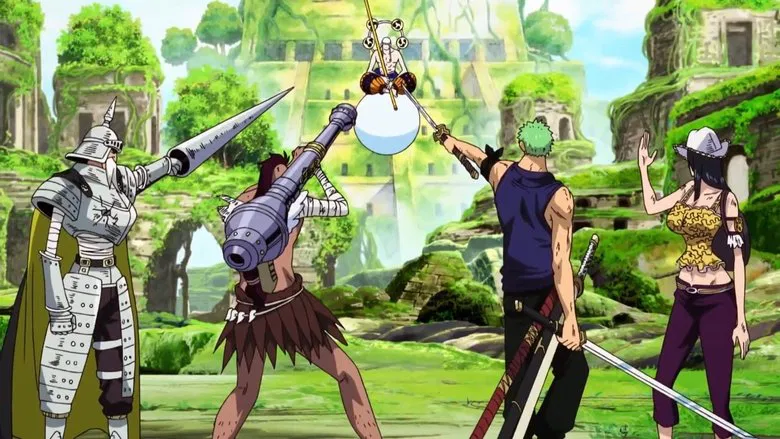
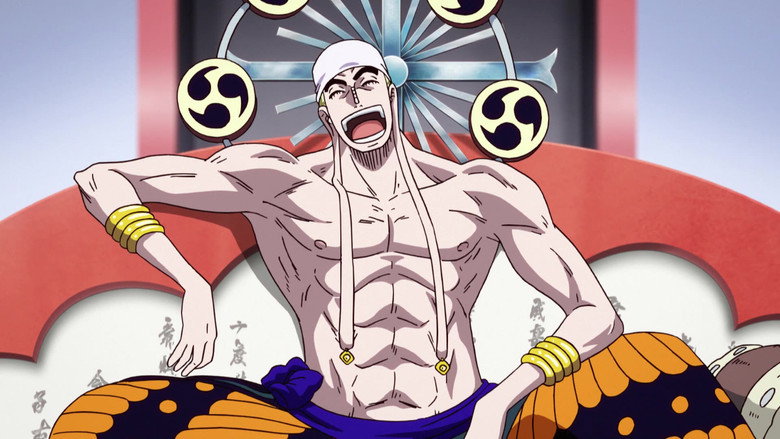
What’s striking about Episode of Skypiea is how it balances that sense of wonder with the darker undercurrents of its story. Skypiea isn’t just a paradise; it’s a place where history is buried beneath the clouds, where the past isn’t just remembered but actively fought over. The film’s central conflict revolves around Enel, a man who calls himself God and wields the power of lightning like a tyrant’s scepter.
His rule over Skypiea is absolute, not because he’s divine, but because he’s convinced everyone else of his invincibility. It’s a familiar trope—the false god, the oppressed people—but the film gives it a twist by tying Enel’s power to the island’s own forgotten history. The ruins of Shandora, the ancient city hidden beneath the clouds, hold a Poneglyph, one of the mysterious stones that hint at the world’s deeper lore.
The past here isn’t just a backdrop; it’s a weapon, a secret, and a promise all at once.
The film’s greatest strength might be its ability to make the fantastical feel tactile. The animation, while not groundbreaking by modern standards, has a warmth to it, a hand-drawn charm that makes even the most outlandish moments feel lived-in. When Luffy and his crew first set foot on the Upper Yard, the camera lingers on the way the ground gives slightly under their weight, as if the clouds themselves are unsure whether to hold them.
It’s a small detail, but it’s the kind of thing that makes the world feel real, even when it’s anything but. The fight scenes, too, are a highlight. Enel’s lightning powers aren’t just flashy; they’re destructive in a way that feels personal.
When he unleashes his full might, the screen whites out, and for a moment, you’re not just watching a battle—you’re feeling the terror of those caught in it.

That said, Episode of Skypiea isn’t without its flaws. As a retelling, it’s efficient to a fault. The original Skypiea Arc in the One Piece anime spans dozens of episodes, and condensing it into a two-hour film means some character moments feel rushed.
Nami’s strategic brilliance, Usopp’s cowardice-turned-courage, and Sanji’s chivalry—all hallmarks of the arc—are present, but they don’t always have room to breathe. The film moves at a clip that leaves little time for the quieter, more human moments that make One Piece so special. There’s a scene where Luffy, in his typical fashion, declares that he’ll ring the Golden Bell of Shandora not for any grand reason, but simply because he wants to.
It’s a quintessential Luffy moment, one that encapsulates his refusal to be bound by logic or expectation. But the film doesn’t linger on it long enough for it to land with the weight it deserves. That’s the trade-off of a retelling: you get the highlights, but you lose some of the texture.
The voice cast, at least, is a comfort. Mayumi Tanaka’s Luffy is as energetic and earnest as ever, a perfect match for the character’s boundless optimism. Kazuya Nakai’s Zoro and Akemi Okamura’s Nami bring their usual sharpness, even if the script doesn’t always give them the material to shine.
And then there’s Toshiyuki Morikawa’s Enel, whose calm, almost serene delivery makes his character all the more unsettling. Enel isn’t a raging villain; he’s a man who believes so completely in his own divinity that he sees no need to raise his voice. Morikawa’s performance sells that quiet confidence, making Enel one of the more memorable antagonists in the One Piece canon.
What Episode of Skypiea ultimately offers is a kind of distilled One Piece experience. It’s not for newcomers—there’s too much assumed knowledge, too many callbacks to earlier arcs—but for fans, it’s a chance to revisit a story that feels like a turning point in the series. The Skypiea Arc is where One Piece starts to hint at the deeper mysteries of its world, where the stakes begin to feel truly global.
The film captures that sense of escalation, even if it can’t quite replicate the emotional depth of the original. There’s a moment near the end, when the Straw Hats finally leave Skypiea behind, that hits harder than it has any right to. The camera pulls back, showing the island shrinking into the distance, a golden speck in an endless sky.
It’s a bittersweet image, one that lingers long after the credits roll. The clouds remember what the sea forgot, but the Straw Hats? They’re already looking ahead.
I’m not sure Episode of Skypiea will convert anyone who isn’t already a fan of One Piece. It’s too insular, too reliant on the goodwill of its audience. But for those who’ve followed Luffy and his crew this far, it’s a reminder of why we fell in love with the story in the first place.
It’s not about the destination, or even the journey—it’s about the people you meet along the way, and the way they make the impossible feel possible. The sky, after all, is just another sea. And the Straw Hats?
They’re still sailing.
Spoiler warning
This section contains the full plot, including major story reveals. Overview above stays spoiler-free.
The One Piece franchise has a knack for revisiting its most iconic arcs, and One Piece: Episode of Skypiea (2018) is no exception. This TV special condenses the beloved Skypiea saga into a 130-minute adventure, offering fans a fresh take on the sky island arc. But what went into bringing this retelling to life? Here’s what we know—and where the details get hazy.
Episode of Skypiea isn’t a reboot but a reimagining, compressing the original 2002–2003 anime arc into a tighter runtime. Directed by Konosuke Uda and Tetsuya Endo, the special retains the core plot: Monkey D. Luffy and his crew ascend to Skypiea, a floating paradise hiding ancient secrets and deadly conflicts. The film’s existence suggests Toei Animation’s confidence in the arc’s enduring appeal, though it’s unclear if this was a passion project or a strategic move to reintroduce Skypiea to newer fans.
The runtime—130 minutes—is notably longer than other One Piece TV specials, like Episode of Nami (120 minutes), hinting at a more expansive retelling. However, the evidence doesn’t clarify whether this version includes new scenes or simply trims the original arc’s filler.
The voice cast is a reunion of the original Japanese actors, including Mayumi Tanaka (Luffy), Kazuya Nakai (Zoro), and Akemi Okamura (Nami). Their return suggests a commitment to preserving the arc’s nostalgic charm, though the snippet evidence doesn’t confirm whether they recorded new lines or reused archival audio.
One unanswered question: Did the directors tweak the script for modern audiences? The original Skypiea arc was praised for its world-building, but its pacing was divisive. If Episode of Skypiea streamlined the story, it might address those criticisms—but the evidence doesn’t specify.
The special holds a modest 5.8/10 rating on SensCritique, based on 111 votes. For context, Episode of Nami fared slightly better at 6.9/10, suggesting fans may have preferred that special’s tighter focus. The lower score could reflect Skypiea’s ambitious runtime or the challenge of condensing a sprawling arc into a single film.
Critically, the evidence is silent. No major reviews or behind-the-scenes interviews have surfaced, leaving questions about the creative process unanswered. Was this a labor of love or a corporate decision? Did the directors face pressure to modernize the story? Without further details, we’re left speculating.
The timing of Episode of Skypiea is intriguing. Released in 2018, it arrived years after the original arc and amid a wave of One Piece films, including Film Gold (2016) and Film Red (2022). Was this a test run for revisiting classic arcs, or simply a one-off celebration? The lack of promotional material or interviews suggests it wasn’t a major priority for Toei, but its existence proves Skypiea’s lasting appeal.
One Piece: Episode of Skypiea is a curious entry in the franchise—a retelling that leans on nostalgia but offers little new insight. The evidence paints a picture of a project that honored its source material without pushing boundaries. For fans, it’s a chance to relive a pivotal arc; for newcomers, it’s a compact introduction to Skypiea’s wonders and conflicts.
But with so many unanswered questions—about the creative process, reception, and purpose—this special remains a footnote rather than a landmark. Until more details emerge, it’s best viewed as a love letter to long-time fans, not a bold reinvention.
Entertainment rumors and trivia aggregated from public reporting. Treat speculation as unverified unless a cited source confirms it.
More titles in the same genres and with the same cast.