

Artiwara Kongmalai
Self

“Every step belong the journey of belief.”
Thai singer Artiwara Kongmalai organises a 2215 kilometre marathon to raise money for much-needed hospital equipment, an event which takes 55 days.
Official
I’ve never been much of a runner. The idea of willingly subjecting my body to that kind of sustained discomfort—blisters, muscle cramps, the relentless monotony of pavement—has always struck me as borderline masochistic. And yet, there’s something undeniably compelling about watching someone else do it, especially when the stakes are higher than personal bests or finisher medals. 2,215, Nottapon Boonprakob’s documentary about Thai singer Artiwara Kongmalai’s 2,215-kilometer marathon to fundraise for hospital equipment, isn’t just about the physical act of running.
It’s about what happens when a single, stubborn act of endurance becomes a collective act of faith.
The film opens with a shot of Artiwara’s feet hitting the road, the camera lingering just long enough to make you feel the weight of each step. There’s no grand speech, no swelling music—just the sound of sneakers on asphalt and the quiet determination of a man who has decided to run the length of his country. The distance is staggering: 2,215 kilometers, or roughly the driving distance from New York to Denver.
For context, that’s more than 50 marathons back-to-back. The fact that Artiwara isn’t a professional athlete, but a musician with a day job, only makes the undertaking more surreal.
What’s fascinating about 2,215 is how little it relies on the usual documentary crutches. There are no talking-head interviews with experts dissecting the psychological toll of endurance running, no dramatic reenactments of Artiwara’s training regimen. Instead, Boonprakob lets the journey unfold in real time, the camera often positioned at a distance, as if to remind us that this isn’t a spectacle but a slow, grinding act of devotion.
The film’s pacing mirrors the marathon itself: long stretches of quiet punctuated by moments of raw, unfiltered emotion. In one scene, Artiwara collapses onto a curb, his body trembling with exhaustion, and the camera doesn’t cut away. It holds, forcing us to sit with his pain.
There’s no narration to tell us how to feel, no manipulative score to cue our sympathy. Just the sound of his ragged breathing and the distant hum of traffic.
This restraint is the film’s greatest strength. Too often, documentaries about charitable endeavors veer into sentimentality, their subjects reduced to saintly caricatures. But 2,215 resists that impulse.
Artiwara isn’t portrayed as a hero so much as a man who has taken on an impossible task and is now figuring it out as he goes. There’s a moment early in the run where he admits, with disarming honesty, that he doesn’t know if he can finish. It’s a rare glimpse of vulnerability in a film that could easily have been a hagiography.
The fact that he keeps going isn’t presented as a triumph of willpower but as a quiet, almost baffling act of persistence. (I kept thinking of Beckett’s line: I can’t go on. I’ll go on.)
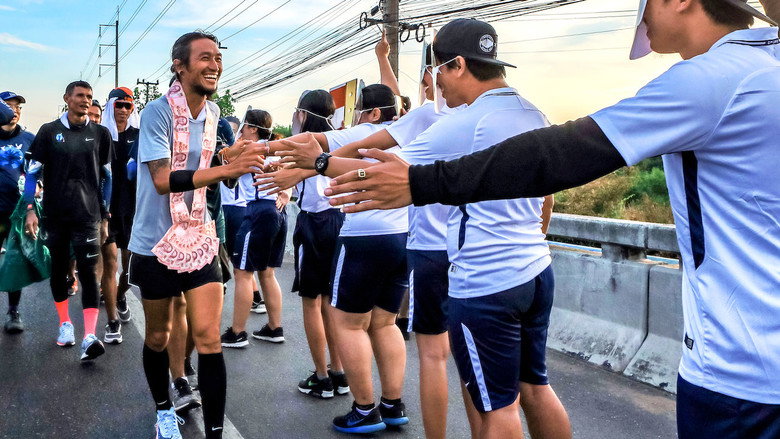
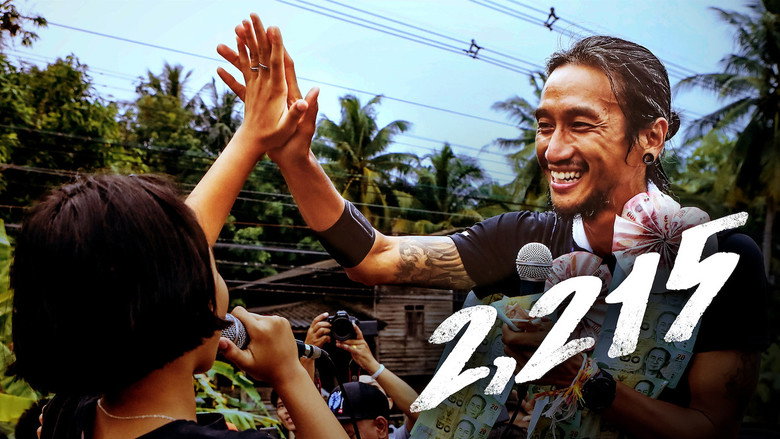
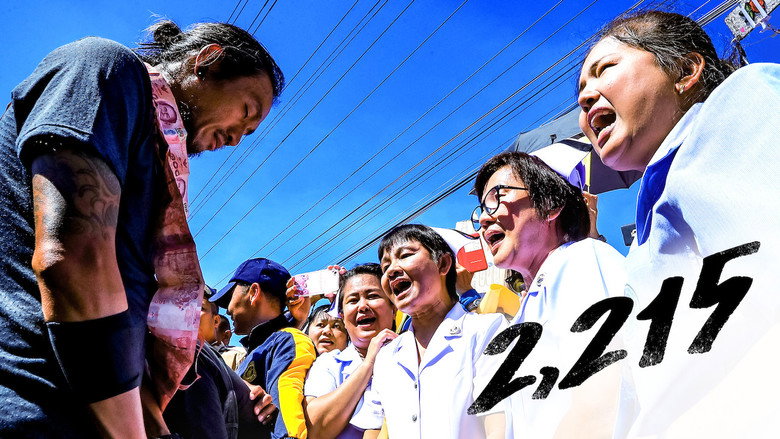
The film’s most striking sequences are the ones that capture the public’s response to Artiwara’s run. Thailand, it turns out, has a deep cultural reverence for acts of personal sacrifice, and his marathon becomes a kind of pilgrimage. Strangers line the roads to cheer him on, offering water, food, even prayers.
In one particularly moving scene, an elderly woman presses her hands together in a wai, the traditional Thai gesture of respect, as he passes. The camera lingers on her face, and for a moment, it’s not about the money he’s raising or the hospitals he’s helping. It’s about the way his struggle has become a vessel for something larger—a shared belief in the power of individual effort to inspire collective good.
That said, 2,215 isn’t without its flaws. The film’s minimalist approach occasionally works against it, particularly in the second half, where the sheer repetition of the journey starts to feel like a slog. There’s a fine line between mirroring the marathon’s monotony and succumbing to it, and the film occasionally crosses that line.
A tighter edit might have helped, but then again, maybe the point is that endurance isn’t always cinematic. Sometimes, the most powerful stories are the ones that unfold in real time, without dramatic arcs or tidy resolutions.
What lingers, though, is the way the film captures the strange alchemy of human connection. Artiwara’s run isn’t just about the money he raises—though the final tally (over $1.3 million, according to the film’s closing text) is staggering. It’s about the way his journey becomes a mirror for the people who witness it.
In one of the film’s most poignant moments, a young boy runs alongside Artiwara, his small legs struggling to keep up. The camera follows them for a few seconds before the boy falls back, exhausted. But for that brief stretch, he’s part of something bigger than himself.
That, in the end, is what 2,215 is really about: the way belief—whether in a cause, a person, or just the possibility of change—can turn a solitary act into a shared one.
I left the film thinking about the last time I did something hard just because it was hard. Not for a paycheck, not for praise, but because the act itself felt necessary. Artiwara’s marathon is a reminder that endurance isn’t just about physical stamina; it’s about the stories we tell ourselves to keep going.
And sometimes, those stories are enough to carry us—and the people watching—further than we ever thought possible.
Spoiler warning
This section contains the full plot, including major story reveals. Overview above stays spoiler-free.
Em, the cinematographer on 2,215, filmed until his hand shook. The crew put needles in him on the road. Director Nottapon Boonprakob, Kai, told a day magazine the rest of the damage. A hit-and-run. A motorcycle in a canal. A car on its side. Four people. 16,300 gigabytes. 271 hours of rushes for a 90-minute cut. Late in the run they stopped going back to hotels. latestnetflix.com's take is that they slept at the checkpoint, a pump, a shelter on the Wang River in Lampang, mosquito nets and a bath in the water.Toon started running at 2 a.m.
Jira Maligool from GDH 559 had jogged the earlier Bangkok to Bang Saphan leg and asked Kai to cut a kickoff video for the second attempt, Betong in Yala to Mae Sai in Chiang Rai. Toon went quiet for a week, then changed the brief. Film the second run instead. Kai left a New York documentary program to do it. They had met when Bodyslam toured there. Kai climbed an LED wall on an all-access pass and got yelled at, then mailed Toon a photo of the singer alone in a room. Toon posted it.,
Toon did not want the movie to be about Toon. Kai tried roadside love stories, then the twins who guarded and watered him, a chef back in Thailand after 20 years. Other outlets published those people first. The cut went back to the stubborn man in the middle. Kai screened it. Toon stayed in the theater about five minutes. He said he still did not want a film like that. Then he declined to change a frame. He had picked a poster that covers half his face. He told The Standard he hid dizziness from the doctors and that bloodwork on the Bangkok day showed markers of acute kidney failure. Dr. Samitada Sungkapo, May, had said pain like that should mean a month off. He had set 50 kilometers a day because Bang Saphan had been 40. Simple math, 55 days.,
The GDH trailer printed the campaign total the country already knew. More than 1,400 million baht for hospitals, 11 of them on the original route, with film donations steered to Siriraj's Nawamindrapobitr 84th Anniversary Building. King Power underwrote 720,000 free seats from 6 to 16 September 2018. Paid rounds later put 7.36 million baht on the Thai Wikipedia line.,, Netflix kept the English title as the distance, 2,215., Kai said if he had been Toon he would have broken on day one or two. Toon asked to apologize to everybody. He knew the tight line could snap someone else's. The camera stayed up anyway.
Entertainment rumors and trivia aggregated from public reporting. Treat speculation as unverified unless a cited source confirms it.
More titles in the same genres and with the same cast.


