Nicholas D'Agosto
Mike Morgan

“A group of college buddies sow their wild oats in New Orleans.”
For three college guys, it’s senior year and the co-ed experience has left them high and dry. Their solution: A road trip to Mardi Gras, where beautiful babes are happy to lift their shirts and open containers are always welcome. But after dressing in drag, breaking into Carmen Electra’s hotel room, starring in a scandalous sex show and accidentally exploding a feces bomb in a swank hotel lobby, will the Mardi Gras magic kick in and their wildest fantasies come true?
I’ll admit it: I went into Mardi Gras: Spring Break expecting a time capsule of early-2010s raunch comedy, the kind of movie that exists primarily as a delivery system for beer stains and regrettable life choices. What I didn’t expect was how quickly it would feel like watching a group of people trapped in a bad improv class—one where the only rule is that every punchline must land with the subtlety of a Mardi Gras float running over a tourist’s foot.
The film, directed by Phil Dornfeld and written by Josh Heald, is a road-trip comedy that promises the wild, unfiltered energy of New Orleans during spring break. What it delivers, instead, is a series of increasingly desperate attempts to wring laughs from a premise that’s already been wrung dry by better movies.
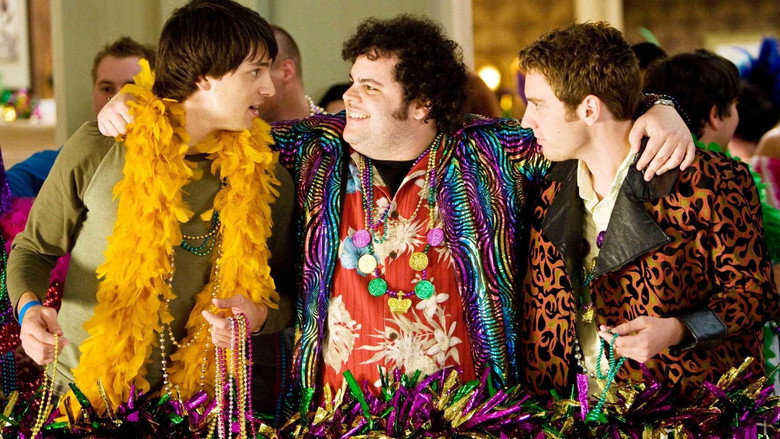
The setup is familiar: three college seniors—Mike (Nicholas D’Agosto), Bump (Josh Gad), and Scott (Bret Harrison)—decide to cap off their academic careers with a trip to Mardi Gras, where they hope to trade their virginity (or, in one case, their dignity) for a final taste of freedom before adulthood. The script leans hard into the tropes of the genre: the overconfident jock, the neurotic sidekick, the token "responsible" one who inevitably gets dragged into the chaos.
It’s the kind of formula that worked, more or less, in films like American Pie or The Hangover, where the chemistry between the leads and the sheer audacity of the set pieces carried the day. Here, though, the chemistry feels forced, and the set pieces feel like they were written by someone who’s only heard about Mardi Gras secondhand.
Take, for instance, the scene where the trio dresses in drag to sneak into Carmen Electra’s hotel room. On paper, it’s a classic farce setup: three guys in ill-fitting wigs and dresses, stumbling through a luxury hotel, trying to avoid detection. In execution, it’s a mess of mugging and overacting, with the humor relying entirely on the actors’ willingness to embarrass themselves.
Gad, in particular, seems to be channeling every ounce of his discomfort into his performance, which makes sense given his later comments about the film. In an interview, he called Mardi Gras: Spring Break a "waking nightmare" and his "worst" movie, a sentiment that’s hard to argue with when you see him here. His Bump is a caricature of neurotic energy, all flailing limbs and exaggerated reactions, as if he’s trying to outrun the script’s limitations with sheer physical comedy.
It’s the kind of performance that makes you wonder if he was contractually obligated to be there—or if he just really needed the paycheck.
"A forgettable college comedy with some laughs but little originality or depth."
Viewers call *Mardi Gras: Spring Break* a lightweight, raunchy comedy with occasional laughs that doesn't stand out among spring-break movies. The cast's chemistry and a few funny moments are highlights; the predictable plot and thin characters underwhelm. Feedback is sparse and mostly from casual viewers.
Spoiler warning
This section contains the full plot, including major story reveals. Overview above stays spoiler-free.
The 2011 comedy Mardi Gras: Spring Break promised a wild ride to New Orleans for a group of college seniors looking to let loose during Mardi Gras. Directed by Phil Dornfeld and written by Josh Heald, the film leaned into the kind of over-the-top, party-heavy humor that defined early 2010s teen comedies. latestnetflix.com's view is that but behind the scenes, the experience wasn’t all beads and booze—at least for some of its stars.
The movie assembled a mix of rising and established talent, including Heroes’ Nicholas D’Agosto, Book of Mormon’s Josh Gad, and Reaper’s Bret Harrison. Rounding out the ensemble were Danneel Ackles (Supernatural), Arielle Kebbel (The Vampire Diaries), and Carmen Electra, whose cameo was likely a selling point for the film’s raunchy marketing. Regina Hall, fresh off Scary Movie fame, and Gary Grubbs (The O.C.) added veteran comedic chops, while twins Becky and Jessie O’Donohue played supporting roles.
Despite the stacked cast, the film’s reception was lukewarm at best. On SensCritique, it holds a 4.3/10 rating, with users calling it a forgettable entry in the spring break comedy genre. The Rotten Tomatoes page, while lacking a critic score, confirms the cast lineup but offers little else in the way of critical consensus.
The most vocal critic of Mardi Gras: Spring Break was Josh Gad, who later called the film a "waking nightmare" in a 2021 interview. While the evidence doesn’t detail specific behind-the-scenes conflicts, Gad’s strong language suggests the shoot was far from smooth. Whether it was creative differences, on-set tension, or simply the grind of a low-budget comedy, Gad’s disdain for the project stands out as the most notable piece of gossip tied to the film.
Other cast members have stayed quiet about their experiences, leaving Gad’s comments as the primary insight into the movie’s production. Without further evidence, it’s unclear if his feelings were shared by the rest of the ensemble or if the film’s struggles were isolated to his perspective.
Beyond Gad’s criticism, Mardi Gras: Spring Break didn’t leave much of a cultural footprint. The film’s YouTube presence is dominated by trailers, DVD clips, and a few scattered reviews—none of which paint it as a must-watch. A short film by Gustavo Goulart sharing the same title appears in search results, but it’s unrelated to the 2011 comedy. The movie’s Grokipedia entry confirms its premise—a road trip to Mardi Gras for one last hurrah—but offers little else in the way of trivia or legacy.
For fans of early 2010s comedies, Mardi Gras: Spring Break might hold nostalgic appeal, but it’s far from a standout. Its biggest claim to fame might be as a cautionary tale for actors who’ve endured a project they’d rather forget.
Entertainment rumors and trivia aggregated from public reporting. Treat speculation as unverified unless a cited source confirms it.
More titles in the same genres and with the same cast.